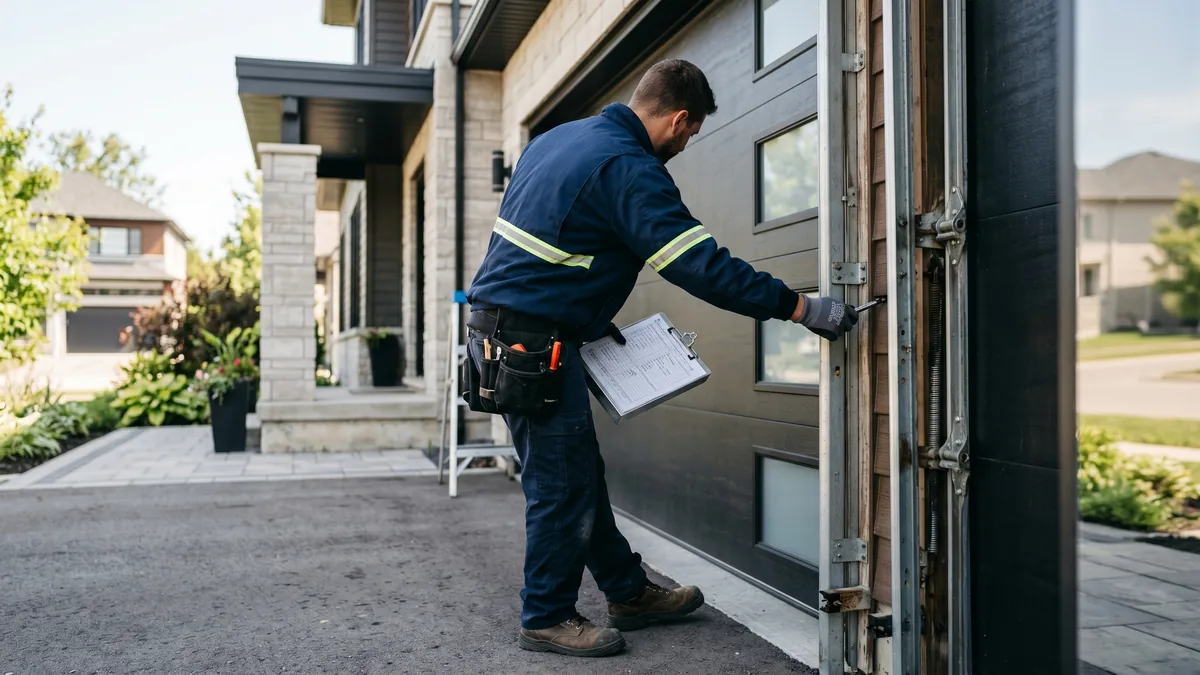
Your annual garage door maintenance checklist has 10 steps: run a visual inspection, do a manual balance test, listen for noises, tighten all hardware, inspect rollers, cables and springs, lubricate moving parts, test the auto-reverse and photo eyes, replace the weatherseal, clean the tracks, and check remote batteries. Most steps take about 45 minutes once a year. Leave springs and cables to a pro — a full professional tune-up runs $120 + tax across Toronto & the GTA.
What Is Garage Door Maintenance?
Garage door maintenance is the routine of inspecting, cleaning, lubricating and safety-testing the door, its hardware and the opener so it keeps running smoothly and safely. An average door cycles up and down more than 1,500 times a year, so a small amount of preventive care each spring stops minor wear — a dry roller, a loose bolt, a fraying cable — from turning into a sudden, expensive breakdown.
A garage door is the largest moving object in most homes, and it is the one we trust over our cars, our kids and our pets every single day. Yet it is also the most ignored. This checklist walks through exactly what I inspect on a professional tune-up so you can do the homeowner-safe parts yourself, in one Saturday morning, once a year.
Why Annual Garage Door Maintenance Matters
Across Toronto and the GTA, the most common emergency calls we get — a snapped spring on a January morning, a door off its track, an opener that finally gave out — almost always trace back to something a 45-minute annual check would have caught months earlier. Preventive maintenance does three things: it extends the life of the springs, rollers and opener; it keeps the safety reversal systems working so the door cannot crush a person or pet; and it keeps the door balanced so the opener motor is not silently overworking itself toward an early grave.
Spring is the ideal time to do it. The freeze-thaw cycle of a GTA winter is hard on lubricant, weatherseal and metal, so checking the door once the cold breaks means you head into the heavy-use seasons with everything tight, lubricated and tested. Here is the full 10-point checklist, in the order a technician works through it.
The 10-Point Annual Checklist at a Glance
- Visual inspection of a full open-and-close cycle
- Manual balance test (opener disconnected)
- Listen for grinding, popping or scraping noises
- Tighten all hardware: brackets, hinges, lag screws
- Inspect rollers, cables and springs for wear
- Lubricate hinges, rollers, bearings, springs and chain
- Test auto-reverse with a 2x4 and test the photo eyes
- Inspect and replace the bottom and side weatherseal
- Clean the tracks (clean, do not grease)
- Check and replace remote and keypad batteries
Step 1: Visual Inspection
Start from the inside with the lights on. Run the door through one full open-and-close cycle and just watch. A healthy door moves smoothly and evenly; a door that hesitates, jerks, shudders or pauses partway is telling you something is binding. Look at the door as a whole: are the panels straight, or is one section sagging? Are there gaps of daylight around a closed door that should not be there? Then scan the hardware — rusty hinges, bent track, loose cables hanging slack, or rollers that wobble in their brackets are all flags to follow up on in the steps below.
Step 2: The Balance Test
The balance test is the single most important thing you can check, because a balanced door means the springs — not the opener motor — are carrying the weight. Pull the red emergency release cord to disconnect the opener, then lift the door by hand to about waist height and let go.
- It stays put: the springs are properly balanced. Good.
- It drops to the floor: the springs are weak or losing tension.
- It flies upward: the springs are over-tensioned.
If the door does not hold its position, do not try to fix it yourself. We cover the full procedure in our garage door balance test guide, but the takeaway is the same: torsion-spring adjustment is a job for a technician. Re-engage the opener by running the door until the trolley clicks back onto the carriage.
Step 3: Listen for Unusual Noises
With the opener reconnected, cycle the door again and close your eyes to listen. A well-maintained door is fairly quiet. Grinding usually means dry metal-on-metal contact or a worn opener gear. Popping or banging at the springs can mean a spring is about to fail. A rhythmic squeak tracks a dry roller or hinge. Scraping along the track points to a bent track or a roller off its guide. Note where each sound comes from — most are cured by the tightening and lubrication steps that follow, but persistent grinding from the opener head itself is worth a professional look at the opener.
Step 4: Tighten All Hardware
All that daily vibration loosens fasteners over time. With a socket wrench and the door closed, work through every roller bracket, hinge, and the lag screws and bolts that hold the tracks to the wall and ceiling. Snug them firmly but do not overtighten — stripping a bolt hole in soft track metal creates a new problem. Pay special attention to the lag bolts on the vertical track brackets and the bolts on the opener rail mount, which take the most stress. This is a five-minute job that quietly prevents a lot of rattling and misalignment.
Step 5: Inspect Rollers, Cables and Springs
Now look closely at the moving parts — with your eyes, not your hands, on anything under tension.
- Rollers: spin each one. It should turn freely without wobbling. Cracked, chipped or worn nylon rollers, or steel rollers with flat spots, should be replaced.
- Cables: follow the lift cables from the bottom bracket up to the drum. Look for fraying, kinks, broken strands or rust. A frayed cable is an emergency — stop using the door and book a repair.
- Springs: look for gaps in the coils, rust, or an uneven, stretched section. A torsion spring with a visible gap has likely already broken. Do not touch them.
Step 6: Lubricate the Moving Parts
Lubrication is the heart of the whole checklist. Using a lithium-based or silicone garage door spray, coat the hinges, the roller bearings (not the nylon wheel), the spring coils, the bearing plates, and the opener chain or screw. Wipe up drips so they do not attract grit. Our full how to lubricate a garage door guide walks through each point in detail.
Step 7: Test Auto-Reverse and the Photo Eyes
Federal safety standards require every opener built since 1993 to have two reversal systems. Test both, every year.
- Mechanical (force) reversal: lay a 2x4 board flat on the floor in the centre of the door's path and close the door with the opener. The instant the door bottom touches the board it must stop and reverse back up. If it keeps pushing or stops without reversing, the close-force setting is wrong — stop using the opener.
- Photo-eye reversal: start the door closing, then wave a broom or box through the invisible beam between the two sensors near the floor. The door must immediately reverse. If it does not, check that both sensor lights are solid (not blinking) and that the lenses are clean and aligned.
Both tests must pass. A door that will not auto-reverse is a genuine hazard to children and pets and should be serviced before further use.
Step 8: Inspect and Replace the Weatherseal
Check the rubber bottom seal (astragal) along the base of the door and the weatherstripping down both sides and across the top. After a GTA winter, these go brittle, crack and tear, letting in cold air, water, leaves and pests. Press the bottom seal — if it has lost its flexibility or you can see daylight under a closed door, replace it. Fresh weatherseal is one of the cheapest upgrades you can make and it pays back in lower heating bills and a cleaner garage.
Step 9: Clean the Tracks
Wipe the inside of both vertical and horizontal tracks with a damp cloth to clear out cobwebs, dirt and old grease buildup that knocks rollers off their path. A dry roller against a gritty track is a leading cause of that scraping sound from Step 3.
Step 10: Check Remote and Keypad Batteries
Finish with the easy wins. Replace the batteries in every remote and in the exterior wireless keypad once a year so they do not die at the worst moment, then test each opening method — wall button, every remote, keypad and any smartphone app. If you have a battery-backup opener, confirm the backup battery still holds a charge; most need replacing every two to three years. This is also the moment to delete any lost or old remotes from the opener's memory for security.
DIY Checklist vs. Professional Tune-Up
You can safely do most of this yourself. The line to draw is anything storing mechanical energy — springs, cables and the parts under their tension — plus roller and track replacement. Here is how the two approaches compare.
| Task | Safe DIY | Call a Pro |
|---|---|---|
| Visual inspection & balance test | Yes | — |
| Tighten hardware | Yes | — |
| Lubrication | Yes | — |
| Track cleaning & weatherseal | Yes | — |
| Auto-reverse & battery checks | Yes | — |
| Spring adjustment / replacement | No | Yes |
| Cable replacement | No | Yes |
| Roller / track replacement | No | Yes |
A professional garage door tune-up from Royal Garage Doors covers every item on this list plus the spring and cable work you should not touch. Our maintenance package is $120 + tax and includes full lubrication, a balance check, safety-sensor alignment, auto-reverse testing and hardware tightening — and the technician will flag any early wear on springs, cables or rollers before it becomes a 2 a.m. emergency. For reference, the U.S. Consumer Product Safety Commission has long documented serious injuries from spring and cable failures, which is exactly why those parts belong to a trained tech (CPSC.gov). For the official safety-test procedure, see the standards body for the door industry, the International Door Association (doors.org).
How Often to Do Each Task
Not everything is annual. Keeping a simple rhythm prevents surprises:
| Task | How Often |
|---|---|
| Auto-reverse & photo-eye safety test | Monthly |
| Lubrication of moving parts | Every 6 months |
| Full 10-point inspection | Once a year |
| Professional tune-up | Once a year |
| Weatherseal replacement | As needed (1–3 years) |
| Remote / keypad batteries | Annually |
Doors that cycle more than four times a day, or those exposed to heavy salt, dust or extreme cold, should move to twice-yearly inspections.
Book Your Annual Garage Door Tune-Up
Let an IDEA Certified technician handle the full checklist — including the spring, cable and balance work you should not DIY. Maintenance packages from $120 + tax across Toronto & the GTA, with same-day appointments available.
Call 437-265-9995