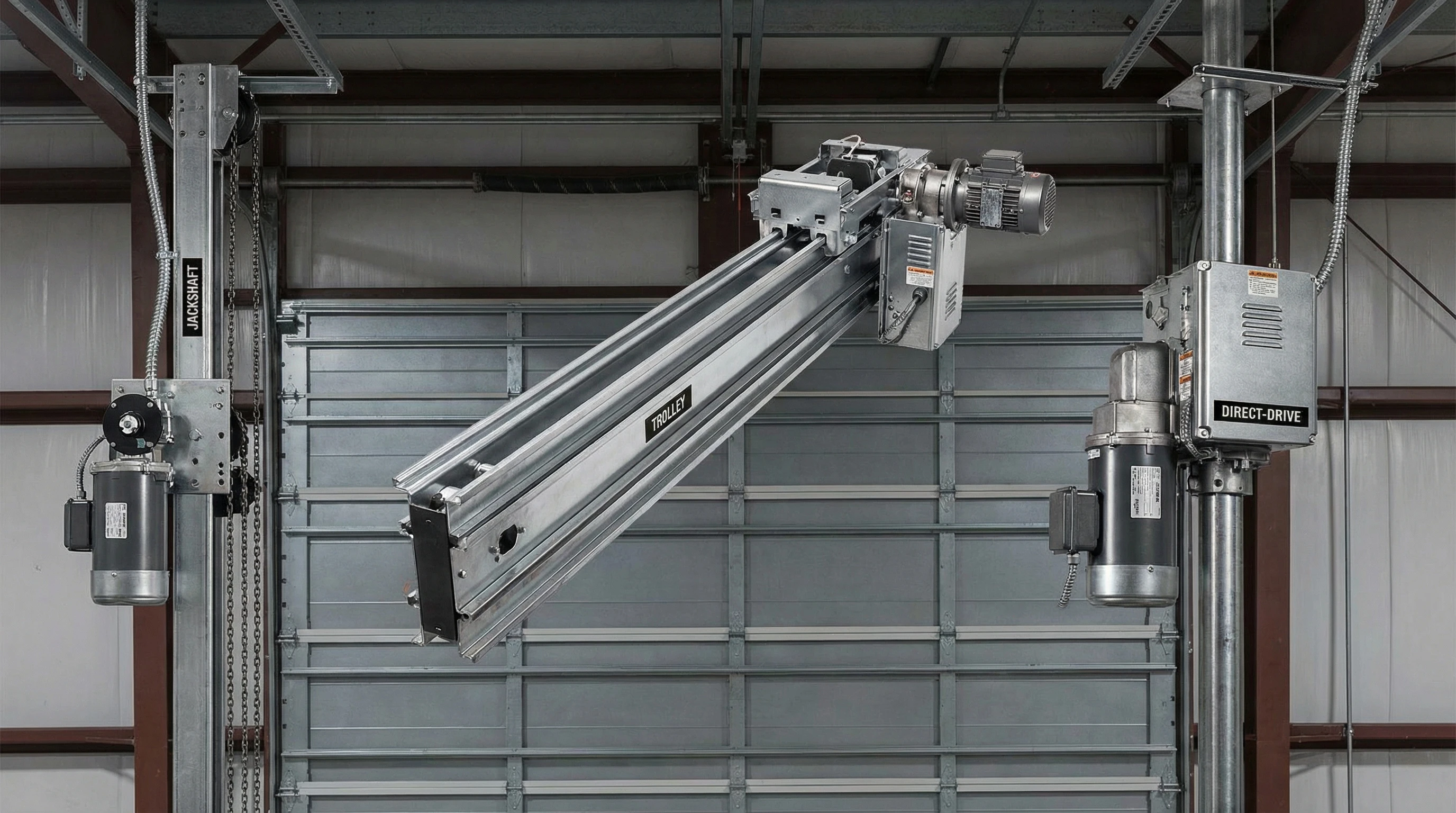
Royal Garage Doors supplies and services two main operator styles for compatible commercial sectional doors: Trolley (T-style) — ceiling mounted for standard sectional doors — and Jackshaft (J-style) — wall mounted for high-headroom or high-lift sectional doors. Trolley operators cost $1,000-$3,000 installed and jackshaft operators $1,500-$4,000. The right type depends on the door size, weight, track configuration, cycle requirements, and headroom.
What Is a Commercial Door Operator?
A commercial door operator is an electric motor system designed to automatically open and close industrial or commercial overhead doors. Unlike residential openers (typically 1/2 to 3/4 HP), commercial operators are rated for heavy-duty use with high cycle counts, greater lifting capacity (often 1-5 HP), and advanced control options including loop detectors, safety edges, key switches, and building automation integration.
Specifying the right commercial door operator is not just about power — it's about matching the operator type to your door's design, headroom constraints, and operational requirements. Choose the wrong type and you'll have an operator that works poorly, wears out quickly, or simply can't be installed. Here's how to get it right for your Toronto-area facility.
Commercial Door Operators for Sectional Overhead Doors
The commercial door industry classifies operators by their mounting style and mechanical drive method. Understanding these classifications is the foundation for specifying the right unit.
| Type | Best For | Door Size | Price Range (Installed) | Key Brands |
|---|---|---|---|---|
| Trolley (T) | Standard sectional commercial | Up to 18x18 ft | $1,000 - $3,000 | LiftMaster, Linear |
| Jackshaft (J) | High-lift, space saving | Up to 20x20 ft | $1,500 - $4,000 | LiftMaster, Chamberlain |
Trolley Operators: Standard for Most Commercial Applications
The trolley operator is the workhorse of the commercial door world. Mounted on the ceiling above the door opening, the unit drives a carriage along a steel rail to push and pull the door panel trolley arm. The motor connects to the carriage via a chain, belt, or screw drive — the same basic mechanism as a residential opener but built to much higher specifications.
How Trolley Operators Work
When activated (by push button, key switch, loop detector, or remote), the motor turns the drive sprocket, moving the chain or belt, which moves the carriage along the rail. The carriage connects to the door's top section via a trolley arm. As the carriage travels toward the motor, the door rises. As it travels away, the door closes. Commercial trolley operators run on 120V or 240V single-phase power, or three-phase for the largest units.
Trolley Operator Specifications
- Motor HP: 1/3 HP to 2 HP for commercial sectional doors; larger for extra-heavy or oversized doors
- Cycle rating: 100-300+ cycles per day (residential openers are typically rated 10-15 cycles/day)
- Speed: 8-12 inches per second (standard); 14-18 in/sec for high-speed applications
- Chain vs belt: Chain drives are more durable for high-cycle commercial use; belt drives are quieter but more expensive
- Headroom required: Typically 10-14 inches above the highest door panel in the up position
Best LiftMaster Trolley Models for Commercial Use
LiftMaster's commercial trolley line includes the HCTD (1 HP, 240V, heavy commercial, rated for doors up to 800 lbs), the CSL24 (24V DC for battery backup applications), and the MT5011 series for standard commercial sectional doors. These are available through authorized commercial dealers, not retail stores.
Jackshaft Operators: For High-Headroom and High-Clearance
Jackshaft operators (also called wall-mount commercial operators) solve the headroom problem. Instead of mounting on the ceiling and using a rail, a jackshaft operator mounts to the wall beside the door and connects directly to the torsion spring shaft (the jackshaft), turning it to wind or unwind the springs and raise or lower the door. This eliminates the need for any overhead rail, freeing the entire ceiling area above the door.
When to Specify a Jackshaft Operator
- High-lift door systems: Doors that travel straight up before going horizontal on high tracks — impossible to do with a trolley arm
- Vertical lift doors: Doors that travel straight up with no horizontal track — jackshaft only
- Low overhead clearance: Buildings where ceiling obstructions prevent rail installation
- Ceiling-mounted equipment: Facilities with cranes, HVAC systems, or overhead conveyors using ceiling space
- Large doors: Doors wider than 18-20 ft where trolley rail deflection becomes a problem
Key Considerations for Jackshaft Installation
Jackshaft operators require a properly balanced door with correctly tensioned torsion springs — the operator drives the spring shaft, so any imbalance translates directly to motor strain. The wall mounting structure must be capable of withstanding the torque forces generated during operation. Professional installation is essential: an improperly installed jackshaft operator on an unbalanced door can cause immediate failure or safety hazards.
Choosing the Right Power Supply
Commercial operators in Toronto must be matched to your facility's electrical service. Most commercial operators run on 120V single-phase (standard), 208-240V single-phase (common for larger motors), or 208-240V three-phase (for industrial-scale equipment). Verify available power before specifying an operator — adding a dedicated circuit or upgrading electrical service adds $500-$2,000+ to the project cost.
Choosing the Right Operator for Your Toronto Facility
Beyond the basic type selection, several additional factors determine the right commercial operator specification.
Safety and Control Features to Specify
- Safety edge (bottom bar sensor): Reverses the door if it contacts an obstruction during closing — required for Ontario OHSA compliance in facilities where people or vehicles operate near doors
- Loop detectors: Vehicle detection loops embedded in the floor approach that automatically open the door for approaching vehicles
- Key switches: Allow authorized personnel to operate the door without a remote or push button
- Photoelectric sensors: Beam across the door opening that prevents closing when the path is blocked
- Timer-to-close: Automatically closes the door after a set period, reducing energy loss and security exposure
- Fire door integration: For fire-rated doors, the operator must connect to the building fire alarm system for automatic release
Service and Warranty Considerations
For GTA commercial installations, purchase operators through a local authorized dealer rather than direct or online. Local dealer relationships mean faster parts availability, factory-trained service technicians, and warranty claims handled without international shipping. Royal Garage Doors works with multiple commercial operator brands to find the right fit for each application and provides ongoing service for all brands we install.
Need a Commercial Operator Quote?
Royal Garage Doors installs and services all types of commercial door operators across Toronto, Mississauga, Brampton, Vaughan, and GTA. Free site assessment available.
Call 437-265-9995