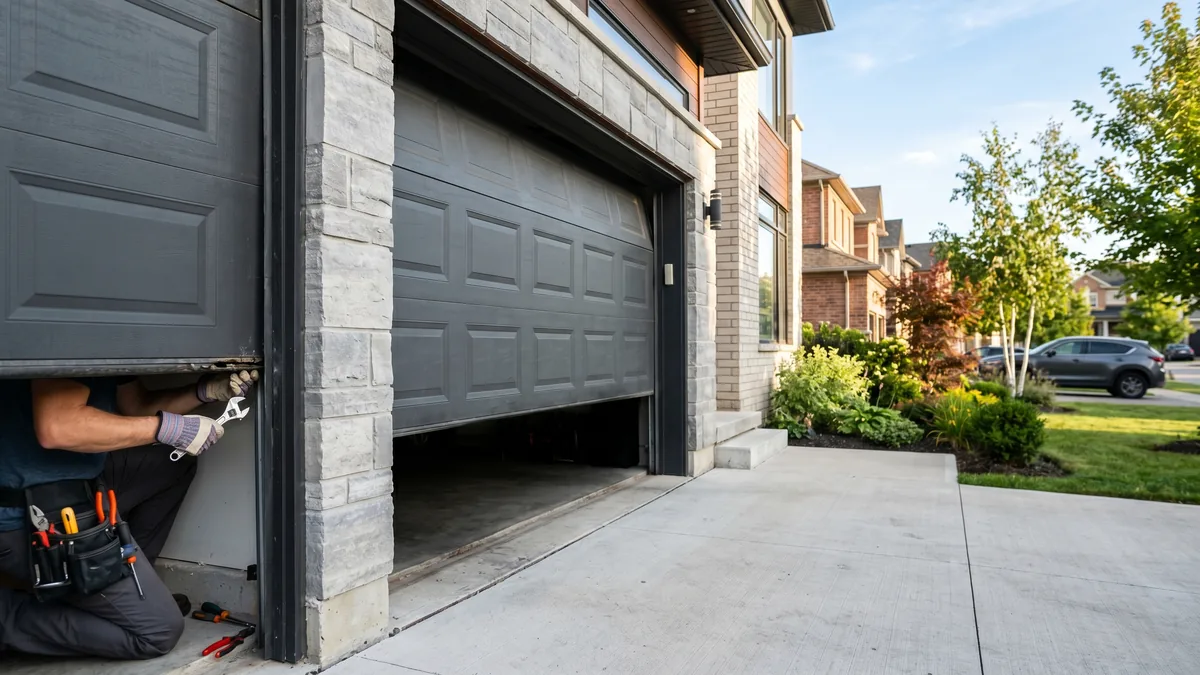
If your garage door opens a few inches then stops, the most likely cause is a broken torsion spring — without the spring’s counterbalance, the opener cannot lift the full door weight, so it stalls almost immediately. Other common causes are an up force setting that is too low, a bent track or jammed roller, an obstruction, or a worn opener drive gear. Stop pressing the button, disconnect the opener with the red release cord, and lift the door by hand: if it feels extremely heavy or crashes down, you have a spring problem and should call a technician.
What Does “Opens a Few Inches Then Stops” Actually Mean?
It means the opener begins the up cycle, travels only 2–12 inches, and then either freezes in place or reverses back down. The motor has hit a resistance it cannot overcome and its built-in force limit shut it off. The opener is doing its job — the real fault lies in the door hardware, the spring counterbalance, or a force setting that is no longer matched to the door.
This is one of the most frequent emergency calls we take across Toronto and the GTA, especially during cold snaps when spring steel becomes brittle and finally snaps. The good news: with a few safe checks you can pinpoint the cause in minutes, and you can avoid making it worse by knowing when to stop pressing that button.
How Your Garage Door Lifts (And Why It Stalls)
A garage door does not actually get lifted by the opener motor. The motor only nudges the door along; the heavy lifting is done by the torsion or extension springs, which store energy and counterbalance the 130–350+ lb weight of the door. A typical opener is rated for roughly half a horsepower — nowhere near enough to lift a double door on its own.
When something disrupts that balance — a snapped spring, a binding roller, or a bent track — the motor suddenly has to push against far more resistance than it is rated for. Modern openers built to the UL 325 safety standard sense that excess force and shut down within an inch or two to prevent gear damage and injury. That protective shut-off is exactly what you see when the door “opens a few inches then stops.”
7 Causes of a Garage Door That Opens Then Stops
1. Broken Torsion Spring (Most Common)
This is the number-one cause we find on service calls. The torsion spring sits on the metal shaft above the door. When it snaps, you may hear a loud bang like a firecracker (often overnight in winter). With the counterbalance gone, the opener strains, lifts the door a few inches, hits its force limit, and stops. Look at the spring above the door: a visible 1–2 inch gap in the coil means it is broken. Learn more in our guide to a broken garage door spring.
2. Up Force Setting Too Low
Every opener has an adjustable up force (open force). If it drifts too low — or was never set correctly after an install — the opener will quit the moment it meets normal resistance. This is more likely if the problem appeared gradually rather than overnight, and if the door still feels properly balanced when lifted by hand.
3. Bent Track or Jammed Roller
If the door binds at a specific height, a dented track section or a roller that has popped out of the track creates a pinch point. The opener pulls up to that point, meets a wall of resistance, and stops — often at the same spot every time. Worn or seized rollers are a frequent culprit; see our garage door roller replacement guide.
4. Obstruction in the Path
A bike, a snow shovel, a paint can, or even a thick patch of ice frozen to the bottom seal can stop the door cold. In GTA winters, doors that freeze to the concrete are a classic cause of a door that lurches up an inch and stops.
5. Worn Opener Drive Gear or Sprocket
On chain and screw-drive openers, a stripped plastic drive gear can let the motor spin without moving the carriage fully. The door may rise a few inches, then the gear slips and motion stops. You will often hear the motor running with little or no door movement — a sign the opener itself needs service. Our garage door opener repair team handles gear and sprocket replacements.
6. Damaged or Loose Cable
The lift cables wind around drums at each end of the spring shaft. If a cable frays, slips off its drum, or unwinds, one side of the door binds and the opener stalls. You may notice the door sitting crooked or one corner lower than the other. A snapped cable is closely related to a spring failure and should be inspected together.
7. Cold-Weather Stiffness and Dry Hardware
In sub-zero GTA temperatures, hardened grease and contracted metal increase friction throughout the system. A door that opens fine in summer may stall a few inches up on the coldest mornings. Often a proper lubrication and tune-up restores smooth travel. We see a sharp spike in these calls every January and February across Mississauga, Brampton, and Vaughan, when overnight lows make old factory grease set like glue and brittle spring steel finally fails.
Quick Way to Tell Springs Apart From Opener Faults
The fastest mental shortcut: if the motor sounds like it is working hard and straining, suspect the springs or hardware; if the motor sounds normal but the door barely moves, suspect the opener (gear or sprocket). A snapped spring almost always announces itself with a loud bang beforehand, while a stripped gear tends to fail gradually with grinding noises over several weeks. This single distinction resolves the majority of diagnoses before a technician even arrives.
How to Diagnose It Yourself in 5 Minutes
Follow these steps in order. Stop immediately if anything feels unsafe or extremely heavy.
- Stop forcing the opener. Repeated attempts against resistance can strip the gears or burn out the motor.
- Inspect the spring. With the door closed, look at the torsion spring above the door. A gap in the coil = broken spring. Do not touch it.
- Pull the red release cord to disconnect the opener (door fully closed first, if possible).
- Lift the door by hand. A balanced door rises smoothly and stays put at waist height. If it is brutally heavy, won’t budge, or slams down, the spring is the problem.
- Check the tracks and rollers at the height where the door stalls. Look for dents, debris, or a roller out of the track.
- Look for obstructions and ice along the bottom seal and floor.
- Listen to the motor when you press the button (opener reconnected). Motor running with no movement points to a stripped gear; opener struggling then stopping points to a spring or force issue.
DIY Fix vs. Call a Technician
Some causes are safe homeowner fixes; others are strictly professional jobs. Use this table to decide.
| Cause | Safe to DIY? | What It Takes |
|---|---|---|
| Obstruction / ice on floor | Yes | Clear debris, melt ice, retest |
| Dry / stiff hardware | Yes | Lubricate rollers, hinges, springs |
| Up force too low | Sometimes | Small force-dial adjustment after ruling out hardware |
| Roller out of track | Sometimes | Minor reseating; bent track = pro |
| Broken torsion spring | No | Professional spring replacement |
| Frayed / off cable | No | Professional cable replacement |
| Stripped opener gear | No | Opener gear kit or unit replacement |
Adjusting Up Force Safely (When Springs Are Good)
If your spring is intact and the door balances correctly by hand but the opener still stalls, the up force may simply need a small bump:
- Find the UP FORCE (or OPEN FORCE) dial/screw on the back or side of the motor head.
- Turn it slightly clockwise to increase force — a small amount at a time.
- Run the door and test. The door must still reverse on contact with an obstruction (place a 2x4 flat under the door to verify the safety reverse).
- Never set force higher than needed; an over-forced opener defeats the auto-reverse safety required by code.
Repair Costs in the GTA
Royal Garage Doors keeps pricing transparent — no hidden fees, and the service call is FREE with any repair. Typical costs for the issues behind a door that opens then stops:
| Repair | Price (CAD + tax) |
|---|---|
| Single torsion spring replacement | $280 |
| Double spring setup (both springs) | $320–$460 |
| Cables & brackets replacement | $180–$260 |
| Maintenance & tune-up (lube, balance, alignment) | $120 |
| New opener / motor (incl. install) | chain from $600; belt DC from $630 |
For a full breakdown of every service, see our pricing page. If the opener itself is failing, our opener repair and door replacement teams can advise whether repair or replacement is the smarter long-term value.
One common question we get: is it worth fixing an older door that has started stalling, or should you replace it? As a rule of thumb, if the springs are the only issue and the door panels, tracks, and rollers are in good shape, a spring replacement is by far the most cost-effective fix and will give you years more service. If you are facing a stripped opener, worn cables, and tired springs all at once on a 15-plus-year-old door, the combined repair cost can approach the price of a major refurbishment, and a new insulated door (from $1,350 + tax, opener from $630) may deliver better energy performance and curb appeal. Our technicians give an honest assessment on-site, never a hard sell.
How to Prevent It From Happening Again
Most of the failures behind a stalling door are preventable with simple seasonal upkeep. A small amount of maintenance dramatically extends the life of springs, rollers, and the opener motor.
- Lubricate twice a year. Apply a garage-door-specific lubricant to the springs, rollers, hinges, and bearings — once in spring and once before winter. Avoid WD-40 as a lubricant; it is a solvent that strips grease.
- Test the door balance every season. Disconnect the opener and lift the door halfway. If it drifts down or springs up, the springs are losing tension — schedule service before they snap.
- Keep the bottom seal clear of ice. Sweep snow away from the door and use a strip of weather-stripping or a threshold seal to stop the door freezing to the slab.
- Listen for new noises. Grinding, popping, or straining sounds are early warnings. Addressing them early prevents the sudden mid-winter failure.
- Book an annual tune-up. Our $120 maintenance package includes lubrication, balance check, sensor alignment, and hardware tightening — cheap insurance against a door that quits on the coldest day of the year.
The U.S. Consumer Product Safety Commission and Health Canada both emphasize regular testing of the auto-reverse and balance features; you can review safe-operation guidance from the CPSC garage door opener safety page. Following these steps keeps your door — and your family — safe year-round across the GTA.
Door Stuck Partway Open? We Can Help Today
A door that opens a few inches then stops is often a broken spring — a job that requires professional tools and training. Royal Garage Doors offers same-day service and FREE service calls with any repair across Toronto & the GTA.
Call 437-265-9995