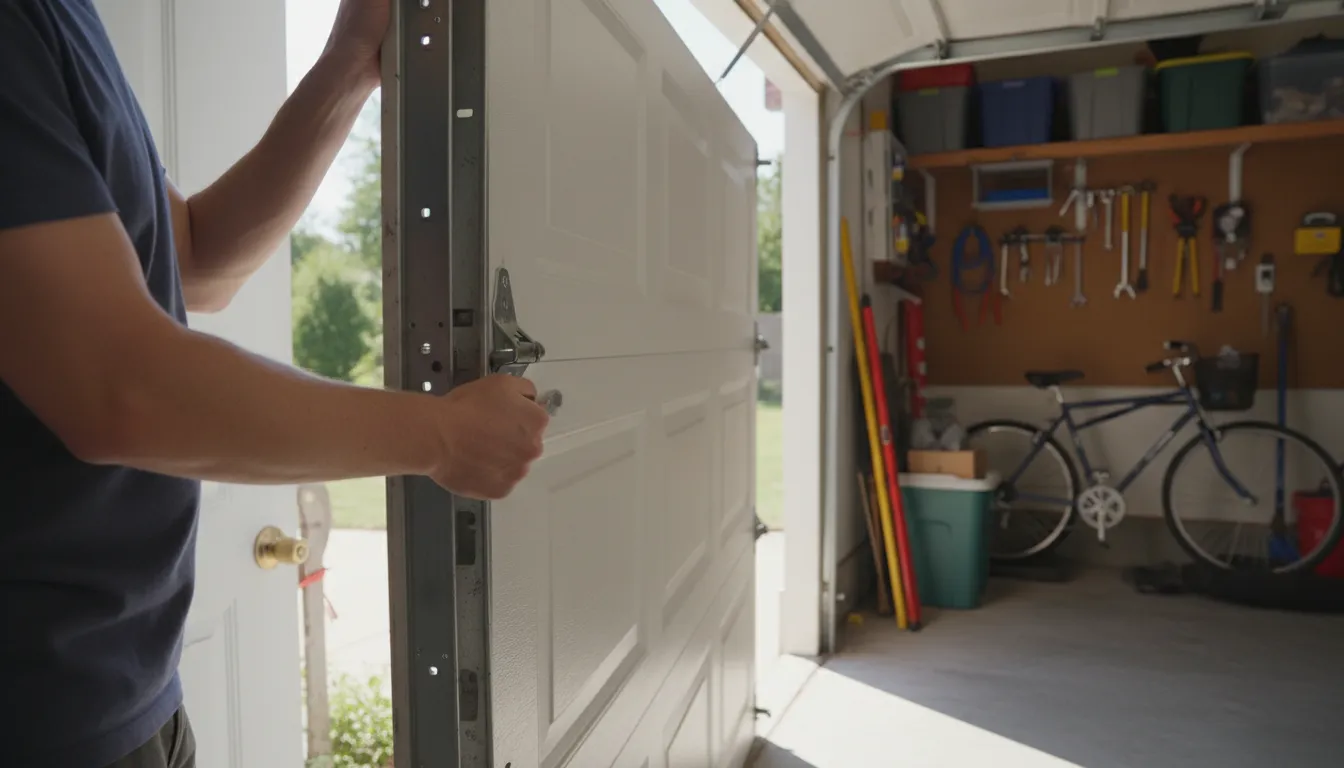
The 60-Second Balance Test
This simple test tells you immediately if your garage door is properly balanced. Do this test every 6 months:
Disconnect the Opener
Pull the emergency release rope (usually red) hanging from the opener rail. This disconnects the door from the opener so you can move it manually.
Lift the Door Halfway
Using both hands, lift the door to about waist height (roughly 3-4 feet from the floor). It should lift smoothly without much effort if springs are working properly.
Release and Observe
Carefully let go of the door. Stand clear in case it moves. Watch what happens over the next few seconds.
Evaluate the Result
A balanced door stays in place (maybe drifts 1-2 inches either way). If it moves significantly, note whether it falls down or rises up—this tells you how the springs need adjustment.
Understanding Your Test Results
Stays in Place
Springs are properly balanced. Door is safe and opener isn't being strained. No action needed.
Rises Up
Springs have too much tension. Door may slam open. Reduces spring lifespan. Needs adjustment.
Falls Down
Springs have too little tension. Heavy on opener motor. May not stay closed. Needs immediate attention.
Additional Tests
- Lift test: Door should feel light (10-15 lbs effort) when lifting. If it feels heavy (30+ lbs), springs are weak.
- Multi-position test: Test at 1/4, 1/2, and 3/4 open positions. Door should stay at each point.
- One-side test: If door leans to one side when half-open, one spring may be weaker than the other.
What Causes an Unbalanced Door?
- Spring fatigue: Springs lose tension over time, typically after 7-10 years or 10,000 cycles. This is the most common cause.
- Temperature changes: Metal springs contract in cold weather. Toronto doors often test unbalanced in winter but fine in summer. See our winter garage door problems guide.
- Uneven spring wear: In double-spring systems, one spring may weaken faster than the other, causing side-to-side imbalance.
- Changed door weight: Adding insulation, replacing panels, or installing windows changes the door weight, requiring spring re-adjustment.
- Cable stretch: Over time, cables can stretch unevenly, causing one side to be higher than the other.
- Impact damage: If the door was hit by a vehicle or fell hard, it may be bent slightly, affecting balance.
Why Balance Matters
An unbalanced door causes:
- Opener strain: Motor works harder, reducing its lifespan from 15 years to 7-10 years
- Higher energy bills: Struggling opener uses more electricity
- Safety hazards: Over-tensioned door may slam open; under-tensioned door may not stay closed
- Uneven wear: Door components wear faster on the heavier side
- Noise: Strained system is louder during operation
- Eventual failure: Springs break sooner; cables wear faster
Pro tip: If your opener frequently reverses before fully closing, an unbalanced door is often the cause—the opener's force sensor detects too much resistance.
Can You Adjust Balance Yourself?
What You CAN Do Safely:
- Perform the balance test (as described above)
- Lubricate springs, hinges, and rollers
- Tighten loose hardware (hinges, brackets, tracks)
- Clean and align sensors
- Check cables for fraying (visual inspection only)
What Requires a Professional:
- Adjusting torsion spring tension
- Replacing broken springs
- Adjusting extension spring cables
- Drum adjustments
- Any repair involving removing spring tension
Professional Balance Adjustment Cost
Toronto & GTA Pricing (2025)
Balance adjustment only
$100-$150
Springs in good condition, just need tension adjustment
Single spring replacement
$160-$220
One spring worn/broken, includes balancing
Double spring replacement
$280-$400
Both springs replaced (recommended even if one is good)
Full tune-up with balance
$100-$120
Includes lubrication, hardware check, sensor alignment
Free service call with any repair. Same-day service available in Toronto & GTA. See our pricing page for complete rates.
Frequently Asked Questions
Michael Thompson
IDEA Certified Garage Door Technician. 15+ years balancing and adjusting garage doors across Toronto & GTA.