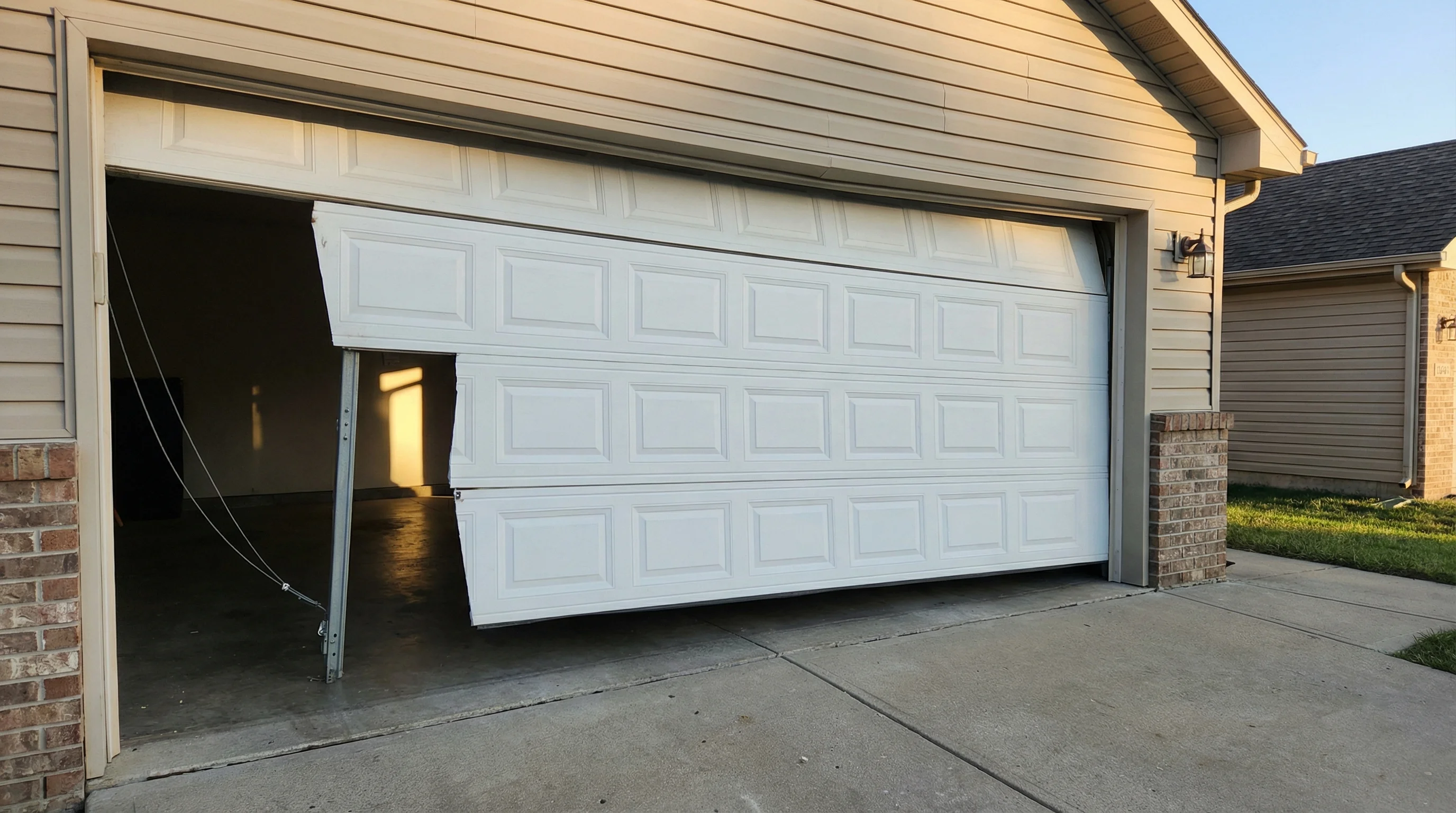
A garage door that is crooked with a gap on one side is almost always caused by a cable that jumped off the drum, unequal spring tension (one spring more worn or broken than the other), or a bent track. This is not a cosmetic issue -- it is a mechanical failure that will worsen with each cycle and can cause complete door collapse. Stop operating the door and call for service.
What Does a Crooked Garage Door Mean?
A crooked or uneven garage door is one where the bottom edge is not parallel to the floor -- one side is lower than the other, creating a triangular gap at one corner. This indicates the door's counterbalance system is out of balance, either from spring failure, cable issues, or track problems. It is one of the most common issues I see in Toronto homes.
When a homeowner describes their garage door as "sitting crooked" or "having a gap on one side," I already know roughly what I am going to find before I arrive. The cause is almost always one of three things: a cable off its drum, a spring that is more worn (or broken) than its counterpart, or a bent track section. The important thing is to understand what is causing it before it gets worse -- because it always gets worse if you keep operating the door.
Why Is Your Garage Door Crooked or Uneven?
Garage doors are counterbalanced systems -- springs on either side of the door provide equal tension to support the door's weight as it opens and closes. When this balance is disrupted on one side, the door tilts. Here are the main causes in order of likelihood:
1. Cable Off the Drum (Most Common)
Each side of your garage door has a cable that wraps around a drum at the top of the door opening. These cables are under significant tension and must be wound in specific grooves on the drum. If a cable slips out of its groove -- from a hardware failure, a spring breaking, or simply from an older drum with worn grooves -- the cable cannot support that side of the door properly. One side drops, the other stays up: classic crooked door symptom.
2. Unequal Spring Tension
On a double spring system, if one spring is significantly more worn than the other, or if one spring has broken entirely, the door receives unequal lifting force on each side. The side with less spring support drops lower than the other. This is common on doors where one spring was replaced but the other was not -- an unbalanced approach that creates exactly this problem over time. We always recommend replacing both springs simultaneously. See our guide on spring replacement costs.
3. Bent or Misaligned Track
If a track is bent -- from a vehicle backing into it, from hardware vibrating loose over years, or from a previous DIY repair -- the rollers on that side cannot travel smoothly. The door binds and skews to follow the path of least resistance. Bent tracks are most common at the vertical section near the floor and at the horizontal-to-vertical transition curve.
4. Worn or Missing Roller
If a roller has shattered (plastic rollers are prone to this in cold Toronto winters) or fallen out of the track, the door panel on that side has no track guidance. The panel drops at that point, creating a twist or gap. Look inside the garage when the door is closed -- you should see rollers in the track at every hinge point.
Diagnosing the Cause: Cable vs Spring vs Track
Here is how to identify which problem you have without touching the hardware (leave repairs to professionals):
Diagnosing a Cable Problem
Stand inside the garage with the door closed. Look at both upper corners of the door opening. You should see cables running from the bottom corners of the door, up and over a drum mounted near the top of each vertical track. If you see:
- Slack or coiled cable on one side while the other is taut -- cable is off the drum
- Cable lying on the floor -- cable has detached from the drum entirely
- The cable wrapped in the wrong direction or outside the drum grooves -- cable has jumped
Diagnosing a Spring Problem
Look at the torsion spring bar running horizontally above the door (inside the garage). On a two-spring system, there are two springs -- one on each side of the center bearing plate. If you see:
- A visible gap in one of the spring coils -- that spring is broken
- One spring visibly shorter or with looser coils than the other -- unequal tension
- A spring with visible rust scaling -- weakened and possibly nearing failure
Diagnosing a Track Problem
Visually inspect both vertical tracks (the metal channels the rollers run in). Look for:
- Visible bends, kinks, or sections that are not vertical
- Sections of track pulled away from the wall mounting
- A point where the track curves inward or outward abnormally
Is It Safe to Operate a Crooked Garage Door?
The short answer is no. You should not continue operating a door that has a visible gap or is noticeably tilted. Here is why:
- Cable failure risk: A cable that has jumped its drum is under abnormal stress and can snap at any point, causing sudden door movement
- Panel damage: Operating a skewed door forces panels to twist against each other and against the tracks, damaging hinges, bending panels, and potentially cracking panel sections
- Opener damage: Uneven door loading puts side stress on the opener rail, wearing out the trolley and potentially bending the rail
- Spring snap risk: An unbalanced spring system can result in the remaining functional spring snapping suddenly under the overload
- Complete collapse: In severe cases, a door that has been operated in a significantly skewed state can fall suddenly
Can You Fix a Crooked Garage Door Yourself?
For most homeowners, the answer is no -- and here is why that is the right answer:
What You Can Safely Do
- Inspect visually to identify whether it is a cable, spring, or track issue
- Disconnect the opener and secure the door in closed position with C-clamps on the track
- Clear any obstructions from the track path
- Tighten any visibly loose track mounting bolts (using the correct tool, not overtightening)
What Requires a Professional
- Re-seating a cable on its drum (requires precise winding under spring tension)
- Any spring adjustment or replacement (springs are under 150-300 ft-lbs of torque)
- Track realignment beyond simple bolt tightening
- Roller replacement in the middle sections of the door
Attempting to rewind a cable on a drum or adjust spring tension without proper training and tools causes many injuries each year. The cable winding bars required for spring adjustment, and the technique for loading them, are not intuitive -- and mistakes happen fast.
Professional Repair Costs in Toronto
Here is what to expect for crooked door repair in the GTA in 2026:
| Repair Type | Cost (+ tax) | Includes |
|---|---|---|
| Cable re-seat and drum adjustment | $150-$220 | Cable back on drum, inspection, lubrication |
| Single spring replacement | $160-$240 | New spring, balance test, cable check |
| Both springs (recommended) | $280-$400 | Both springs, cables inspected, full balance |
| Track straightening | $100-$200 | Track re-alignment, hardware tightening |
| Full service (cable + spring + balance) | $350-$500 | Complete inspection, all adjustments, test |
Need emergency service? Book online now or call 437-265-9995 for 24/7 emergency garage door repair in Toronto.
Crooked Garage Door in Toronto or GTA?
Do not wait until it gets worse. We provide same-day diagnosis and repair across Toronto, Mississauga, Brampton, Vaughan, and surrounding areas. FREE service call included.
Call 437-265-9995