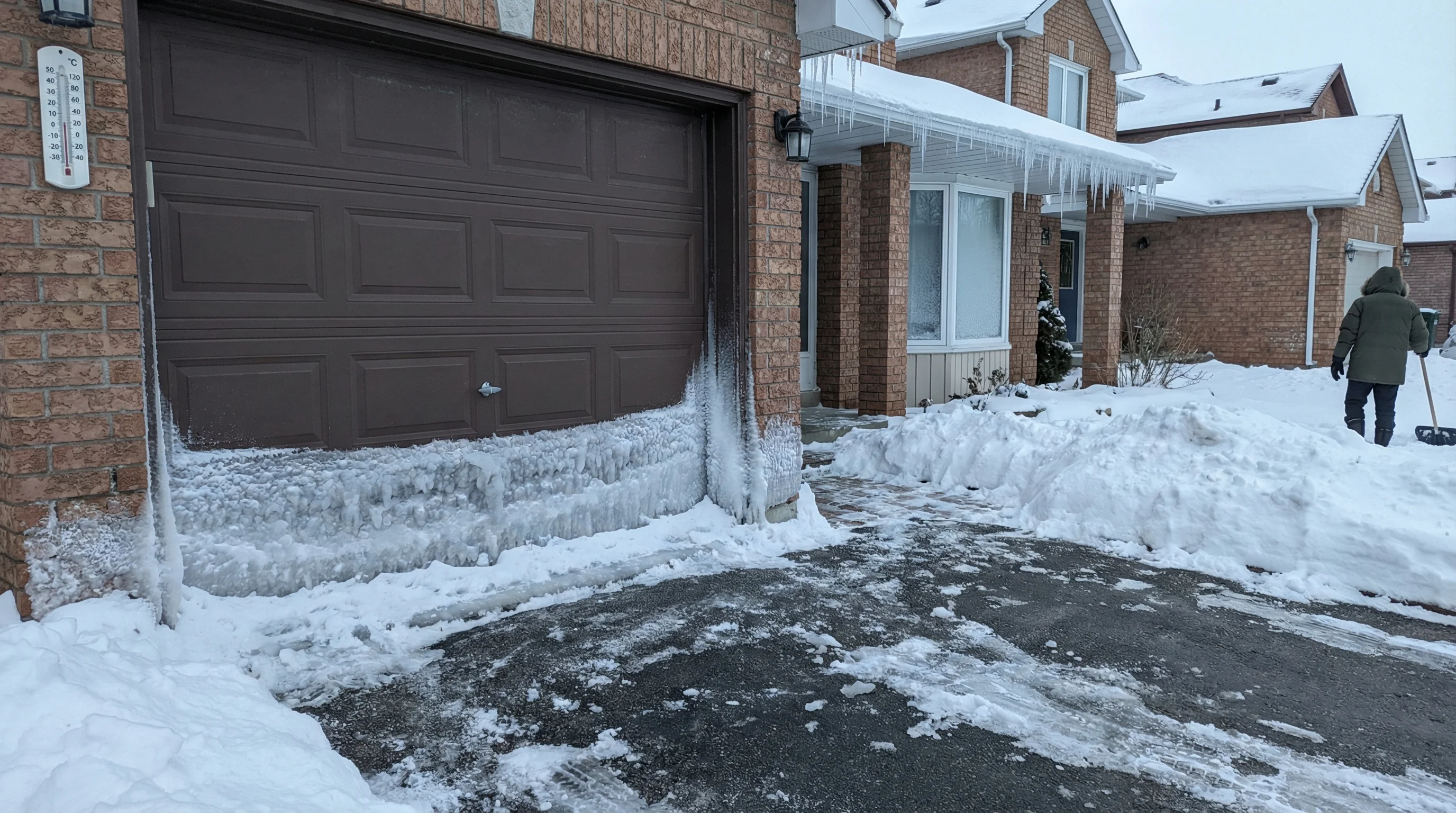
A garage door frozen to the ground can be freed safely by breaking the ice seal manually before operating the opener. Apply warm water, a heat gun, or calcium chloride ice melt to the bottom seal, then manually try to break the seal by pulling the door up by hand. Never run the opener against a frozen door -- this is the number one cause of spring damage in Toronto winters.
Why Garage Doors Freeze to the Ground
When water -- from snowmelt, rain, or condensation -- accumulates under the door's bottom seal and temperatures drop below zero, the water freezes and bonds the rubber seal to the concrete floor. Toronto's frequent freeze-thaw cycles make this one of the most common winter garage door issues, especially in January and February when temperatures fluctuate around the freezing point.
Every Toronto winter I get a surge of calls from homeowners who hit the opener button, heard the motor straining, and then heard a loud bang. That bang is almost always a spring breaking because someone tried to force open a frozen door. Preventing this damage is simple once you know what to do. This guide gives you the step-by-step process and the prevention strategies that actually work in Ontario winters.
Why Garage Doors Freeze Shut in Toronto Winters
Understanding why it happens helps you prevent it. The freeze-shut problem has two root causes:
Bottom Seal Water Trapping
The rubber bottom seal on your garage door creates a weatherproof barrier against the concrete floor. This is exactly what it is designed to do. The problem occurs when water infiltrates the seal-to-concrete contact zone -- from:
- Snow blown under the door and melted by warmer garage air
- Wet tires bringing water into the garage when you park after driving in rain or snow
- Condensation forming on the cold concrete floor under the door
- Melted ice from the bottom of the door itself
When temperatures drop below -2C to -5C, this water freezes and creates a bond between the seal and the concrete that can require 50 to 200 pounds of force to break -- far more than most opener motors should provide.
The Toronto Freeze-Thaw Problem
The GTA's climate is particularly prone to this issue because temperatures frequently cycle above and below freezing throughout January, February, and March. A 10-degree day followed by a -15-degree night creates the perfect conditions for door freeze. Areas like North York, Scarborough, and suburban Mississauga that see more snowfall also see more door freeze events.
STOP: Do Not Force the Opener (Here Is Why)
The single most important thing to understand about a frozen garage door is this: hitting the opener button again and again is the worst thing you can do.
When your door is frozen to the ground and you press the opener button:
- The motor engages and pulls on the door rail
- The door cannot move because it is bonded to the ice
- The torsion spring absorbs this force (this is literally the spring's job)
- After 2-3 forced attempts, the spring coil fatigues at a stress point
- The spring snaps -- a loud bang you will definitely hear
- Now you have a frozen door AND a broken spring
Safe Ways to Unfreeze a Stuck Garage Door
Here are the safe methods to unfreeze a garage door, ordered from fastest to most involved:
Method 1: Warm Water (Fastest)
Pour warm (not boiling) water along the bottom seal line where it contacts the concrete. Use about 2-3 litres applied steadily along the full width of the door. The water melts the ice bond within 30-60 seconds. The drawback is that if the temperature is very cold, this water may re-freeze quickly -- you need to break the seal and open the door immediately after applying. This works best when temperatures are -5C to -10C rather than at deep freeze temperatures.
Method 2: Heat Gun or Hair Dryer
A heat gun or hair dryer directed at the bottom seal provides controlled, targeted heat. Work from one end of the door to the other, holding the heat source 15-20cm from the seal. This method is slower than warm water but works well in any temperature and does not create a re-freezing risk. It takes 3-8 minutes for a standard 9-foot door.
Method 3: Ice Melt (Calcium Chloride)
Sprinkle calcium chloride ice melt (the blue crystals sold at Canadian Tire) along the inside and outside of the bottom seal. This melts ice at temperatures down to -29C. It takes 5-15 minutes to work. Calcium chloride is safe for concrete and rubber seals, unlike rock salt which can damage concrete surfaces and accelerate corrosion on door hardware.
Method 4: Manual Break (After Softening)
After applying any of the above methods, manually attempt to break the ice bond by pulling the door upward by the handle with moderate force. The door should break free with 20-50 pounds of force if the ice seal has been adequately softened. Once the seal is broken, then activate the opener.
Preventing Your Garage Door from Freezing Again
Prevention is far better than spending 20 minutes in -15C weather breaking a frozen door. Here is what actually works in the GTA:
Silicone Spray on the Bottom Seal
Apply a silicone-based lubricant (WD-40 Silicone Specialist, 3M Silicone, or any clear silicone spray) to the bottom seal in late October or November before the freeze season begins. Silicone creates a water-repelling, non-stick surface that prevents water from bonding to the seal. Reapply after any major rain or snow event. This is the single most effective prevention method.
Clear Snow From In Front of the Door
Snow accumulating against the outside of the closed door creates a reservoir that melts and refreezes repeatedly. After every snowfall, brush or shovel snow away from the bottom 30cm of the door's exterior. This takes 2 minutes and prevents the most common freeze cause.
Do Not Park With Wet Tires Immediately Before Closing
If you drive through slush or rain and park in the garage, the water dripping from your car's undercarriage and tires creates a puddle that can freeze under the door seal overnight. If possible, wait a few minutes before closing the door, or wipe up standing water before closing in temperatures forecast to drop below zero.
Replace Damaged Bottom Seals Before Winter
A cracked, torn, or compressed bottom seal creates gaps and irregularities where ice forms most readily. If your seal is more than 5-7 years old or visibly damaged, replacing it before winter costs $80-$150 installed and prevents freeze problems for another 5+ years.
When Freezing Causes Damage That Needs Repair
If someone in your household already forced the door open with the opener before reading this guide, here is what may be broken and the cost to fix it in Toronto:
- Broken torsion spring: The most common freeze-force casualty. Single spring $160-$240, both springs $280-$400. See our spring replacement cost guide for details.
- Stripped opener gear: The plastic gear inside the opener that the motor drives. If the spring did not break, this often does. Gear kit replacement $150-$250 installed.
- Buckled bottom panel: In severe cases, the bottom door section buckles upward from the force. Panel replacement $200-$400 depending on door type.
- Damaged cable: Less common but possible if the door was forced unevenly. Cable replacement $150-$220 with inspection.
Need emergency service? Book online now or call 437-265-9995 for 24/7 emergency garage door repair in Toronto.
Garage Door Frozen Shut or Damaged by Freezing?
We repair freeze damage across the GTA same day. Broken springs, damaged openers, and buckled panels. FREE service call with any repair.
Call 437-265-9995