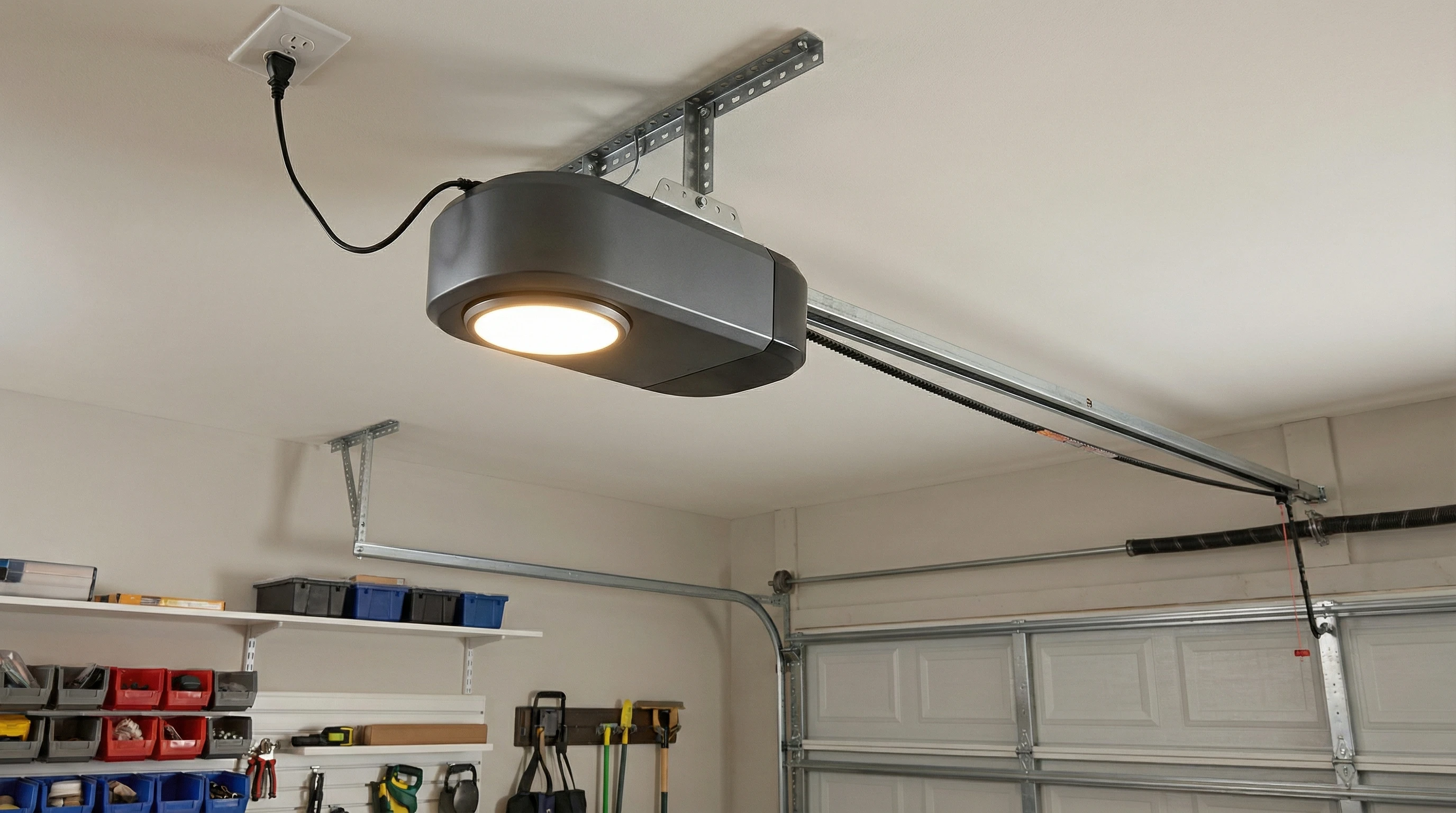
For most Toronto homes: 1/2 HP for single-car uninsulated doors, 3/4 HP for double-car or insulated doors. HP matters for longevity, not just lifting ability. An undersized opener wears out faster. Modern DC-motor openers are quieter and more energy-efficient than older AC models regardless of HP rating.
Garage door opener specs are confusing because horsepower ratings do not tell the whole story. A 3/4 HP DC-motor belt drive opener will outperform a 1 HP AC chain drive in nearly every measure of daily use. Here is what actually matters.
Horsepower Ratings Explained
| HP Rating | Max Door Weight | Best For | Motor Watts |
|---|---|---|---|
| 1/3 HP | Up to 150 lbs | Single car, uninsulated | ~250W |
| 1/2 HP | Up to 250 lbs | Single or double, uninsulated | ~375W |
| 3/4 HP | Up to 350 lbs | Double car, insulated | ~560W |
| 1 HP | Up to 500 lbs | Heavy wood or custom doors | ~750W |
| 1-1/4 HP | Up to 700 lbs | Carriage house, solid wood | ~935W |
The Real Rule: Size Up, Not Down
Garage door openers run quieter, cooler, and last significantly longer when operating at 50-70% of their rated capacity. A 3/4 HP opener lifting a 250-lb door will outlast a 1/2 HP opener lifting the same door by 3-5 years. The incremental cost of stepping up one HP tier is typically $50-$100.
Drive Type Matters More Than HP
The drive mechanism dramatically affects daily experience:
- Chain drive: Loudest, most affordable, very durable. Good for detached garages where noise is not a concern. Cost: $350-$600 installed.
- Belt drive: Quietest operation (rubber belt absorbs vibration). Best for attached garages with living spaces above. Cost: $500-$900 installed.
- Screw drive: Fewer moving parts, moderate noise, good in cold climates. Requires lubrication 1-2x per year. Cost: $400-$700 installed.
- Direct drive: Motor moves along a stationary chain - extremely quiet. Premium option. Cost: $700-$1,200 installed.
Modern Features Worth Paying For
- Battery backup: Operates during power outages. Essential in Ontario where ice storms are common.
- Wi-Fi connectivity (myQ): Monitor and control via smartphone. Know if you left the door open from anywhere.
- Auto-close timer: Automatically closes after set interval. Prevents accidental all-night open doors.
- Rolling code security: Changes access code every use, preventing code grabbing. All openers made after 2011 include this.
- Soft start/stop (DC motor): Reduces strain on door hardware and springs with gradual acceleration/deceleration.
Opener Cost Guide - Toronto Installation
| Opener Type | HP | Features | Cost Installed |
|---|---|---|---|
| Chain drive basic | 1/2 HP | Standard | $480 - $650 |
| Belt drive standard | 1/2 HP | Wi-Fi, myQ | $600 - $800 |
| Belt drive mid-range | 3/4 HP | Wi-Fi, battery backup | $750 - $1,000 |
| Belt drive premium | 1 HP | Wi-Fi, backup, camera | $1,000 - $1,400 |
| Direct drive | 3/4 HP | Ultra-quiet, Wi-Fi | $900 - $1,200 |
Royal Garage Doors includes installation, spring balance verification, safety sensor alignment, and remote/keypad programming in all opener installation quotes. No hidden fees.
Garage Door Opener Installation in Toronto
Royal Garage Doors supplies and installs LiftMaster belt-drive openers starting at $680 + tax installed. We will verify your spring balance and safety sensors during installation. Same-day service available.
Call 437-265-9995 for Fast ServiceFrequently Asked Questions
For a standard single-car garage door (up to 200 lbs): 1/2 HP. For an insulated or double-car door (200-350 lbs): 3/4 HP. For a heavy double-car or solid wood door (350 lbs+): 1 HP or 1-1/4 HP. When in doubt, size up - an overpowered opener runs cooler, lasts longer, and handles weight changes as your door ages.
A 1/2 HP garage door opener draws approximately 300-400 watts during operation. A 3/4 HP draws 450-550 watts. A 1 HP draws 600-750 watts. However, a typical cycle takes only 15-20 seconds, so the actual energy cost per operation is tiny - less than $0.001 per cycle at current Ontario electricity rates.
No - an oversized opener does not damage the door. Garage door opener force is limited by the spring system balance, not the motor size. A properly balanced door should lift with minimal motor force. More horsepower simply means the motor runs cooler and with less strain.
DC motors (most modern openers) are quieter, allow soft-start/soft-stop operation, can run on battery backup, and are more energy efficient. AC motors are older technology - louder, less refined, but extremely durable and often cheaper. All major brands now offer DC motors as standard on most residential openers.
A 1/2 HP opener can technically lift many insulated doors if the spring system is properly balanced. However, the motor will run near its limit, generating more heat and wearing out faster. For insulated double doors (which commonly weigh 300-400 lbs), 3/4 HP is the right minimum for longevity.
Modern garage door openers last 10-15 years with average use (4-6 cycles per day). Signs it is time to replace: grinding noises, inconsistent operation, or inability to hold programming. Openers more than 15 years old should be evaluated as they lack current safety standards.