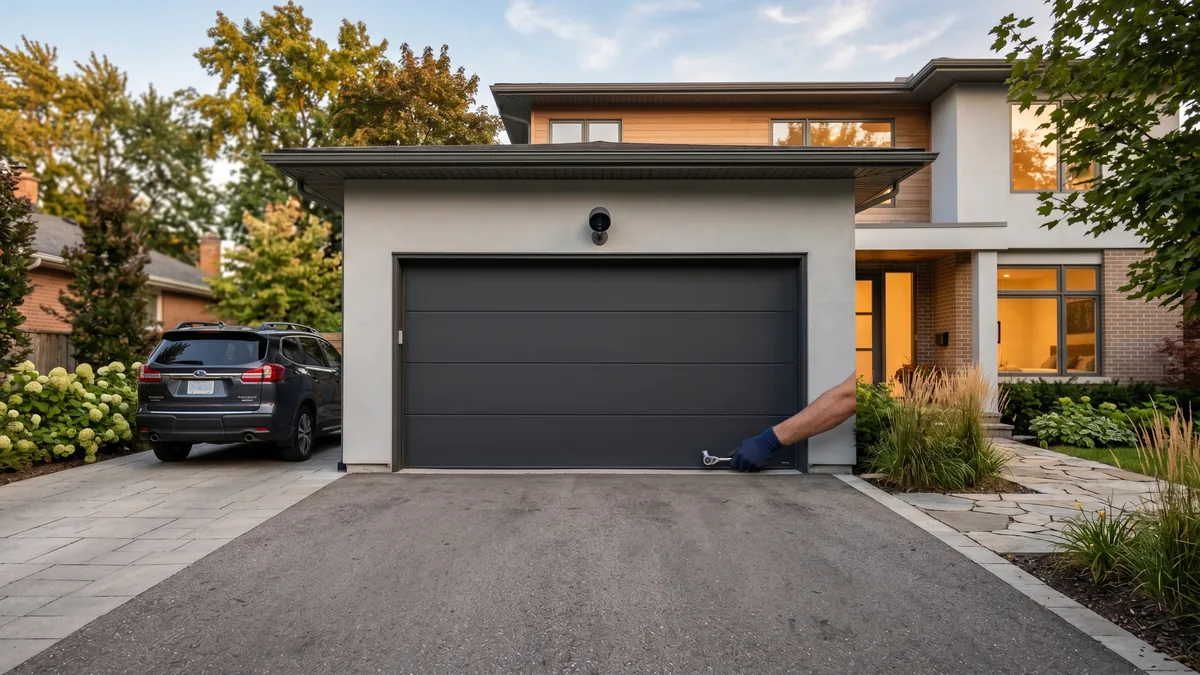
The fastest way to secure a garage door in 2026 is to shield or zip-tie the emergency-release latch so it can’t be reached with a coat hanger, confirm your opener uses a rolling-code remote, and add a smart opener with two-factor authentication. Layer on motion-activated lights, a camera covering the driveway, and a deadbolt on the interior man-door. These five steps stop the “fishing” attack and remote cloning — the two most common ways thieves get in.
What Is Garage Door Security?
Garage door security is the combination of mechanical, electronic, and behavioural measures that keep an attached garage — and the door connecting it to your house — from being used as an easy entry point. Because most attached garages share a wall with living space and often hold tools, bikes, and a second entry door, a vulnerable garage is effectively an unlocked back door to the whole home.
An attached garage is the single most overlooked entry point in most GTA homes. Homeowners install smart locks and video doorbells on the front porch, then leave a wide aluminum door at the side that a determined thief can defeat in under ten seconds with a piece of wire. The good news: garage door security in 2026 is mostly about a handful of cheap, fast upgrades — not an expensive overhaul.
Rolling-Code vs Fixed-Code Remotes: Why It Matters
Every garage door opener communicates with its remote over a radio frequency. How that signal is encoded determines whether a thief sitting in a car across the street can copy it.
Fixed-code openers (most units made before roughly 1996) transmit the exact same code every single time you press the button. With a cheap “code grabber” device, a thief captures that code once and replays it whenever they like — effectively a permanent copy of your remote.
Rolling-code openers (also called hopping-code) solve this. Each press generates a new, single-use code from a synchronized sequence shared only between your remote and the motor. A captured code is useless on the next press, so replay attacks fail. LiftMaster’s Security+ 2.0, Chamberlain, and Genie Intellicode are all rolling-code systems.
Smart Opener Security: myQ, Matter & Two-Factor Authentication
Smart openers add convenience — open and close from your phone, get alerts when the door is left open, grant access to a delivery driver — but each new connection is also a potential attack surface. Securing a connected opener in 2026 comes down to a few non-negotiables:
- Enable two-factor authentication (2FA): LiftMaster’s myQ app supports 2FA. Turn it on so a stolen password alone can’t open your door. This is the single most important smart-opener setting.
- Use a unique, strong password: Never reuse your email or Wi-Fi password on the opener account. A leaked password from an unrelated breach is how most “hacks” actually happen.
- Keep firmware and the app updated: Manufacturers patch vulnerabilities. An opener running three-year-old firmware is the digital equivalent of a fixed-code remote.
- Prefer Matter where available: The Matter standard, now shipping on newer openers and bridges in 2026, allows local, encrypted control through your smart-home hub (Apple Home, Google Home, SmartThings). Local control means the door can still be operated — and access revoked — even if the manufacturer’s cloud is down, and it reduces how much of your access data sits on a third-party server.
Preventing Garage Break-Ins: The Fishing Attack & Vacation Lock
The most-shared garage break-in video on the internet shows a thief opening a closed door in about six seconds with nothing but a coat hanger. This is the emergency-release “fishing” attack, and it works on a huge percentage of installed doors.
Here’s how it works: there’s a gap between the top of most garage doors and the header. The thief slides a hooked wire through that gap, snags the red emergency-release cord that hangs from the opener trolley, and pulls. That disengages the door from the motor — exactly as designed for when the power is out — and the door now lifts by hand. To shut it down:
- Shield the release latch: Remove the dangling cord and handle (or shorten it), and add a manufacturer or DIY shield over the trolley so a hook can’t catch it. A zip-tie on the release mechanism is a stopgap that still releases under firm manual pull but resists a casual snag — though a dedicated shield is better.
- Seal the top gap: Proper weather-stripping and a top seal close the opening a fishing wire needs. It improves energy efficiency too.
- Use vacation / lock mode when away: Most LiftMaster, Chamberlain, and Genie wall consoles have a LOCK button that disables every handheld remote and keypad. The door still works from the inside wall button, but a cloned or stolen remote does nothing. Engage it any time the house is empty for more than a day.
- Add a manual slide lock or side-lock kit on doors that aren’t used daily, so the door physically can’t be lifted even if released.
For the full step-by-step on defeating the coat-hanger trick, see our deep dive on the garage door fishing attack, and the vacation lock mode guide for engaging lock mode on each brand.
Motion Lights & Cameras: Deterrence and Evidence
Hardening the door stops entry; lighting and cameras stop the attempt from ever starting. Most garage break-ins happen after dark and rely on the intruder being unseen.
- Motion-activated floodlights on the driveway and side of the garage are the cheapest, highest-impact deterrent. A light that snaps on when someone approaches removes the cover a thief depends on.
- A camera covering the door and driveway gives you real-time alerts and recorded evidence. Built-in opener cameras like LiftMaster Secure View are convenient and tie into the same app, but a separate weatherproof camera often gives wider, better-angled coverage of the whole approach for a GTA driveway.
- Visible deterrence works: a camera the intruder can see, plus a small sign, measurably reduces the odds your home is chosen at all.
Not sure whether to buy an opener with a built-in camera or a standalone unit? Our comparison on smart garage camera benefits breaks down the trade-offs for 2026.
Securing the Man-Door (Garage-to-House Entry)
Even if a thief gets into the garage, a properly secured interior door — the one between the garage and your house — can stop them from reaching the living space and forces them to leave empty-handed and exposed. Yet this door is often the weakest in the home.
- Install a solid-core or steel door with a deadbolt. A hollow interior door with only the handle lock is trivial to defeat. Treat this door exactly like your front door.
- Reinforce the strike plate with 3-inch screws that bite into the wall framing, not just the jamb.
- Never leave a garage door opener remote clipped to a car visor if the car is parked outside or the garage can be entered — it’s a key to your house sitting in plain sight.
- Keep the man-door locked even when home. It’s the single behaviour change that costs nothing and closes the loop on every hardening step above.
Wi-Fi & App Hygiene for Connected Openers
A smart opener is only as secure as the network and accounts behind it. Most “smart garage hacking” in the real world isn’t a Hollywood signal exploit — it’s a weak password, an old router, or a phone left logged in.
- Put the opener on a secure, WPA3 (or at least WPA2) Wi-Fi network with a strong router password. Replace any router that still only supports outdated encryption.
- Consider a separate IoT / guest network for smart-home devices, so a compromised gadget can’t reach the opener.
- Review who has app access. Remove old roommates, former cleaners, or ex-partners from shared access lists. Delete guest access codes you no longer use.
- Lock your phone with a PIN or biometrics — an unlocked phone with the opener app is a physical key.
- Factory-reset before selling or moving. Clear all remotes, keypad codes, and app links from the old opener so the previous owner’s remotes are wiped.
Garage Door Security Upgrades Compared
Not every measure costs the same or stops the same threat. Here’s how the core 2026 upgrades stack up, prioritized by impact-per-dollar:
| Upgrade | Stops This Threat | Effort | Typical Cost |
|---|---|---|---|
| Emergency-release shield / zip-tie | Coat-hanger “fishing” attack | 15 min DIY | $0–$25 |
| Top & side weather seal | Closes the wire gap; energy loss | Pro or DIY | $120–$260 + tax |
| Vacation / lock mode | Cloned & stolen remotes (while away) | 1 button press | Free |
| Rolling-code chain-drive opener (if fixed-code) | Code-grabber cloning | Pro install | From $600 + tax |
| Smart/myQ opener + 2FA + Matter | Account takeover; left-open door | Setup + app | From $760 + tax |
| Motion floodlight | After-dark approach | DIY / electrician | $40–$150 |
| Driveway camera | Deters & records the attempt | DIY / pro | $60–$400 |
| Steel man-door + deadbolt | Garage-to-house entry | Pro install | $300–$800 |
If you only do one paid upgrade this year, replacing a fixed-code opener with a rolling-code smart unit covers the most ground at once. If you only do one free thing today, engage lock mode and shield the release latch.
Want a Security Check for Your Garage Door?
Our technicians can inspect your opener’s code type, shield the emergency release, seal the top gap, and recommend the right rolling-code or smart upgrade. Royal Garage Doors provides FREE service calls with any repair or installation across Mississauga & the GTA.
Call 437-265-9995Frequently Asked Questions
Further reading: the Toronto Police Service publishes home and crime-prevention advice for residents, and Public Safety Canada offers national crime-prevention resources on securing your home.