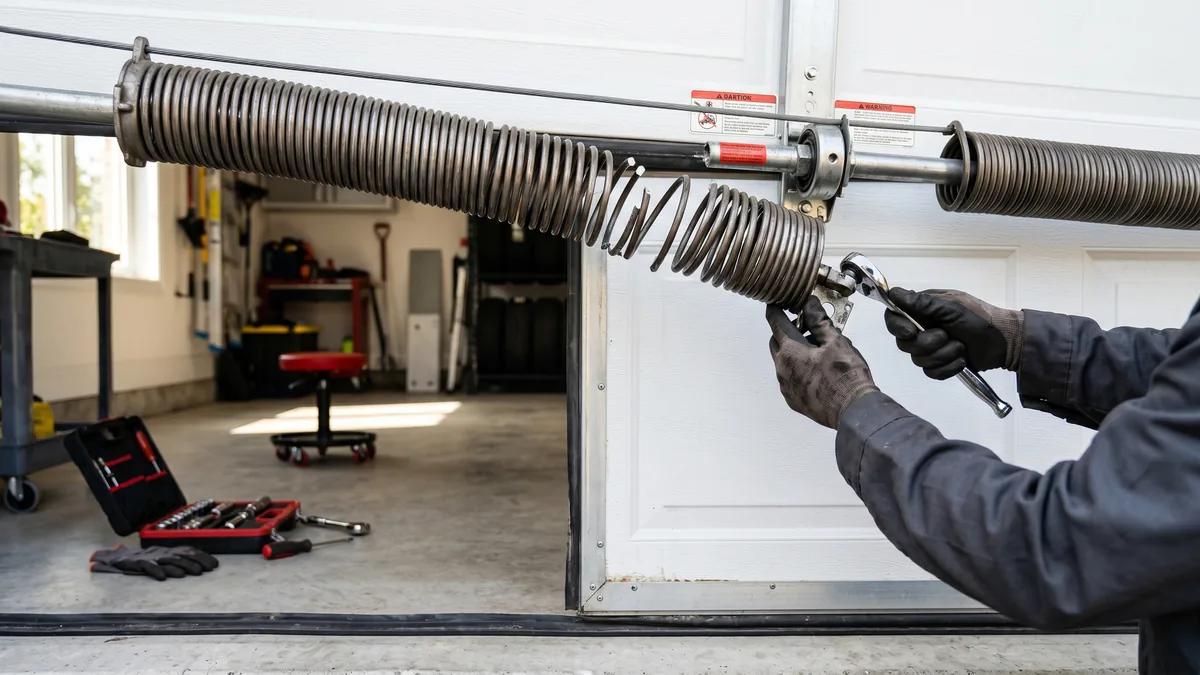
A garage door slams shut when the counterbalance system that holds its weight fails. The number one cause is a broken or weakened torsion spring, which can no longer offset the door’s 150–250 lb weight, so gravity drops it. A frayed or snapped lift cable, a worn cable drum, or an opener with incorrect force and limit settings can also make the door fall fast. This is a serious safety hazard. Stop using the door, keep people and pets away, and call a technician.
Why “Slamming” Is Different From a Normal Close
A healthy garage door is counterbalanced by torsion springs and cables that carry almost all of its weight, so the opener only has to nudge it up and lower it gently. When that counterbalance fails, the opener (or your hands) is suddenly holding the door’s full weight against gravity — and it loses. The result is a door that drops fast and slams against the floor instead of settling softly.
A garage door that slams shut is not a quirk to live with — it is a warning that the part holding hundreds of pounds in the air is failing. This is one of the most urgent calls we get across Mississauga and the GTA, because the same fault that makes the door slam can let it fall on a car, a pet, or a person without warning.
What Causes a Garage Door to Slam Shut
Almost every slamming door traces back to the counterbalance hardware — the springs, cables and drums that hold the door’s weight — or to an opener that has been set to fight a door it cannot safely control. Here are the causes in the order we see them most often.
1. Broken or Weakened Torsion Spring (Most Common – Dangerous)
The torsion spring mounted above your door is the single component doing the heavy lifting. As it slowly unwinds over thousands of cycles — or snaps outright — it stops counterbalancing the door. With the spring gone, nothing holds the weight, and the door free-falls the moment the opener releases or you let go by hand.
Tell-tale signs of a spring problem include a loud bang from the garage (a spring breaking sounds like a firecracker), a visible gap or separation in the spring coil above the door, the door feeling extremely heavy to lift manually, or the opener straining and the door dropping the last foot in a rush. If you suspect the spring, read our guide on a broken garage door spring and stop operating the door.
2. Frayed or Snapped Lift Cable
Two steel cables run from the bottom corners of the door up to drums on the spring shaft. They transfer the spring’s stored energy into smooth, controlled travel. When a cable frays, slips off its drum, or snaps, one side of the door loses its support and the door can drop suddenly or jam crooked in the tracks.
A cable failure often follows a spring failure, because a broken spring forces the opener and remaining hardware to take loads they were never sized for. Look for kinked, rusted, or fraying cable strands, a door that hangs lower on one side, or a cable hanging loose. Cable and bracket repair is a standard fix — see our pricing below.
3. Opener Force and Travel Limit Settings
If your springs and cables are healthy but the door still closes too fast or thumps at the bottom, the opener’s close force and down travel limit may be set too aggressively. The motor is driving the door past where it should gently stop, or pushing harder than needed on the down stroke. On a balanced door, recalibrating these settings restores a soft close.
Important: opener settings only matter when the mechanical system is intact. If a spring has failed, no amount of force or limit tuning will make the door safe — the opener simply is not built to hold a full-weight door. When the opener itself is acting up, our garage door opener repair page covers force and logic-board issues in depth.
4. Worn or Damaged Cable Drum
The grooved drums that the cables wind around can wear, crack, or loosen on the shaft over time. A worn drum lets the cable jump its groove or unwind unevenly, so the door loses tension partway down and accelerates. Drums are inspected and replaced as part of cable service, and a slipping drum is a common reason a door “closes fine, then drops at the bottom.”
5. Stripped Opener Gear or Failed Sensors (Secondary)
A stripped opener drive gear can release the door so it coasts down faster than the motor intends, and misaligned safety sensors that fail to reverse the door can let it complete a hard close. These are less common than spring and cable failures but worth ruling out during a professional inspection.
The Real Safety Risk of a Slamming Door
This is the part homeowners underestimate. A single residential door weighs 130–180 lb and a double door commonly weighs 150–250 lb. When the counterbalance fails, that entire load is held back only by gravity — and gravity wins in under a second.
- Crush hazard: A falling door can crush a child, a pet, a vehicle hood, or a hand reaching under it. The U.S. Consumer Product Safety Commission has documented deaths and serious injuries from garage doors closing on people.
- No warning: A weakened spring may hold for several more cycles, then let go suddenly mid-travel. A door that “mostly works” is not safe.
- Cascading failure: Operating a door after a spring breaks overloads the cables, drums, opener, and brackets, turning a single repair into several.
What to Do Immediately
If your door is slamming or dropping fast, take these steps before anything else:
- Stop using the opener. Repeated cycles accelerate damage and put more stress on already-failing parts.
- Keep people, pets, and vehicles clear of the door path until it is inspected.
- Pull the emergency release cord only if the door is fully closed. Never disconnect the opener while the door is open with a suspected broken spring — it can crash down.
- Visually inspect from a safe distance. Look for a separated spring coil, a hanging or frayed cable, or a door sitting crooked. Do not touch the springs or cables.
- Call a professional. Spring and cable work involves stored tension that requires the right tools and training.
Repair Cost in the GTA
The cost to fix a slamming door depends on which part of the counterbalance system failed. These are current Royal Garage Doors rates for the Toronto and GTA area, parts and labour included:
| Repair | Typical Cost (CAD) | What’s Included |
|---|---|---|
| Single torsion spring | $280 + tax | Spring, labour, 3-tier warranty |
| Double spring setup (both) | $320–$460 + tax | Both springs replaced, balanced & checked |
| Cables & brackets | $180–$260 + tax | Cable replacement, bracket realignment, full inspection |
| Cables with bottom brackets | $260 + tax | Cables plus bottom bracket replacement |
| Maintenance / tune-up | $120 + tax | Lubrication, balance, sensor & hardware check |
| Opener force & limit recalibration | Often included | Bundled with a related repair on a balanced door |
The service call is FREE with any repair; a $120 diagnostic applies only if you choose not to proceed after assessment. There are no extra charges for weekends or holidays, and same-day service is available. See our full pricing page for every service, or check our detailed garage door spring replacement cost breakdown.
How to Prevent a Garage Door From Slamming
Most slamming failures are the end stage of slow wear that gives warning signs for weeks. You can stay ahead of them:
- Test the balance twice a year. The halfway lift test above takes two minutes and catches a weakening spring early.
- Lubricate springs, rollers, hinges and the cable drums with a garage-door-rated lubricant every 6 months to reduce wear.
- Inspect cables for fraying and rust, especially near the bottom brackets where moisture collects.
- Watch the cycle count. A standard spring is rated for roughly 10,000 cycles — about 7–9 years for an average household, per DASMA industry guidance. If your springs are near that age, plan a proactive replacement.
- Book an annual tune-up. A technician re-tensions springs, checks force and limit settings, and replaces worn hardware before it fails. For broader symptoms, see our guide to why a garage door won’t close properly.
Royal Garage Doors serves the entire GTA. If you are local, our garage door repair in Mississauga team can usually be out same-day, and you can always reach a technician through our garage door repair near me page.
Door Slamming or Dropping Fast? Stop Using It.
A slamming door means a failing spring or cable holding hundreds of pounds. Don’t risk it. Royal Garage Doors offers FREE service calls with any repair and same-day service across Mississauga & the GTA.
Call 437-265-9995