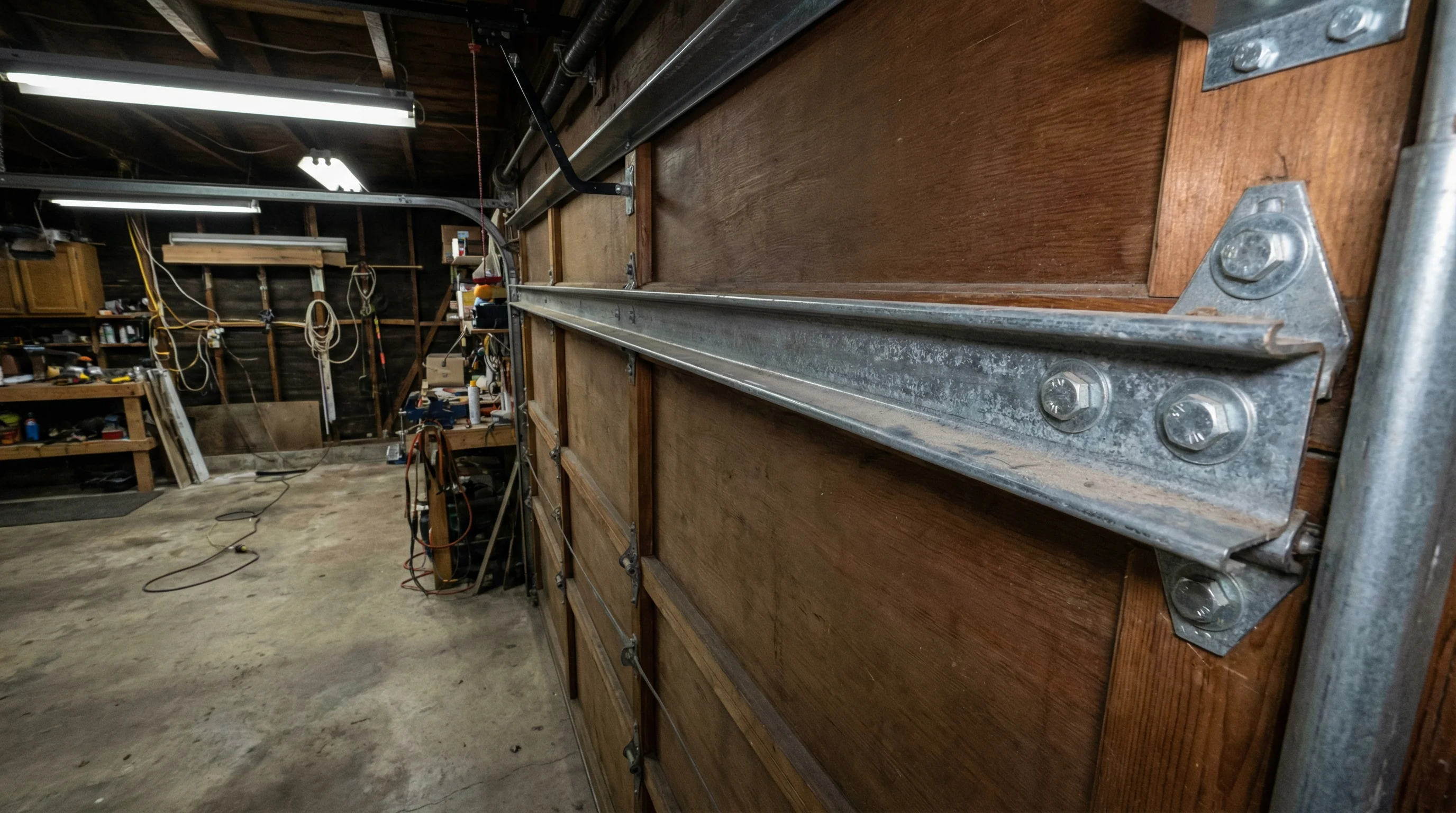
A garage door needs a horizontal strut when the top panel bows, bends, or flexes visibly as the door opens — especially on single-layer steel doors wider than 14 feet. A strut is a full-width metal reinforcement bar that prevents the top panel from bending around the curved track section. Strut installation costs $150–$250 in Toronto, compared to $200–$400 per panel replacement if the bowing is left untreated.
What Is a Horizontal Strut on a Garage Door?
A horizontal strut is a galvanized steel bar (typically 14-16 gauge) that runs the full width of a garage door, bolted to the top section (and sometimes additional sections) of the door. It acts as a lateral spine that distributes lifting forces evenly across the door's width, preventing any single panel from bending or flexing as the door travels through the curved portion of the track. Struts are sold in standard widths from 8 to 18 feet.
I see this constantly on older single-layer steel doors in Etobicoke and North York: the homeowner opens their garage door and the top panel visibly bows inward as it rounds the curve. They've been watching it happen for months, hoping it will stop. It won't. Once a panel starts bowing, every cycle makes it worse. A strut installed early costs a fraction of what panel replacement costs later.
What Is a Garage Door Strut and What Does It Do?
Think of a strut as a backbone for your garage door's top panel. When a garage door opens, the top section travels through a curved section of track where it transitions from vertical (closed) to horizontal (overhead). This curved travel subjects the top panel to significant bending forces.
On a well-designed door, these forces are handled by the door's internal stiffeners and, on insulated doors, by the polyurethane or polystyrene core. But single-layer steel doors have only the thin steel skin to resist these forces. On wide doors (14+ feet), the steel skin alone is often insufficient, and the panel bends.
A horizontal strut solves this by:
- Distributing force: Instead of the opener's lifting force concentrating at the center attachment point, the strut spreads it across the full width of the door.
- Adding rigidity: The strut's L-shaped or U-shaped cross-section provides substantial bending resistance that the door panel alone cannot provide.
- Protecting the panel skin: By preventing the panel from flexing, the strut prevents the microscopic stress cracks in the steel skin that eventually become visible deformation.
Signs Your Door Needs Strut Reinforcement
Inspect your garage door from inside the garage with the door in the closed position, then watch carefully as it opens. Signs that a strut is needed:
- Visible bowing: The top panel curves inward (toward the garage interior) as the door opens. Even slight bowing — 1-2 cm — is a sign the panel is being stressed beyond its design limits.
- Creaking from the top panel: Metal stress sounds (creaking or cracking) from the top section as the door opens and closes indicate flexing that a strut would prevent.
- Waviness when closed: Step back and look at the garage door when it's fully closed. If the top panel looks wavy or slightly curved rather than flat, it has already experienced permanent deformation from repeated bowing.
- The door is wide and single-layer: Any single-layer steel door 16 feet or wider should have at least one strut regardless of visible symptoms — consider it a preventive measure.
- Center-mounted opener: If your opener attaches to the center of the top section with a J-arm (rather than using a trolley with a rail), the force concentration is higher and strut reinforcement is strongly recommended.
Standard Strut vs Full-Width Double Strut
There are two main strut options for residential garage doors:
Single Horizontal Strut
A single 14-16 gauge steel bar spanning the full door width, bolted to the top rail of the top panel. This is the standard solution for most residential doors and handles the vast majority of bowing problems on doors up to 16 feet wide. Most single-car doors (8-10 feet wide) only need a single strut if they need one at all.
Double Strut System
Two struts — one on the top rail and one on the bottom rail of the top panel, or one on the top panel and one on the second panel — providing greater rigidity. Recommended for:
- Double-wide doors (16-18 feet) with significant bowing
- Very lightweight (thin gauge) steel doors
- Doors with active wind load concerns
- Doors where previous single-strut installation was insufficient
Garage Door Strut Installation Cost in Toronto
| Service | Price Range (+ tax) | Includes |
|---|---|---|
| Single strut installation | $150–$250 | Strut, hardware, installation, alignment check |
| Double strut installation | $250–$400 | Two struts, hardware, installation, balance check |
| Panel replacement (if bowing progresses) | $200–$400 per panel | New panel, installation, adjustment |
| Full door replacement (if multiple panels affected) | $800–$2,400 | New door, installation, disposal of old door |
The math is clear: a $150-$250 strut installation today prevents a $200-$400 panel replacement, which can itself become a $800+ door replacement if multiple panels are affected. Struts are one of the highest-ROI preventive repairs in residential garage door maintenance.
Can You Install a Strut Yourself?
Strut installation is a moderate DIY project that mechanically-confident homeowners can complete. Here's what it involves:
- Measuring and marking the panel for bolt hole locations (typically every 12-18 inches along the panel width)
- Drilling through the door panel at marked locations
- Threading carriage bolts through the panel and strut and securing with nuts
- Verifying door balance and operation after installation
Where DIY can go wrong:
- Incorrect hole placement: If holes aren't evenly spaced and properly located, the strut doesn't provide even reinforcement and may cause the panel to bow in a different direction.
- Wrong strut size: A strut that's too short or too long won't provide adequate reinforcement and may interfere with track operation.
- Disturbing door balance: Adding weight to the top panel (a strut can add 10-15 lbs) may require spring tension adjustment. A door that was perfectly balanced may become heavy to lift manually.
If you're comfortable with basic metalworking and have experience with garage door mechanics, strut installation is doable. If you're unsure, professional installation is recommended to avoid creating additional problems.
Panel Already Bowing? Get a Free Assessment
We'll tell you whether a strut can save your existing panel, or whether the panel has already deformed beyond recovery and needs replacement. Free assessment with every service call.
Call 437-265-9995 — Free Assessment