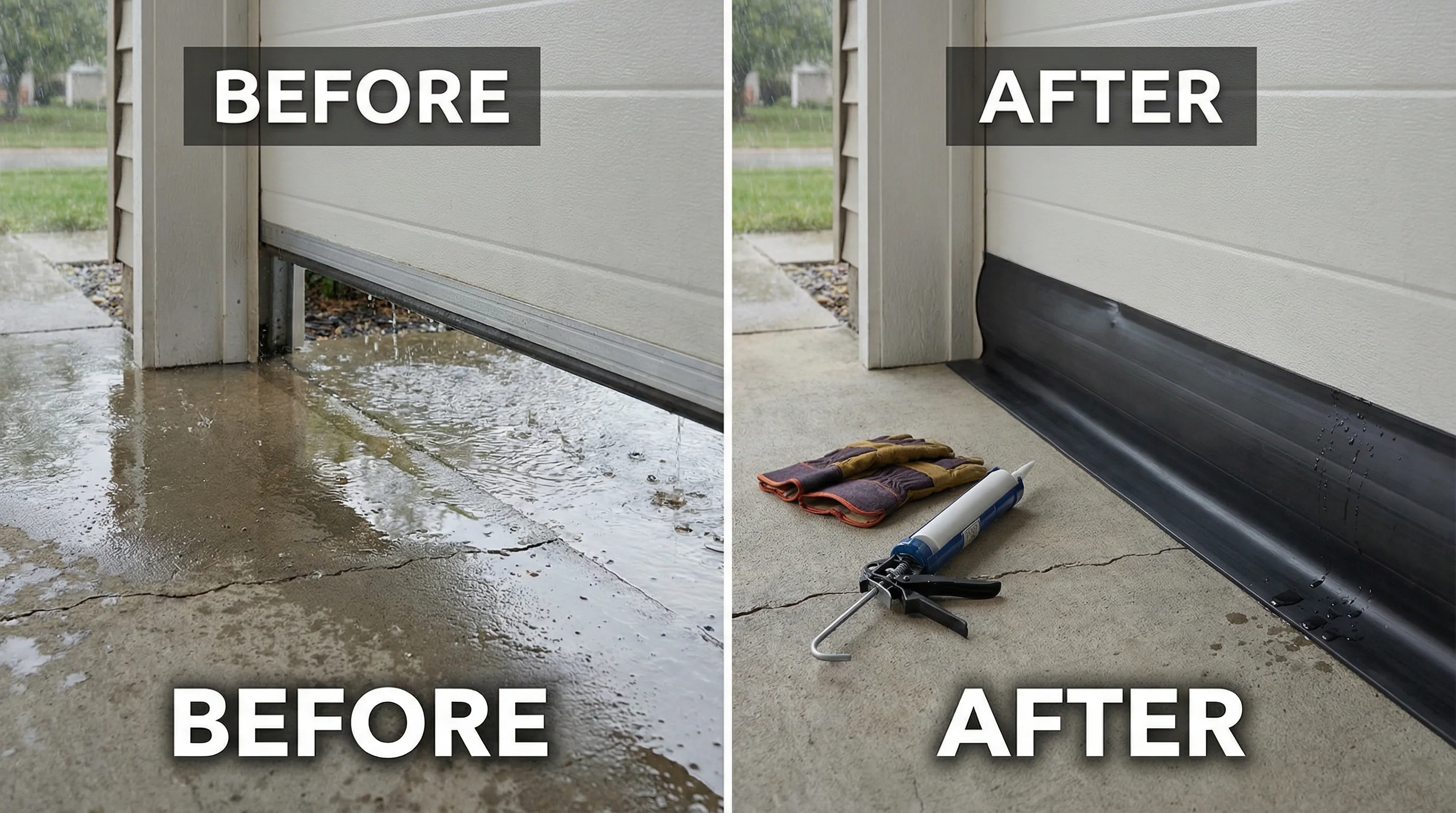
A garage door threshold seal is a rubber strip adhered to the garage floor at the base of the door opening. Unlike a bottom seal (which attaches to the door), the threshold seal creates a raised barrier on the floor that the door closes against. In Toronto's climate, a threshold seal is the most effective way to stop water, leaves, pests, and drafts from entering your garage — especially if your garage floor is uneven. DIY kits cost $40–$80; professional installation runs $120–$180.
What Is a Threshold Seal?
A garage door threshold seal is a rubber or vinyl raised strip permanently bonded to the concrete floor at the base of the garage door opening. It creates an elevated barrier — typically 1/2 to 3/4 inch high — that the door's bottom seal (or the door itself) compresses against when fully closed. It supplements the door's own bottom seal by compensating for uneven floors and providing an additional waterproof barrier.
Most Toronto homeowners know about bottom seals — those rubber strips on the bottom edge of the door. But far fewer know about threshold seals, which bond to the floor itself. If you've ever watched water creep under your garage door during a rainstorm, or found leaves and debris inside after a windy night, a threshold seal is almost certainly the missing piece in your garage door weatherproofing.
What Is a Garage Door Threshold Seal?
A threshold seal works on a simple principle: instead of relying solely on the bottom seal (which hangs from the door) to bridge the gap between the door and the floor, you create a raised barrier on the floor itself. When the door closes, it presses against this raised seal, creating a tight compression seal that water and debris cannot pass through.
Most residential threshold seals are made of:
- EPDM rubber: The best option for Toronto's climate — remains flexible at -40°C, resists UV degradation, and handles repeated compression without cracking. More expensive but much longer lasting.
- Vinyl (PVC): Less expensive but becomes brittle in extreme cold, which is a significant drawback in Ontario winters. Acceptable for mild climates, less ideal for the GTA.
- Aluminum-backed composite: Combines an aluminum base (for stability) with a rubber sealing surface. Excellent for uneven floors where a pure rubber seal might not adhere evenly.
Threshold Seal vs Bottom Seal: What's the Difference?
Homeowners often confuse these two products because they both seal the bottom of the garage door. They are completely different components:
| Feature | Bottom Seal | Threshold Seal |
|---|---|---|
| Where it attaches | Bottom edge of the door | Garage floor/concrete |
| How it seals | Conforms to floor unevenness | Raised barrier the door presses against |
| Best for | Sealing the door-to-floor gap | Stopping water sheet flow and pests |
| DIY cost | $20-$50 | $40-$80 |
| Lifespan | 3-5 years | 5-10 years (EPDM) |
| Works on uneven floors? | Partially (flexes) | Better (fills floor gaps) |
For maximum protection, use both. The bottom seal handles the door's variable compression as it opens and closes. The threshold seal provides the elevated floor barrier that stops water sheet flow. Together, they're nearly impossible for water or small pests to get past.
Benefits of a Threshold Seal in Toronto's Climate
Toronto homeowners face specific challenges that make threshold seals particularly valuable:
Spring Snowmelt and Rain Runoff
Toronto's spring thaw brings significant water flow across driveways toward garage doors. Without a threshold seal, this water sheet flows directly under the door into the garage. Repeated water infiltration damages stored belongings, causes garage floor concrete to spall (deteriorate), and creates mold-friendly conditions.
Winter Draft Control
An uneven garage floor creates gaps at the bottom of the door even when it's closed. These gaps allow cold air infiltration that dramatically increases heating costs for attached garages with conditioned space above. A threshold seal fills these floor irregularities and eliminates cold drafts.
Pest Prevention
Mice, centipedes, and other pests that seek warmth in winter often enter through the gap at the base of the garage door — even through gaps smaller than 1/4 inch. The raised threshold seal eliminates this entry point completely.
Leaves and Debris
Toronto's fall brings heavy leaf accumulation. Without a threshold seal, leaves blow under the door and accumulate inside the garage, clogging floor drains and creating slip hazards when wet.
How to Install a Garage Door Threshold Seal
- Measure and cut the sealMeasure the width of your garage door opening precisely. Most threshold seals come in standard lengths (10 ft, 16 ft, 20 ft) and can be cut with a utility knife or heavy scissors to the exact width needed.
- Clean the floor thoroughlySweep and vacuum the floor area. Then clean with a degreaser or acetone-based cleaner — the floor must be completely free of oil, dust, and loose particles for the adhesive to bond properly. Allow to dry completely (at least 2 hours).
- Do a dry fit with the door closedPosition the threshold seal with the door closed to find the exact correct position. The door's bottom edge (or bottom seal) should compress the threshold seal slightly when fully closed. Mark the floor position with chalk or tape.
- Apply adhesive to the floorMost threshold seal kits include a specific adhesive. Apply it to the floor area (not to the seal), following the manufacturer's pattern (usually a wavy bead or specified coverage). Do not use general-purpose adhesive — it may not bond to concrete properly or may fail in extreme temperatures.
- Press the seal into positionPress the threshold seal firmly onto the adhesive along its full length. Walk along the seal to press it down uniformly. Use a rubber mallet on stubborn sections.
- Cure and testAllow the adhesive to cure 24-48 hours before driving over the threshold seal or regularly operating the door against it. Once cured, test by closing the door — you should feel slight resistance as the door compresses the seal. Pour a small amount of water at the base and verify no water passes through.
How Much Does Threshold Seal Installation Cost?
| Option | Cost (+ tax) | Notes |
|---|---|---|
| DIY threshold seal kit (single door) | $40–$60 | EPDM rubber seal + adhesive for 8-10 ft opening |
| DIY threshold seal kit (double door) | $60–$80 | EPDM rubber seal + adhesive for 16 ft opening |
| Professional installation (single door) | $120–$150 | Includes EPDM seal, adhesive, installation |
| Professional installation (double door) | $150–$180 | Includes EPDM seal, adhesive, installation |
| Bottom seal + threshold seal combo (pro) | $150–$220 | Complete bottom weatherproofing for single door |
Stop Water Getting Into Your Garage
We install threshold seals and bottom seals for Toronto and GTA homeowners. Professional installation ensures the seal is correctly positioned and properly bonded to your specific floor type. Free service call with any installation.
Call 437-265-9995 — Book Installation