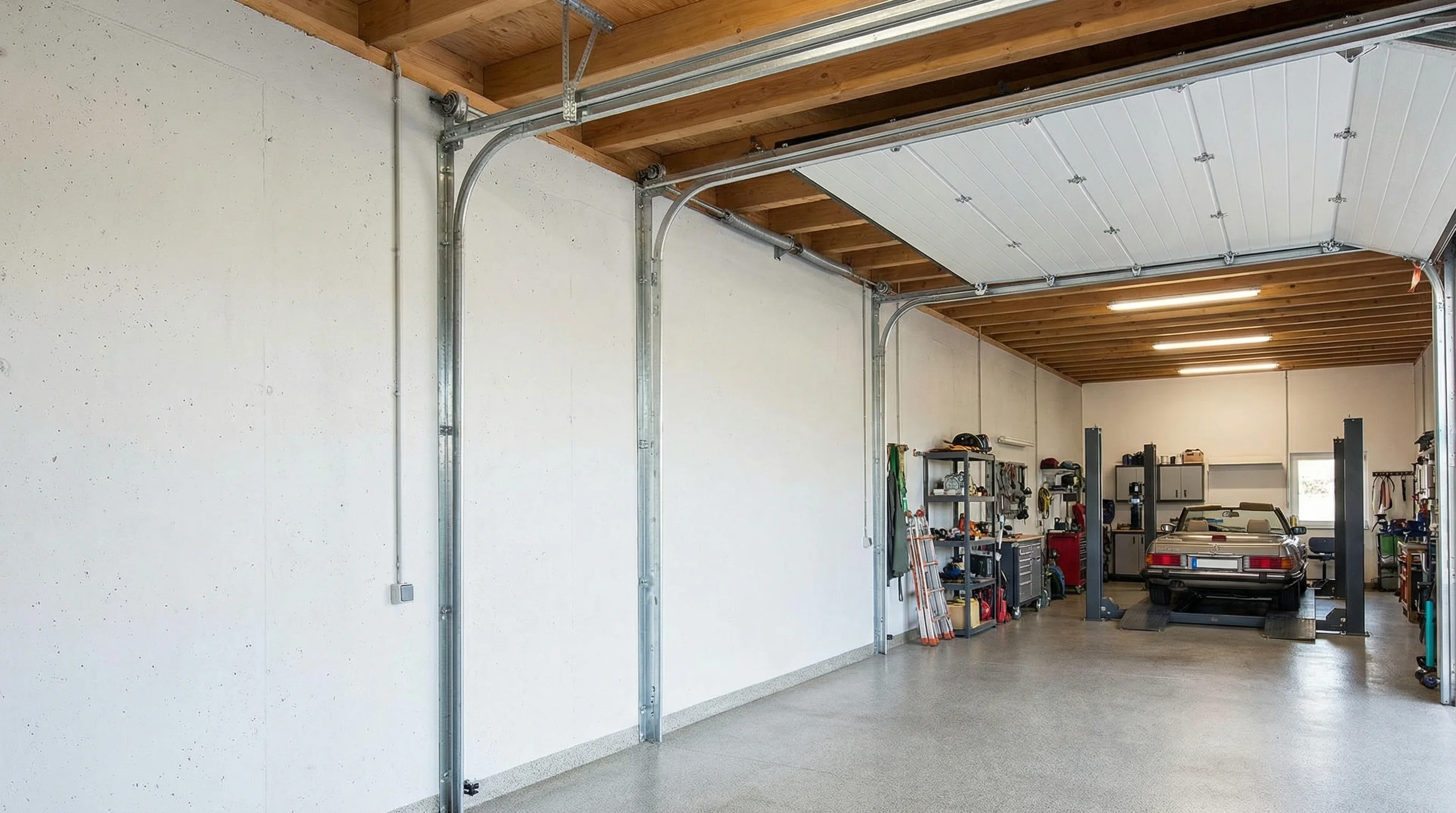
A high-lift garage door conversion replaces standard curved tracks with extended vertical track sections, allowing the door to travel 1-4 feet higher before transitioning overhead. This creates additional clearance beneath the horizontal track for car lifts, tall vehicles, and overhead storage. Cost in Toronto: $600–$1,200 for the track conversion, plus $900–$1,200 if a compatible jackshaft opener (LiftMaster 8500W) is needed. Standard trolley openers do not work with high-lift tracks.
What Is a High-Lift Garage Door Conversion?
A high-lift garage door conversion is a modification to the track and hardware system of a sectional garage door that allows the door to travel farther up the vertical track before transitioning to the horizontal overhead position. Standard residential garage door tracks use approximately 12 inches of vertical clearance above the door. High-lift adds 12 to 48 or more additional inches of vertical travel, proportionally raising the point at which the door becomes horizontal.
A growing number of GTA homeowners are installing two-post car lifts, four-post storage lifts, or large ceiling-mounted storage systems — and discovering that their standard garage door track is sitting exactly where the lift arm needs to go. A high-lift conversion is the solution. It's not a minor project, but for the right application it's transformative.
What Is a High-Lift Garage Door Conversion?
To understand high-lift, you need to understand how standard residential garage door tracks work. A standard track consists of:
- Vertical sections: The straight sections that run vertically beside the door opening, typically 7 feet tall for a standard 7-foot door
- Curved section: The curved transition piece that takes the door from vertical travel to horizontal
- Horizontal sections: The sections that extend back toward the rear of the garage, where the door lies flat when fully open
On a standard track, the curve begins immediately above the door opening. On a high-lift track, an additional straight vertical section is inserted before the curve, pushing the curve (and therefore the horizontal run) higher up in the garage. The result: more vertical space between the floor and the horizontal track sections.
High-lift conversions are available in several increments:
- 12" high-lift: Adds about 1 foot of clearance
- 24" high-lift: Adds about 2 feet of clearance (most common for car lifts)
- 36" high-lift: Adds about 3 feet of clearance (requires adequate ceiling height)
- Vertical lift: The door travels entirely vertically with no horizontal run — requires a very high ceiling and is typically commercial
When Do You Need a High-Lift System?
High-lift conversions are primarily needed when:
Installing a Car Lift
Two-post and four-post vehicle lifts require at least 11-12 feet of usable overhead clearance above the raised vehicle. A standard garage with 9-foot ceilings and a door opening 8 feet high may have only 10-11 feet of clearance to the horizontal garage door track — barely enough, or not enough. A 24" high-lift conversion gains the clearance needed to safely operate a car lift with a full-size vehicle raised.
Tall Vehicles
Ford F-250 and F-350 trucks with lift kits, full-size vans, and recreational vehicles often exceed the clearance that standard garage door track allows. If you can barely get your truck in but the garage door track contacts the roof rack or antenna, high-lift may solve the problem without requiring an entirely new garage structure.
Overhead Storage Systems
Ceiling-mounted storage platforms and heavy-duty shelving systems need mounting points on the ceiling or upper wall. A standard garage door track running at a low angle can interfere with where these systems need to go. High-lift moves the track higher, freeing up the prime upper-wall space for storage hardware.
High-Lift vs Standard Track: Key Differences
| Feature | Standard Track | High-Lift Track |
|---|---|---|
| Clearance above door | 10-12 inches | 24-48+ inches (depending on conversion) |
| Compatible opener | Any trolley or jackshaft | Jackshaft only (LiftMaster 8500W) |
| Conversion cost | N/A (standard) | $600-$1,200 |
| Good for car lifts | Sometimes | Yes |
| Spring adjustment needed | No | Yes (torsion spring recalculated) |
| Ceiling height required | 10-11 feet typical | 12-14 feet minimum for full high-lift |
High-Lift Conversion Cost in Toronto
| Service | Price Range (+ tax) | Notes |
|---|---|---|
| 12” high-lift conversion (track only) | $600–$800 | Track, hardware, spring adjustment, labor |
| 24” high-lift conversion (track only) | $700–$1,000 | Most common for car lift applications |
| 36” high-lift conversion (track only) | $900–$1,200 | Requires adequate ceiling height |
| LiftMaster 8500W jackshaft opener | $900–$1,200 | Required for high-lift; installed price |
| Complete high-lift + opener package | $1,400–$2,200 | Track conversion + LiftMaster 8500W installed |
Choosing an Opener Compatible with High-Lift Tracks
This is the most important technical point about high-lift conversions: standard trolley-style openers (belt drive, chain drive, screw drive) are NOT compatible with high-lift track systems.
Here's why: a trolley opener uses a rail mounted to the ceiling, with the opener motor mounted to the ceiling at the center of the garage. This rail attaches to the door at a specific angle. On high-lift track, the door no longer lines up with a standard ceiling-mounted rail because the door travels much higher before going horizontal.
The solution is a jackshaft opener (also called a wall-mount opener). A jackshaft opener mounts to the wall beside the door and drives the torsion spring shaft directly. It works regardless of track geometry because it connects to the spring shaft, not to the door via a rail.
The best jackshaft opener for high-lift conversions in Canada is the LiftMaster 8500W ($900-$1,200 installed). It features:
- DC motor with battery backup
- myQ WiFi connectivity with smartphone control
- Timer-to-close and remote monitoring
- Ultra-quiet operation (quieter than belt drive)
- Compatible with doors up to 14 feet wide and 8 feet tall
Planning a High-Lift Conversion?
We do high-lift track conversions and LiftMaster 8500W jackshaft opener installations throughout the GTA. Free consultation on your specific clearance requirements and the best solution for your garage.
Call 437-265-9995 — Free Consultation