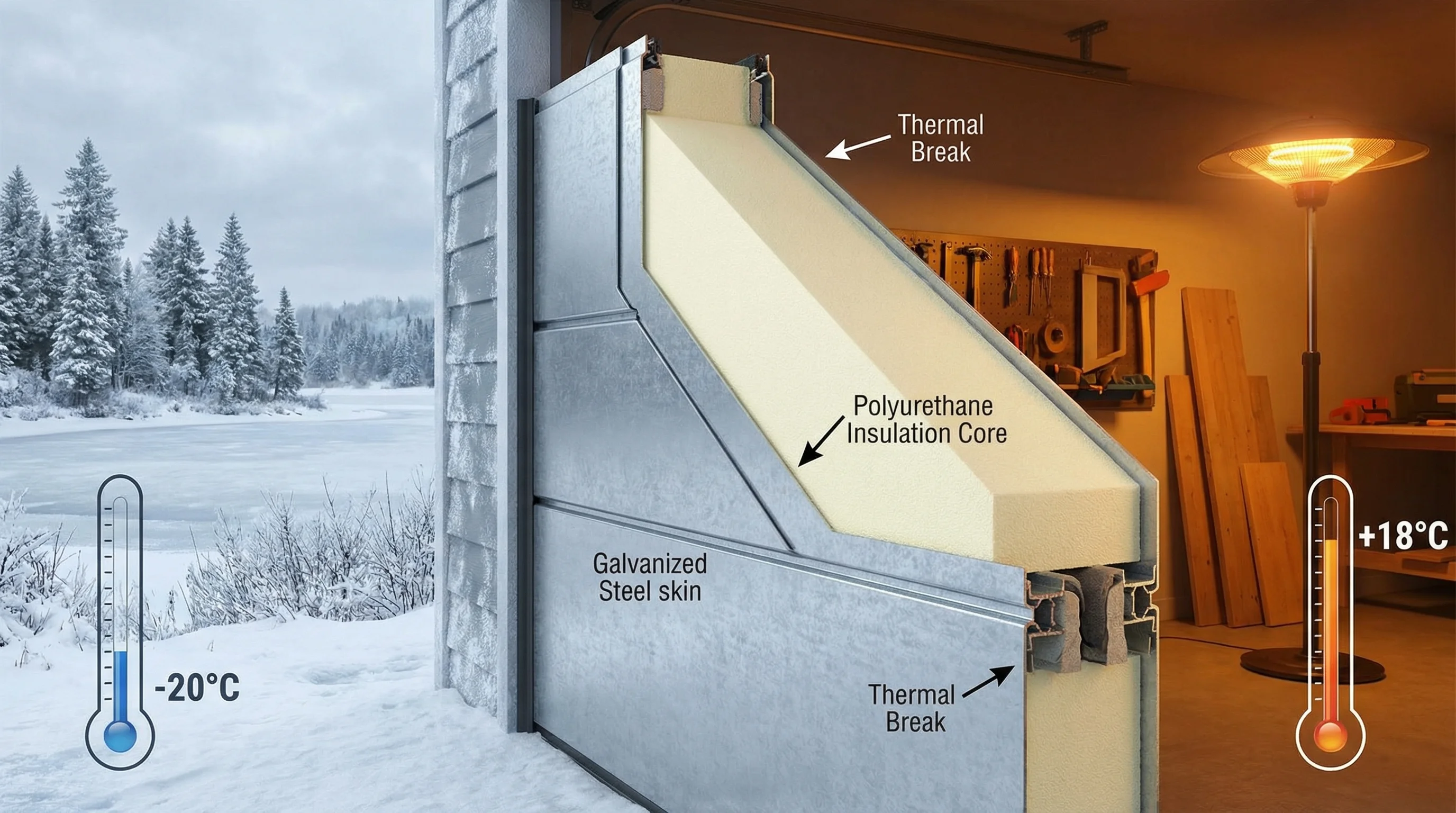
Insulated garage doors do save money in Toronto -- but only under the right conditions. An attached garage with an insulated door (R-12 to R-16) can save $100 to $300 per year on heating costs. The payback period is typically 4 to 8 years on the price premium over a non-insulated door. For detached garages, the energy savings are minimal unless you actively heat the garage.
What Is Garage Door R-Value?
R-value measures thermal resistance -- how well a material resists heat flow. A higher R-value means better insulation. Garage doors in Ontario range from R-0 (non-insulated steel pan) to R-18+ (triple-layer polyurethane-filled steel). For Toronto winters that regularly reach -15C to -25C, R-value matters significantly for attached garages.
The question I hear constantly from GTA homeowners: "Is it worth spending the extra $400 on an insulated door?" The honest answer is -- it depends on your specific situation. For an attached garage in Toronto, yes. For a detached garage you use for storage only, probably not. Here is the complete analysis so you can make the right call for your home.
What Is Garage Door R-Value and Why Does It Matter?
Toronto's climate creates extreme thermal demands on your garage door. In January, a typical GTA winter day swings from -15C overnight to perhaps -5C in the afternoon. An uninsulated steel garage door conducts cold directly into your garage space, and in an attached garage, that cold transfers into your home through the shared wall.
Common R-Values in Toronto Market
- R-0 (non-insulated pan door): Single layer steel, no insulation. Cold to the touch in winter. Zero thermal resistance. Fine for fully detached garages used only for storage.
- R-6 (polystyrene sandwich): Basic two-layer door with thin polystyrene backer. Provides modest improvement. Common in entry-level doors.
- R-12 (polyurethane injection): Three-layer door with injected polyurethane foam filling all air gaps. Significantly warmer interior surface. Good balance of cost and performance for most GTA attached garages.
- R-16+ (premium polyurethane): High-performance insulation with thicker polyurethane fill. Recommended for attached garages where the adjacent room is frequently used, or where a workspace is maintained in the garage. Often combined with excellent weatherstripping.
Note that polyurethane (injected foam) consistently outperforms polystyrene (rigid board) at equivalent stated R-values because polyurethane fills all cavities and bonds to the steel, eliminating thermal bridging at the frame.
Insulated vs Non-Insulated: Energy Savings in Toronto
The actual energy savings from a garage door upgrade depend heavily on three factors: whether the garage is attached, how the rest of the garage is insulated, and your heating source.
Attached Garage Savings Scenario (Toronto)
Consider a typical 1990s Mississauga home with a 9x7 foot attached garage, natural gas heat at roughly $0.40/cubic metre, and an uninsulated pan door. The garage shares a wall with the kitchen. Upgrading from R-0 to R-16:
- Garage temperature improvement on a -15C day: approximately +6 to +8 degrees Celsius
- Reduced heat loss through the shared kitchen wall: estimated 15-25% reduction
- Annual heating cost savings: approximately $120-$280 per year for natural gas
- Savings are higher with electric baseboard heat (typically 2-3x the gas cost per BTU)
Detached Garage Savings
If you have a fully detached garage that you heat in winter for workshop use, an insulated door reduces the cost of maintaining that temperature. However, if you do not heat the detached garage at all, an insulated door provides no measurable energy savings for your home -- it only affects garage interior temperature, which you are not paying to maintain.
Cost Difference: Insulated vs Non-Insulated Doors
Here are 2026 pricing comparisons for single doors in the GTA, installed:
| Door Type | R-Value | Installed Price | Premium vs R-0 |
|---|---|---|---|
| Non-insulated pan door (9x7) | R-0 | $700-$1,150 | -- |
| R-6 polystyrene (9x7) | R-6 | $900-$1,200 | $200-$350 |
| R-12 polyurethane (9x7) | R-12 | $1,100-$1,500 | $400-$550 |
| R-16+ premium (9x7) | R-16+ | $1,400-$2,000 | $700-$1,050 |
Payback Period Calculation for Toronto Homeowners
Using the numbers above, here is how the payback calculation works for a typical GTA scenario:
Scenario: Upgrading from a non-insulated door to R-12 polyurethane on an attached single-car garage in Brampton. Natural gas heating. Annual savings estimated at $180.
Price premium for R-12 vs R-0: approximately $450 (door cost difference, before labour which is similar for both)
Payback period: $450 / $180 = 2.5 years
For R-16+ with a $750 premium and $220 annual savings: payback is about 3.4 years. Both are excellent investments on a door with a 15 to 20-year lifespan.
The calculation changes if your garage is detached (no savings) or if you use electric baseboard heat in the adjacent room (higher savings, faster payback).
Other Benefits of Insulated Doors in GTA Climate
Beyond pure energy savings, insulated doors offer several important benefits for Toronto homeowners specifically:
Reduced Condensation and Rust
Non-insulated steel doors act as a cold surface against which warm indoor air condenses, causing rust on the door's interior surface and ice formation on the bottom seal. An insulated door with a warmer interior skin dramatically reduces this condensation. This extends the door's lifespan and prevents the bottom panel rust that plagues many Toronto garage doors by year 10.
Noise Reduction
A triple-layer insulated door is significantly quieter than a single-layer pan door, both from mechanical noise during operation and from outside traffic noise. If your garage is attached to a bedroom or home office, this is a meaningful quality-of-life improvement.
Structural Rigidity
Polyurethane-filled doors are structurally stiffer than non-insulated doors. They resist wind-induced bowing better and maintain panel integrity longer, especially important during Toronto's ice storms when wind pressure on the door can be significant.
Comfort During Loading and Unloading
On a -20C January morning in Toronto, the difference between stepping into a garage that is -18C versus -10C is very noticeable. While not a financial calculation, comfort has real value when you are loading groceries or warming up your car.
See exact pricing: Visit our complete pricing page for up-to-date Toronto rates on all services.
Get a Quote on an Insulated Door in Toronto
We install Garaga and Clopay insulated doors across the GTA. Same-day quotes available. FREE service call with every installation.
Call 437-265-9995