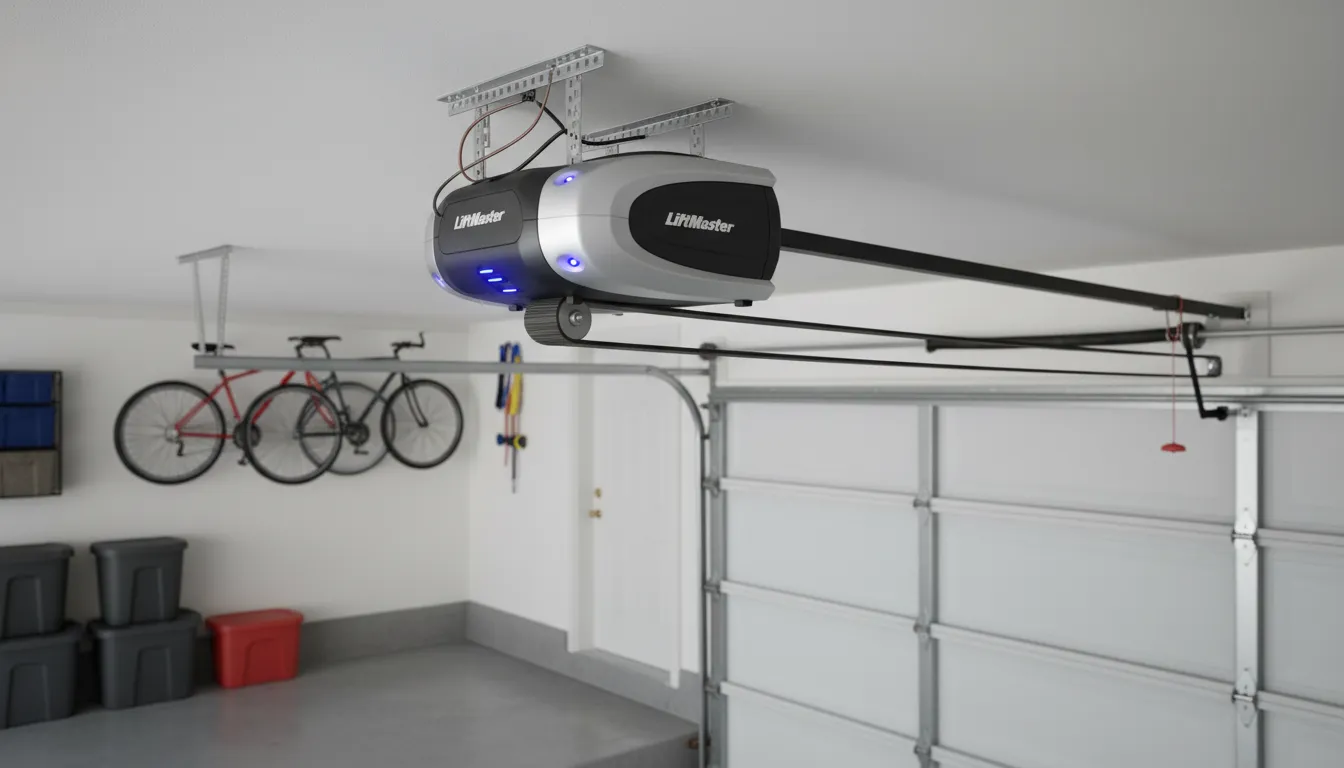
Most Common LiftMaster Problems
LiftMaster garage door openers are known for their durability, but even the best equipment can develop issues over time. After servicing thousands of LiftMaster units across Toronto and the GTA, here are the problems we see most frequently:
| Problem | Likely Cause | DIY or Pro? |
|---|---|---|
| Won't respond to remote | Dead batteries, antenna issue, or receiver failure | DIY First |
| Light blinks but won't close | Safety sensor misalignment or obstruction | DIY First |
| Clicking sound, no movement | Stripped main gear assembly | Call Pro |
| Opens partially then stops | Travel limit settings or spring issues | DIY/Pro |
| Motor runs but door doesn't move | Broken belt/chain or trolley disconnect | Call Pro |
| Reverses before closing | Force settings too sensitive or obstruction | DIY First |
| MyQ app won't connect | WiFi issues or gateway configuration | DIY First |
Pro Tip: Before troubleshooting, always test the wall-mounted button first. If the wall button works but remotes don't, you've narrowed the problem to the remote or receiver - not the entire opener system.
LiftMaster Error Codes Explained
LiftMaster openers communicate problems through blinking LED lights on the motor unit. The number of blinks indicates specific issues. Here's what each code means:
Safety Sensor Wire Disconnected
The sending sensor (amber light) wire is disconnected or has a break. Check the connection at the motor unit and trace the wire for damage.
Sensor Wire Shorted
The sensor wires are touching or shorted together. Look for damaged insulation where wires may be pinched or stapled through.
Sensor Wire Reversed
The black and white sensor wires are connected to wrong terminals. Swap the wire connections at either the sensors or motor unit.
Sensors Slightly Misaligned
The photo eye sensors can "see" each other but alignment isn't optimal. Fine-tune the sensor positions until both indicator lights are solid.
Sensors Blocked or Severely Misaligned
This is the most common error code. The sensors cannot see each other at all. Clean the lenses, check alignment, and ensure nothing is blocking the beam. See our sensor alignment guide for step-by-step instructions.
Logic Board Issue
Continuous blinking (not counting) often indicates a failed logic board or motor capacitor. This usually requires professional diagnosis and parts replacement.
Step-by-Step Troubleshooting
Follow these steps in order to diagnose your LiftMaster problem. Most issues can be identified within the first three steps.
Check Power Supply
Verify the opener has power. Look for illuminated LEDs on the motor unit. If nothing lights up, check the outlet by plugging in another device. Inspect your circuit breaker and GFCI outlets in the garage. Many openers share circuits with garage outlets that can trip.
Test the Wall Button
Press your hardwired wall button. If it works but remotes don't, skip to the remote troubleshooting section. If the wall button doesn't work either, the issue is with the opener itself, the wall button wiring, or the door mechanism.
Inspect Safety Sensors
Check both photo eye sensors at the bottom of your door tracks. The sending sensor should show a steady amber/yellow light. The receiving sensor should show a steady green light. If either light is off or blinking, the sensors need attention.
Listen for Sounds
Press the button and listen carefully. Clicking without movement = stripped gears. Humming without movement = jammed trolley or motor issue. Complete silence = power or logic board problem. Grinding = chain/belt tension or rail issue.
Test Door Balance
Disconnect the opener by pulling the emergency release cord. Manually lift the door halfway. A properly balanced door should stay in place. If it falls or rises, your springs need adjustment - this affects opener performance significantly.
Reset the Opener
Unplug the opener for 60 seconds, then plug it back in. This resets the logic board and clears temporary faults. If your model has a "Learn" button, pressing and holding it for 6+ seconds will erase all programmed remotes (requiring reprogramming).
Safety Warning: Never attempt to adjust garage door springs yourself. Springs are under extreme tension and can cause serious injury. Spring adjustment should always be done by certified technicians.
Motor and Gear Problems
When you hear your LiftMaster motor running but the door doesn't move, the problem is usually in the drive mechanism. Here's how to identify specific motor and gear issues:
Clicking Sound Without Movement
This is the classic symptom of a stripped main gear. The motor engages but can't transfer power to the drive mechanism. You'll hear a rapid clicking or grinding sound. In belt-drive models (like the 8500 series), this may indicate a worn belt or damaged pulleys.
Repair cost: $150-$250 for gear replacement, $200-$350 for belt-drive mechanism repair. On units over 12-15 years old, full replacement is often more economical.
Motor Hums But Doesn't Run
A humming motor that doesn't turn indicates:
- Failed capacitor: The starting capacitor stores energy to initiate motor rotation. When it fails, the motor hums but can't start. Replacement cost: $80-$120.
- Seized motor: Bearings have worn out or the motor has overheated. Usually requires motor replacement: $150-$250 for motor, or consider full opener replacement.
- Jammed trolley: The carriage that moves along the rail is stuck. Disconnect the opener and check for obstructions or damaged rail sections.
Motor Runs Continuously
If the motor doesn't stop when the door reaches fully open or closed position, the travel limits need adjustment. LiftMaster openers have two adjustment screws (usually marked "UP" and "DOWN") that control how far the door travels in each direction.
The most common mistake I see is homeowners adjusting force settings when they should be adjusting travel limits. Force controls how hard the motor pushes. Travel controls where the door stops. Wrong adjustments can damage your door or opener.
- Michael Thompson, IDEA Certified Technician
Remote and Keypad Issues
Remote problems are the #1 reason homeowners call about their LiftMaster opener, and they're usually the easiest to fix yourself.
Remote Won't Work At All
Replace Batteries First
Even if you replaced batteries recently, try fresh ones. LiftMaster remotes typically use CR2032 (coin cell), CR2016, or A23 (cylindrical) batteries depending on the model. Weak batteries cause intermittent operation before failing completely.
Check for LED Bulb Interference
LED light bulbs can emit radio frequencies that interfere with opener remotes. If you've recently switched to LED bulbs in your garage, try temporarily switching back to incandescent or using "garage door opener compatible" LED bulbs.
Reprogram the Remote
Press and release the "Learn" button on your opener. Within 30 seconds, press and hold the button on your remote until the opener light blinks. This reprograms the remote's code into the opener's memory.
Check the Antenna
The receiving antenna is the short wire hanging from your motor unit. It should hang straight down, not coiled or touching metal. A damaged or poorly positioned antenna drastically reduces range.
Keypad Not Responding
Outdoor keypads face additional challenges from weather exposure:
- Dead battery: Keypads use a 9V battery that typically lasts 1-2 years
- Water damage: Check the battery compartment for corrosion
- Frozen buttons: In winter, ice can prevent button contact
- Code lockout: After too many wrong entries, keypads lock out for 15-30 minutes
- Sun damage: UV exposure can damage the keypad membrane
MyQ App Connectivity Problems
For WiFi-enabled LiftMaster openers with myQ technology:
- Ensure your WiFi network is 2.4GHz (myQ doesn't support 5GHz)
- Check that the WiFi gateway has a solid blue light
- Move your router closer to the garage or add a WiFi extender
- Reset the gateway by unplugging for 10 seconds
- Verify your myQ account subscription status
Pro Tip: If you have a Security+ 2.0 opener (model years 2011+), make sure you're using remotes with the correct frequency. Older 315MHz remotes won't work with newer 390MHz Security+ 2.0 systems.
When to Call a Professional
While many LiftMaster problems can be fixed DIY, some issues require professional expertise and tools. Call a certified technician if you experience:
- Stripped gears or motor replacement: Requires disassembly and proper parts
- Spring-related issues: Door balance problems indicate spring wear
- Electrical or wiring problems: Especially if you see sparks or burning smells
- Repeated sensor failures: May indicate electrical issues in the garage
- Track or hardware damage: Bent tracks or broken brackets affect opener performance
- Multiple system failures: When several components fail simultaneously
- Opener over 15 years old: Repeated repairs may cost more than replacement
| Service | Price Range | Time |
|---|---|---|
| Diagnostic service call | FREE with repair | 30 min |
| Gear replacement | $150 - $250 | 45-60 min |
| Logic board replacement | $175 - $300 | 30-45 min |
| Sensor replacement (pair) | $120 - $180 | 30 min |
| New LiftMaster opener (installed) | $680+ | 1.5-2 hours |