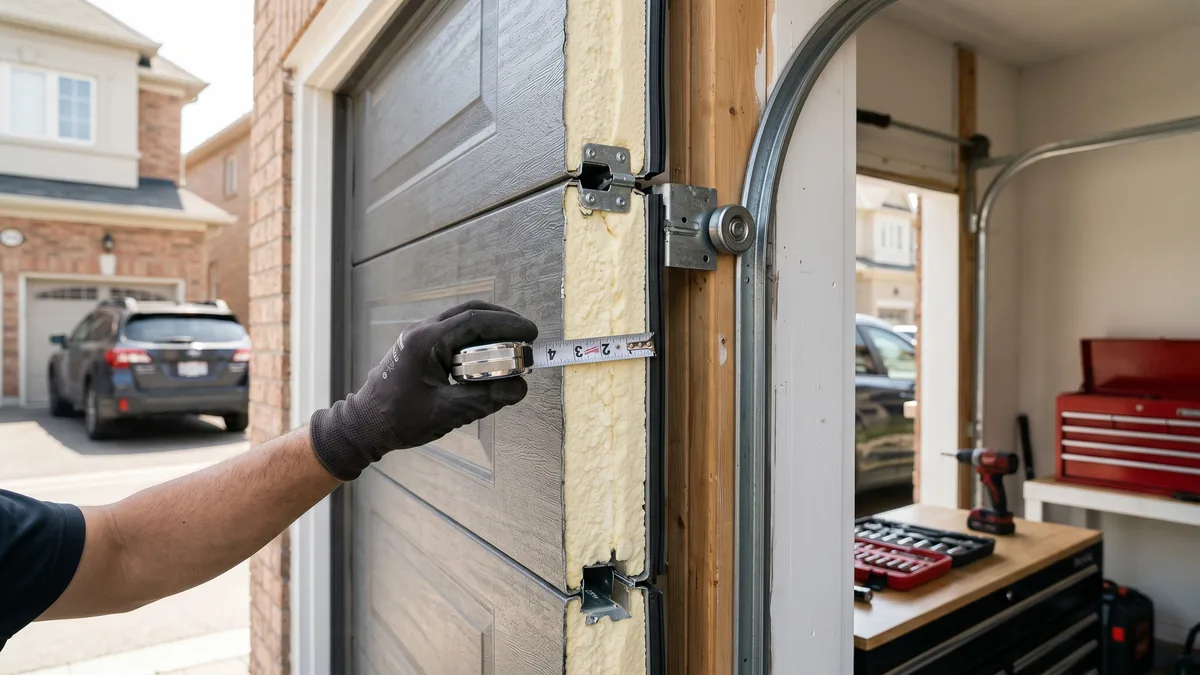
R-value measures the insulation resistance of a single garage door panel — how well the foam core resists heat flow, so a higher number is better. U-factor measures whole-door heat transfer through the assembled door, including the steel skins, frame, glass and seams, so a lower number is better. They are inverses: R-value rates one part of the door, while U-factor rates the entire finished door as you actually install it. Because manufacturers usually quote the most flattering center-of-panel R-value, U-factor is the more honest figure for real-world energy performance — but it is rarely advertised. When you compare doors, treat R-value as a rough guide and ask for the whole-door rating.
R-Value vs U-Factor in One Sentence
R-value tells you how good the insulation inside the panel is (higher = better), while U-factor tells you how much heat actually leaks through the whole door once steel, frame, glass and air gaps are counted (lower = better). One is the marketing number; the other is the engineering number.
Every insulated garage door brochure leads with a big R-value — R-12, R-16, even R-18 — but almost none of them print the U-factor. After installing and replacing hundreds of doors across Toronto and the GTA, we can tell you the gap between those two numbers is where most homeowners get misled. This guide explains what each rating really measures, why the advertised R-value is usually inflated, and which number you should actually trust when buying an insulated door for a Canadian winter.
What R-Value Means (and How It Gets Inflated)
R-value is a measure of thermal resistance — how strongly a material resists the flow of heat through it. The higher the R-value, the slower heat moves from the warm side to the cold side. It is the same metric used for attic batts and wall insulation, which is exactly why garage door makers like it: homeowners already associate “R-something” with energy savings.
The problem is where on the door the R-value is measured. There is no single mandatory standard that forces every garage door brand to test the same way, so most quote the center-of-panel R-value — the rating at the thickest, foam-filled middle of one section, with nothing else in the way. That ignores the parts of a real door that leak the most heat:
- Steel skins: The front and back steel sheets conduct heat readily and barely add R-value.
- Rails and stiles: The structural framing between sections creates thermal bridges where heat shortcuts straight through.
- Section joints: Every horizontal seam between panels is a weak point compared with the foam core.
- Windows: Glass inserts can have an R-value below R-2, dragging the whole door down.
- Perimeter air leakage: Gaps around the jambs and under the bottom seal let conditioned air escape entirely — something no panel R-value captures.
So a door advertised at “R-16” might perform closer to R-9 or R-10 once you account for the framing, the skins and any windows. The center-of-panel figure is not a lie, exactly — it is just the most flattering slice of the door, not the door you live with.
What U-Factor Means
U-factor (also written U-value) measures the rate of heat transfer through the entire assembled door, per unit of area, for a given temperature difference. Where R-value rates resistance, U-factor rates conductance — so the two are roughly mathematical inverses (U ≈ 1 ÷ R for a simple material). A lower U-factor is better because it means less heat escapes.
The key difference is scope. U-factor is a whole-product rating. When a door or window is tested for U-factor under a recognized standard, the test counts everything: both steel skins, the foam core, the rails and stiles, the section joints, the glass, and the framing. That is why fenestration products (windows, skylights, and increasingly insulated doors) are rated by U-factor in energy codes and on certification labels — it reflects how the finished product behaves, not just one ideal cross-section.
Why Inverses Don’t Convert Cleanly
You might expect an R-16 door to have a U-factor of 1 ÷ 16 = 0.06. In reality the whole-door U-factor is usually higher (worse) than that simple math suggests — often in the 0.10–0.20 range — precisely because the steel, framing and joints that the center-of-panel R-value ignored are now included. The bigger the gap between the “clean” inverse and the real U-factor, the more the advertised R-value was hiding.
Why Manufacturers Quote R but U-Factor Matters
If U-factor is the more honest number, why does almost no garage door brochure lead with it? Three reasons:
- R-value produces a bigger, friendlier number. “R-18” sounds powerful; “U-0.13” sounds like a decimal nobody understands. Marketing wins.
- R-value can be cherry-picked. With no enforced single standard for garage doors, a brand can choose the testing method — usually center-of-panel — that produces the highest figure. Whole-door U-factor testing is harder to game.
- R-value lets brands compete on a single headline. A higher R-number looks like a clear win on a spec sheet, even when the doors perform almost identically once installed.
For you, the practical takeaway is simple: use R-value to rank doors within the same brand and core type, where the testing is at least consistent. But when comparing across brands, or when energy performance genuinely matters, ask the dealer for the U-factor or the whole-door rating. If they can only give you a center-of-panel R-value, mentally discount it. Our team walks through these numbers honestly during any garage door replacement consultation, because the “highest R-value” door is not always the one that keeps your garage warmest.
Typical Garage Door R-Value Tiers (R-9 to R-18)
Insulated residential doors generally fall into a handful of rating tiers. Here is what each one really means in practice, and the rough whole-door behaviour you can expect once framing and skins are counted:
| Advertised R-Value | Typical Core | Realistic Whole-Door Feel | Best For |
|---|---|---|---|
| R-6 to R-9 | Thin polystyrene board | Entry-level insulation; noticeable cold transfer | Detached, unheated garages on a budget |
| R-9 to R-12 | Polystyrene or thin polyurethane | Good everyday comfort, modest energy benefit | Attached but unheated GTA garages |
| R-12 to R-16 | Foamed-in-place polyurethane | Strong, sealed performance; quieter operation | Attached garages with rooms above or beside |
| R-16 to R-18+ | Thick polyurethane, triple-layer | Premium; diminishing returns vs. R-16 | Heated garages, workshops, living space |
Notice the pattern: each jump up the ladder costs more but returns less. Moving from R-6 to R-12 is a meaningful comfort upgrade; moving from R-16 to R-18 is mostly a spec-sheet bragging point. The bigger driver of real-world performance is the core material and the perimeter seal — not the last two points of R-value.
Polyurethane vs Polystyrene: The Real Difference
The single biggest factor behind both R-value and U-factor is which foam fills the panel. There are two common types, and they are not equal.
Polystyrene (EPS board)
Polystyrene insulation is a rigid foam board cut to size and slid into the panel during manufacturing. It delivers roughly R-3.5 to R-4 per inch. Because it is a pre-cut sheet, it leaves small air gaps around the edges, does not bond to the steel, and adds little structural rigidity. It is the budget option and is fine for a detached garage where you mainly want to cut wind chill and noise.
Polyurethane (foamed-in-place)
Polyurethane is injected as a liquid that expands and bonds to both steel skins, filling every gap before it cures. It delivers roughly R-5 to R-6.5 per inch — significantly more R-value in the same thickness — and because it adheres to the steel it also seals air gaps, dampens sound, and makes the whole door stiffer and more dent-resistant. For the same panel thickness, polyurethane gives you a higher R-value and a lower, better U-factor.
| Property | Polystyrene | Polyurethane |
|---|---|---|
| R-value per inch | ~R-3.5 to R-4 | ~R-5 to R-6.5 |
| How it’s installed | Pre-cut board, slid in | Foamed-in-place, bonded |
| Air-gap sealing | Gaps remain at edges | Fills and seals gaps |
| Effect on U-factor | Higher (worse) | Lower (better) |
| Rigidity / dent resistance | Lower | Higher |
| Relative cost | $ | $$ |
If you only remember one thing from this article: a polyurethane door at R-12 will usually outperform a polystyrene door at R-16 in real-world heat retention, because the polyurethane seals the gaps that the polystyrene leaves open. The core material beats the headline number. We break the two foams down further in our dedicated guide on urethane vs polystyrene insulation.
What to Choose for an Attached GTA Garage
Toronto and the GTA see real winters — weeks below freezing, the occasional deep cold snap, and humid summers. For an attached garage, where the door shares the building envelope with your house (a shared wall, or a bedroom or bonus room directly above), insulation actually affects your comfort and energy bills. Here is the practical recommendation:
- Attached, unheated garage: A polyurethane door around R-12 to R-14 is the sweet spot — warm enough to take the bite out of winter, quiet, and cost-effective.
- Attached with living space above or beside it: Step up to R-14 to R-16 polyurethane. The room above will feel the difference on cold mornings.
- Heated garage or workshop: R-16 to R-18 polyurethane is justified, because you are paying to heat that space and want to keep the heat in.
- Detached, unheated garage: You rarely need more than R-9 to R-12; spend the savings on a good bottom and side seal instead.
If you are weighing whether to insulate at all, our comparison of an insulated vs non-insulated door walks through the comfort and cost trade-offs, and our deeper garage door insulation R-value guide covers how the ratings are calculated. You can also model panel styles and colours on our online door designer, or browse construction options on our overhead garage doors page.
The Bottom Line
R-value is the marketing number; U-factor is the engineering number. For a GTA attached garage, choose a polyurethane (foamed-in-place) door around R-12 to R-16, confirm the seal is tight, and don’t overpay for R-18 unless the garage is heated living space. The core material and the perimeter seal matter more than the headline R-value on the brochure.
Authoritative resources worth consulting before you buy: Natural Resources Canada’s ENERGY STAR Canada program explains how whole-product ratings like U-factor are used, and the U.S. Department of Energy’s guide to insulation and R-value covers how thermal resistance is measured and why assembly matters.
Not Sure Which Insulated Door Is Right for Your Garage?
Our IDEA Certified team will recommend the right R-value, core material and seal for your home — no inflated numbers, no upsell. New door installation starts from $1,350, and your service call is FREE with any installation across Toronto & the GTA.
Call 437-265-9995