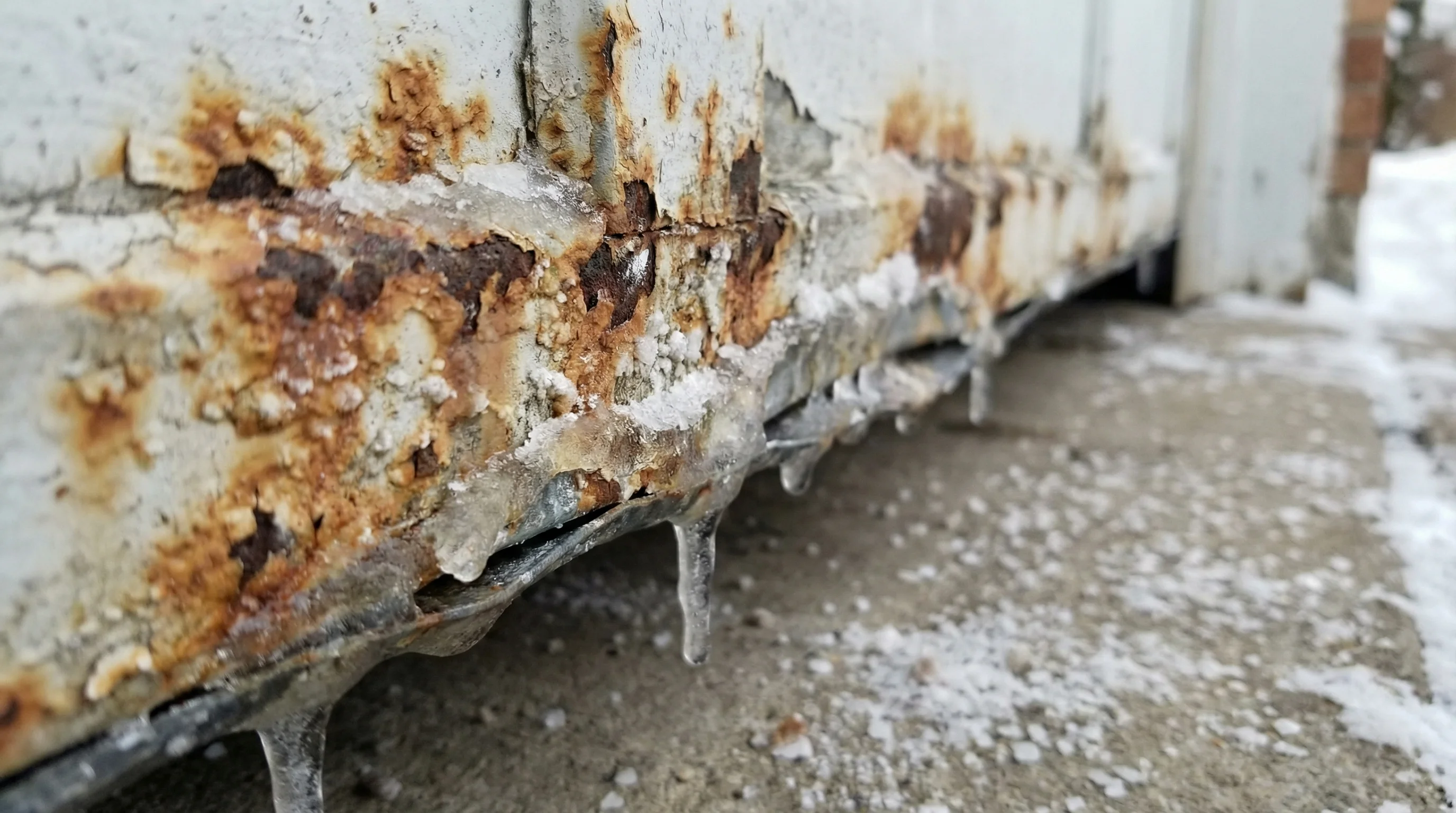
Road salt destroys steel garage doors through accelerated rust formation, especially on the bottom two panels and all metal hardware. Ontario uses 500,000+ tonnes of road salt annually. Protect your door by washing it monthly from November through March, applying automotive wax in October, and lubricating all hardware with silicone spray. Catching rust early saves replacing the door.
Why Ontario Road Salt Is So Destructive to Garage Doors
Ontario applies more road salt per capita than almost anywhere else in the world. Sodium chloride and calcium chloride sprayed onto roads get picked up by vehicle tires and splashed in a fine mist onto everything nearby -- including your garage door. Salt is not just corrosive; it accelerates the rusting process of steel by 10-15x compared to untreated exposure to moisture alone.
After 15 years of replacing garage doors in the GTA, I can spot salt damage from 20 feet away. The signs are unmistakable -- rust bubbles along the bottom panel joints, pitting at the bottom corners, corroded hinges that grind instead of pivot. What is frustrating is that almost all of this damage is preventable with $20 of car wax and a garden hose. This guide shows you exactly how to stop salt from destroying your door.
How Road Salt Destroys Garage Doors in Ontario
The chemistry is straightforward but the consequences are expensive. Here is the exact mechanism:
The Corrosion Accelerator Effect
Steel rusts through an electrochemical reaction where iron atoms in the steel react with oxygen and water to form iron oxide (rust). Normally this is a slow process. Salt ions dissolved in the water film on your door's surface dramatically increase the electrical conductivity of that moisture, accelerating the electrochemical reaction by a factor of 10 to 15.
In practical terms: a steel panel that might last 20 years in a low-salt environment (like rural Ontario) may show significant rust damage in 5 to 8 years on a busy GTA street where it is hit with salt spray daily throughout winter.
Where Damage Occurs First
Salt damage follows a predictable pattern on garage doors:
- Bottom panel (section 1): Most severely affected -- closest to road spray and in direct contact with salt-contaminated water pooling on the driveway
- Bottom panel joints: The seams between panels trap salt and moisture, creating concentrated rust points
- Bottom corners: Water accumulates here; rust typically starts as bubbles under the paint and progresses to pitting
- Hinges and rollers: Metal hardware corrodes, causing squeaking and eventually seizing
- Springs and cables: Torsion springs develop surface rust that weakens the metal; cables develop fraying accelerated by corrosion
Signs of Salt Damage to Watch For
Catch these warning signs early before they require panel or door replacement:
Early Stage (Year 1-3 Without Protection)
- Fine rust staining along the bottom edge or joints -- looks like brown streaks
- Paint starting to bubble or flake near the bottom
- Orange-colored residue on the door surface that does not wash off easily
- Squeaking or grinding hinges that were previously quiet
Moderate Stage (Year 3-7 Without Protection)
- Visible rust pitting on the bottom panel surface
- Panel joints separating slightly due to rust expansion
- Hinges that stick or do not pivot freely
- Rust on the torsion spring coils visible from inside the garage
Advanced Stage (Requires Replacement)
- Rust holes visible in the bottom panel -- light visible through the steel
- Bottom corners completely rusted through
- Panel joints visibly separated from corrosion expansion
- Cable strands visibly frayed from corrosion
How to Properly Clean Salt Off Your Garage Door
The correct cleaning process removes salt before it has time to penetrate the paint surface:
Monthly Winter Cleaning Routine
- Use warm water first -- cold water is less effective at dissolving salt deposits
- Rinse the full door top to bottom with a garden hose or pressure washer on a low setting (max 1,000 PSI to avoid damaging paint)
- Apply car wash soap (pH-neutral) with a soft brush or sponge, working from bottom to top to capture all salt-laden runoff
- Pay special attention to panel joints, corners, and bottom edge -- use the brush to work soap into these crevices where salt accumulates
- Rinse thoroughly -- ensure no soapy residue remains in joints or at the bottom
- After rinsing, spray hardware (hinges, rollers, cables visible from outside) with silicone lubricant while still damp to displace any remaining salt moisture
Protective Coatings and Treatments That Work
Automotive Paste Wax (Best Overall Protection)
The same paste wax you use on your car (Meguiar's, Turtle Wax, Mothers) works excellently on painted steel garage doors. Apply in October before the salt season and again in February during a mild day. Wax creates a hydrophobic barrier that prevents salt-laden water from contacting the painted steel surface. One application protects for 3-6 months. Cost: $10-$20 for a tin that lasts several seasons.
Silicone Spray for Hardware
Spray all metal hardware -- hinges, rollers, springs, cables, and the track -- with silicone lubricant every 3-4 months. Silicone displaces moisture and leaves a protective film that resists salt corrosion. It also improves operation and reduces noise. See our complete guide on how to properly lubricate a garage door for product recommendations and technique.
Rust Converter for Early Rust Spots
If you have already discovered surface rust spots (not through-holes), apply a rust converter product (available at Canadian Tire) before they progress. Rust converter chemically transforms iron oxide into a stable black compound (iron tannate) that halts the corrosion process and provides a paintable surface. Apply, let dry 24 hours, then repaint with a matching exterior metal paint.
Bottom Seal Replacement
The rubber bottom seal takes the most salt punishment of any component. Replace it when it shows cracking, brittleness, or visible deterioration -- typically every 5-7 years in the GTA. A new seal costs $80-$150 installed and dramatically reduces salt water infiltration into the door's bottom section.
When Salt Damage Requires Professional Repair
Know when maintenance has crossed the line into repair territory:
- Surface rust only: DIY treatment with rust converter and repainting is feasible and cost-effective
- Single panel with significant pitting: Panel replacement $200-$400 installed -- cheaper and better result than repainting severely pitted steel
- Multiple panels affected: Full door replacement is often more economical than replacing multiple panels
- Seized hinges: Replacement hinges $15-$25 each, labour $100-$150 for the set -- worth doing before they snap
- Rusted spring: Surface rust alone is not an emergency but indicates the spring is weakening -- have it inspected. A rusted spring that breaks is a more dangerous failure than a clean one
- Frayed cable: Never ignore frayed cables -- replace immediately before failure. Cost: $150-$220
Salt Damage Inspection or Repair in Toronto?
We inspect and repair salt-damaged garage doors across the GTA. From bottom panel replacement to full new door installation. FREE service call with any repair.
Call 437-265-9995