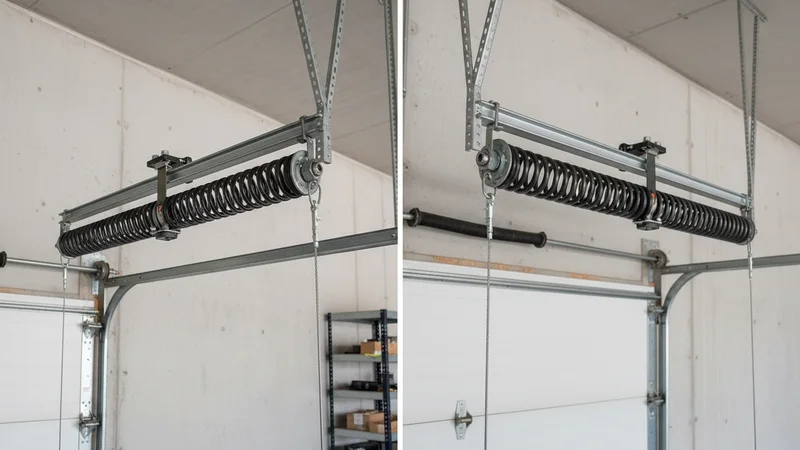
Double springs are better for most garage doors. A dual spring setup costs only $60-120 more but lasts 50% longer (10-12 years vs 7-9 years), provides crucial safety backup if one spring breaks, and reduces strain on your opener. Single springs work adequately for lighter doors under 200 lbs but offer no failsafe protection.
What Are Single and Double Spring Setups?
Single spring setups use one large torsion spring mounted on one side of the torsion tube. Double spring setups use two smaller springs, one on each side of the center bracket. Double springs provide safety redundancy and typically last 50% longer than single springs.
Most homeowners don't realize they have a choice when it comes to garage door springs. Builders typically install single springs to cut costs, but is that the best setup for your door? After replacing thousands of springs across Toronto and the GTA, we've seen firsthand how this decision impacts safety, longevity, and overall cost of ownership.
Understanding Torsion Spring Systems
Before comparing configurations, it's important to understand how torsion springs work. Torsion springs are mounted on a metal shaft (torsion tube) above the garage door opening. When wound, they store rotational energy that helps lift the door's weight. The springs connect to cable drums at each end, and as the door opens, the springs unwind to provide lifting force.
How Spring Tension Is Calculated
Professional technicians calculate spring requirements based on door weight, height, and track radius. For a 200-pound door, you need springs that provide 200 inch-pounds of torque per turn. This can be achieved with one large spring or two smaller springs working together. The math determines the spring wire diameter, inside diameter, and length needed.
Wire Gauge and Lifespan
Spring wire gauge (thickness) directly impacts cycle life. Common wire sizes include:
- .225" wire: Standard residential grade, 10,000-15,000 cycles
- .234" wire: Enhanced durability, 15,000-20,000 cycles
- .250" wire: Commercial grade, 25,000+ cycles
- .262" wire: High-cycle commercial, 50,000+ cycles
In double spring setups, two thinner springs can achieve the same lifting capacity as one thick spring while distributing stress more evenly across the system.
Single vs Double Springs: Side-by-Side
Single Spring Setup
Advantages
- Lower initial cost ($160-220)
- Simpler installation
- Adequate for lightweight doors
- Less hardware required
Disadvantages
- No backup if spring breaks
- Shorter lifespan (7-9 years)
- Uneven tension distribution
- More opener strain
- Door may drop if spring fails
Double Spring Setup
Advantages
- Safety backup if one breaks
- Longer lifespan (10-12 years)
- Even weight distribution
- Smoother door operation
- Less opener wear
- Better for heavier doors
Disadvantages
- Higher initial cost ($280-400)
- Requires more hardware
Complete Comparison Chart
| Feature | Single Spring | Double Springs |
|---|---|---|
| Installation Cost | $160-220 Lower | $280-400 |
| Average Lifespan | 7-9 years | 10-12 years 50% Longer |
| Cycle Rating | 10,000-15,000 cycles | 20,000-25,000 cycles Winner |
| Safety Backup | None | Second spring holds door Safer |
| Weight Capacity | Up to 250 lbs | 400+ lbs Winner |
| Door Balance | Slight side pull | Perfectly centered Winner |
| Opener Strain | Higher | Lower Winner |
| Repair Convenience | Door unusable until fixed | Manual use possible Winner |
| 10-Year Cost | ~$400-500 (2 replacements) | ~$280-400 (1 replacement) Winner |
What Happens When a Spring Breaks?
Single Spring Failure
When a single spring breaks, there's nothing to counterbalance the door's weight (150-400 lbs). The door may drop suddenly, potentially damaging the door, your car, or causing injury. The door becomes completely unusable until repaired—often requiring emergency service.
Double Spring Failure
When one spring breaks in a dual setup, the second spring can still hold the door safely in position. You can manually operate the door (carefully) until repairs are scheduled. This allows you to get your car out and arrange service at your convenience—not as an emergency.
Lifespan Comparison
Expected Spring Lifespan (Average Toronto Usage)
Based on 4 cycles/day average (typical residential use)
Cost Comparison
Single Spring
$160-220
Initial installation
Double Springs
$280-400
Our recommended option
Single to Double Upgrade
$280-400
Full conversion
The Real Math: A single spring costs ~$200 and lasts 8 years. Double springs cost ~$340 and last 11 years. Over 20 years, you'd pay ~$500 for singles (2.5 replacements) vs ~$680 for doubles (2 replacements)—but double springs also protect your car and family from sudden door drops.
Our Professional Recommendation
For any door over 150 lbs (most standard doors), double springs are the smarter choice. The extra $60-120 upfront saves money long-term and—more importantly—provides critical safety backup for your family.
Get Spring AssessmentWhen Single Springs Make Sense
Single springs aren't always wrong. They're appropriate for:
- Lightweight doors under 150 lbs - Small single-car doors made of aluminum
- Low-use applications - Detached garages used less than 2x/day
- Budget constraints - When $200 savings matters more than longevity
- Rental properties - Where minimal investment is preferred
For most Toronto homes with standard 2-car doors (200-300 lbs), double springs are the better investment.
Cold Weather Impact in Toronto
Toronto's extreme temperature swings (-25°C to +35°C) create unique stress on garage door springs that homeowners in milder climates don't experience. Double springs distribute this stress, reducing the failure risk by approximately 40% during extreme cold.
Seasonal Maintenance Recommendations
For Toronto homes, we recommend inspecting springs twice per year—once in late fall before winter arrives and once in early spring after the coldest months. See our complete maintenance guide for detailed inspection steps. Look for visible rust, gaps between coils, or any signs of stretching. Lubricating springs before winter helps prevent moisture from causing corrosion during freeze-thaw cycles.
How to Identify Your Current Setup
Not sure whether you have single or double springs? Here's how to check:
Single Spring Indicators
- One large spring mounted on the left side of the torsion tube (when viewed from inside)
- The right side of the tube appears bare except for the cable drum
- The spring is typically 30-36 inches long and fairly thick (about 2" diameter)
- Only one winding cone visible (the red/black brackets at spring ends)
Double Spring Indicators
- Two springs, one on each side of the center bearing plate
- Each spring is shorter (18-24 inches) and thinner than a single spring
- Two sets of winding cones visible (one pair for each spring)
- The center bracket sits between the two springs
Safety Note: Never touch the springs or winding cones. Torsion springs are under extreme tension (enough to lift your door's full weight) and can cause severe injury if mishandled.
Frequently Asked Questions
Spring Replacement Pricing
| Service | Price Range (+ tax) | Includes |
|---|---|---|
| Single Spring (1-spring setup) | $160 - $220 | Spring, labor, balance test |
| Double Springs (2-spring setup) | $280 - $400 | Both springs, balancing, safety check |
| Upgrade to Double Springs | $350 - $450 | Conversion, new springs, mounting |
| High-Cycle Springs | $350 - $500 | 25,000+ cycle springs, longer life |
1-Year Warranty
IDEA Certified
5-Star Rated
Free Service Call