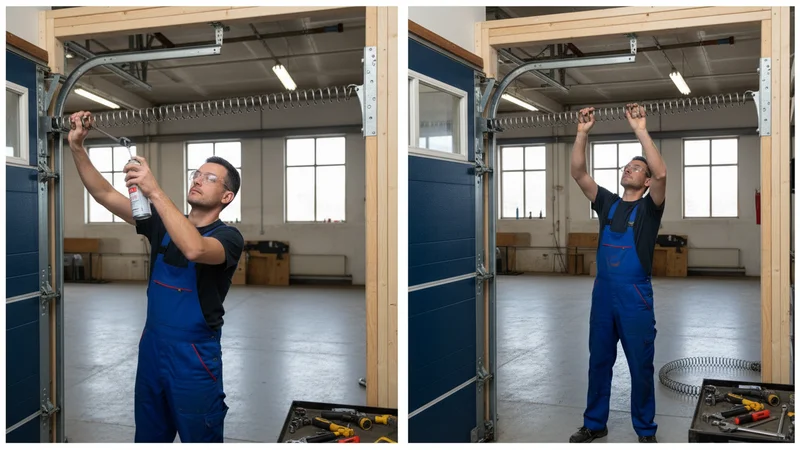
A broken spring always requires replacement - it cannot be repaired. However, springs with minor issues (imbalance, squeaking, surface rust) can sometimes be adjusted or treated. Repair/adjustment costs $80-$150; replacement costs $160-$400. If your spring is over 5-7 years old and showing any signs of wear, replacement is usually the smarter investment.
What Is Spring Repair vs Replacement?
Garage door spring repair involves minor adjustments like lubrication, tension adjustment, or fixing mounting hardware. Spring replacement means removing the old spring entirely and installing a new one. The decision depends on the spring's condition, age, and type of damage.
When your garage door isn't working right, you're probably wondering if you can save money with a repair versus spending more on replacement. Here's the honest answer: it depends on the specific problem. Some issues can be fixed cheaply; others require new springs no matter what. This guide helps you understand which situation you're in.
When Repair/Adjustment Is Possible
Not every spring problem requires a complete replacement. Start with our door balance test to check your springs. Here are situations where repair or adjustment may be sufficient:
Door Hard to Lift, Spring Intact
RepairIf your spring looks fine but the door feels heavy, the spring may just need re-tensioning. This happens naturally over time as springs settle or after temperature changes.
Door Rises Too Fast or Won't Stay Down
RepairOver-tensioned springs make the door shoot up or refuse to stay closed. A technician can reduce the tension to proper levels in about 30 minutes.
Squeaking or Minor Noise
RepairSqueaky springs usually just need lubrication. This is often part of a maintenance visit and can extend spring life significantly.
Light Surface Rust
RepairMinor surface rust can be cleaned and treated with lubricant to prevent further corrosion. This works best on newer springs with only light oxidation.
When Replacement Is Necessary
Some problems simply can't be fixed. In these cases, replacement is your only option:
Spring Is Broken (Snapped)
ReplaceOnce a spring breaks, it's done. There's no way to weld or repair a snapped spring - the metal is fatigued and structurally compromised. Replacement is the only option.
Visible Gaps in Coils
ReplaceGaps between coils mean the spring has already partially failed. It could snap at any moment. Replace immediately to avoid being stranded.
Deep Rust or Pitting
ReplaceHeavy rust that's eaten into the metal weakens the spring beyond repair. Unlike surface rust, pitting indicates the steel has lost structural integrity.
Spring Over 7-10 Years Old
ReplaceEven if it looks okay, a spring near its cycle limit has invisible metal fatigue. Adjusting it just delays inevitable failure - often by only weeks or months.
Spring Types and Repair Differences
The type of spring you have affects both repair options and costs. Understanding your spring type helps you make better decisions.
Torsion Springs (Above the Door)
Torsion springs mount horizontally above the garage door on a metal shaft. They're the most common type in modern installations and generally last longer than extension springs.
- Repair potential: Tension can be adjusted, lubrication helps, but replacement is more straightforward
- Replacement cost: $160-$280 for single spring, $280-$400 for both
- DIY difficulty: Extremely dangerous - high tension requires professional tools and training
- Lifespan: 7-10 years for standard, 15-20+ years for high-cycle
Extension Springs (Along the Tracks)
Extension springs run parallel to the horizontal tracks on each side of the door. They stretch to lift the door and are found in older installations or budget systems.
- Repair potential: Limited - usually replacement is needed for any significant issue
- Replacement cost: $100-$180 for the pair (always replace both)
- DIY difficulty: Still dangerous, but marginally less than torsion springs
- Lifespan: 5-7 years typically, shorter than torsion
TorqueMaster Springs (Wayne Dalton)
TorqueMaster springs are enclosed in a tube above the door. They're proprietary to Wayne Dalton and have unique repair considerations.
- Repair potential: Very limited - the enclosed design prevents most adjustments
- Replacement cost: $300-$400, or $400-$500 to convert to standard torsion
- DIY difficulty: Most dangerous - hidden tension, specialized tools required
- Lifespan: 5-7 years (shorter than standard torsion due to design issues)
Upgrade Opportunity
When replacing springs, consider upgrading to high-cycle springs (25,000-50,000 cycles) for about $50-$100 more. They last 2-3 times longer than standard springs, making them excellent value for busy households.
Cost Comparison
| Service | Cost Range | When Appropriate |
|---|---|---|
| Tension Adjustment | $80 - $120 | Spring intact, door imbalanced |
| Lubrication/Maintenance | $100 - $120 | Squeaking, preventive care |
| Rust Treatment | $100 - $150 | Light surface rust only |
| Single Spring Replacement | $160 - $220 | One spring broken or worn |
| Both Springs Replacement | $280 - $400 | Both springs worn (recommended) |
| High-Cycle Spring Upgrade | $350 - $500 | Want 15-20+ year lifespan |
Why We Often Recommend Replacement
Here's the honest math: if repair costs $100 and replacement costs $200, but the spring is 6 years old, you'll likely need replacement within a year anyway. You'd spend $300 total ($100 repair + $200 replacement) versus just $200 now. Plus, you avoid the hassle of a second service call and potential emergency situation.
How to Decide: Repair or Replace?
Is the spring broken or has visible gaps?
If yes → Replace. No repair is possible.
Is the spring over 7 years old?
If yes → Replace. It's near end-of-life anyway.
Is there deep rust or pitting?
If yes → Replace. Structural damage can't be fixed.
Spring intact but door imbalanced?
If spring is under 5 years old → Repair (adjustment).
Replace One Spring or Both?
If one spring broke but the other looks fine, should you replace both? Yes, almost always. Here's why:
- Both springs experience the same cycles - if one failed, the other is close behind
- Mismatched springs (new + old) cause uneven wear and poor balance
- You save on the service call fee by doing both at once
- New springs are properly matched and balanced together
The only exception: if one spring was replaced recently (within 1-2 years) and failed due to defect or damage, not normal wear.
DIY Repair Risks
You may find YouTube videos suggesting garage door spring repair is a DIY job. Here's why professional technicians strongly advise against it:
Safety Warning
Garage door springs store enormous energy - enough to lift 200-400 pounds. A standard torsion spring can cause severe injuries if it slips. Emergency rooms treat hundreds of spring-related injuries annually, including broken bones, deep lacerations, and head trauma. The $80-$150 saved on a service call is not worth the risk.
What "Repair" Requires
Even simple tension adjustment requires:
- Proper winding bars: Using screwdrivers or other substitutes causes most injuries
- Spring calculation knowledge: Wrong tension damages the door and opener
- Safety protocols: Securing the door, releasing tension correctly, verifying balance
- Physical strength: Winding springs requires significant controlled force
Getting Value from Your Service Call
Whether you're getting repair or replacement, here's how to maximize the value of your technician visit:
Before the Service Call
- Note the symptoms: When did the problem start? Does it happen every time?
- Know your door's age: Check any documentation for installation date
- Clear the garage: Give the technician easy access
- Secure pets: Keep dogs and cats away from the work area
During the Visit
- Ask about spring condition: If getting other repairs, have them inspect springs
- Request a full balance test: This reveals problems before they cause failure
- Get maintenance tips: Ask what you can safely do to extend spring life
- Ask about upgrades: High-cycle springs may cost little more
Not Sure What You Need?
We'll diagnose your spring and give you honest options. No pressure, just expertise.
Call 437-265-9995