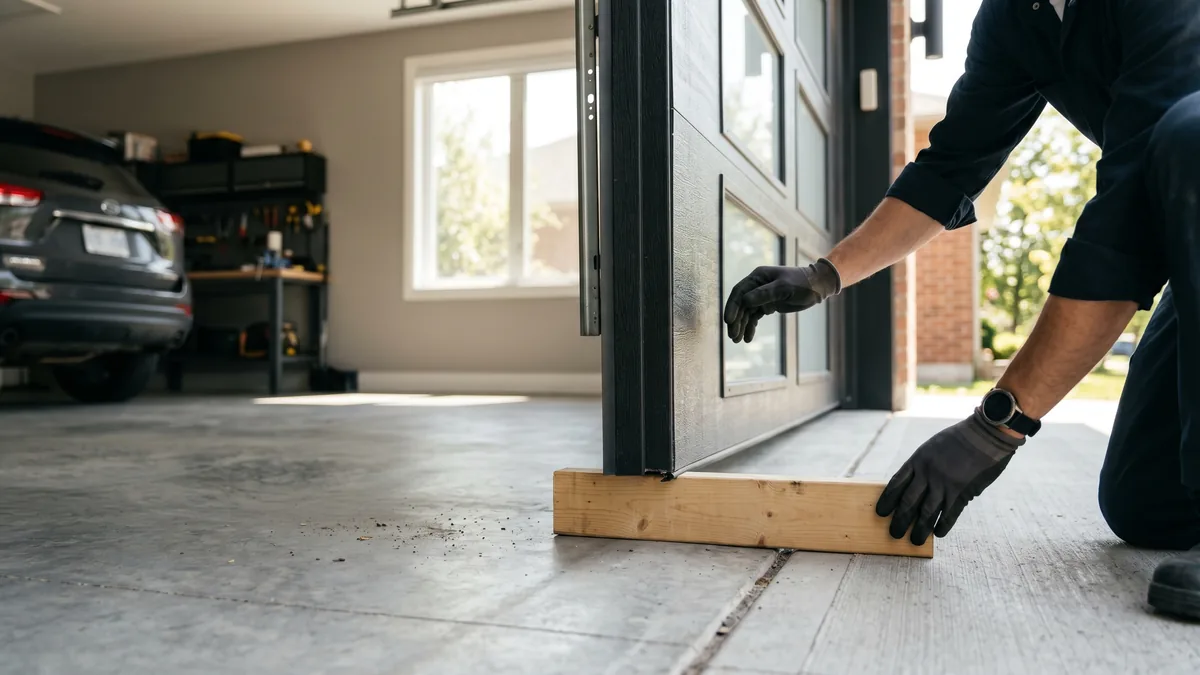
To test your garage door auto-reverse, run the two safety tests required under UL 325 once a month. 1) Mechanical reversal test: lay a flat 2x4 board on the floor in the door’s path and press close — the door must stop and reverse immediately when it touches the board. 2) Photo-eye test: press close, then wave a broom or box through the sensor beam near the floor — the door must reverse at once. If the door fails either test, stop using it, disconnect the opener, and adjust the force/sensors or call a technician.
What Is Garage Door Auto-Reverse?
Auto-reverse is the federally mandated safety system that forces a closing garage door to stop and travel back up before it can crush a person, pet, or object. It works through two independent mechanisms: a mechanical (force-sensing) reversal that reacts when the door physically hits an obstruction, and a photo-eye (infrared beam) reversal that reacts when something breaks the invisible beam near the floor. Both have been required on every residential opener sold in North America since 1993.
A garage door is the largest and heaviest moving object in most homes — a typical double door weighs 150 to 250 pounds. The auto-reverse system is the only thing standing between that weight and a child or pet underneath it. Yet most homeowners have never tested it. Across Toronto and the GTA, we still find doors with dead photo eyes or force settings so high the door won’t reverse on contact. This 10-minute monthly routine could prevent a tragedy.
Why Auto-Reverse Matters: UL 325, Child & Pet Safety
Before 1993, garage doors caused dozens of child entrapment deaths in North America. In response, the U.S. Consumer Product Safety Commission (CPSC) and the safety-certification body UL made UL 325 the law of the land: every residential garage door opener manufactured on or after January 1, 1993 must include two separate entrapment-protection systems. Canada follows the same standard for openers sold here.
Those two systems are deliberately redundant, because each covers a different failure scenario:
- The mechanical (inherent) reversal protects against a door that is already touching an obstruction — for example, a car bumper, a stored bike, or a person who is struck by the bottom of the panel.
- The photo-eye reversal protects against a child or pet that runs into the doorway before contact, stopping the door while there is still clearance underneath.
Both can degrade silently. Springs lose tension and the opener compensates with more force, which can defeat the mechanical reversal. Sensor lenses get dusty, brackets get bumped out of alignment, and wires corrode — any of which can leave a photo eye that looks fine but no longer reverses the door. That is exactly why testing matters: a system that worked last year may not work today, and you will not know until you check.
Step-by-Step: The Mechanical (2x4) Reversal Test
This test confirms the opener’s force-sensing system will reverse the door the instant it meets resistance. You will need one piece of standard dimensional lumber — a 2x4 board works because, laid flat, it is roughly 1.5 inches tall, the height UL specifies for this test.
- Clear the doorway. Make sure no person, pet, or vehicle is in or near the door’s path.
- Place a 2x4 flat on the floor directly under the center of the door, lying on its wide side (so it is about 1.5 inches tall). If you don’t have a 2x4, a roll of paper towels or a similar solid object of that height works.
- Press the close button on your wall control or remote and watch the door.
- Observe the reaction. The moment the bottom of the door touches the board, it should stop and reverse direction back to fully open — with no noticeable pause or downward push.
- Result – PASS: the door reverses immediately on contact. Your mechanical safety is working.
- Result – FAIL: the door pushes into the board, stalls on it, or keeps grinding without reversing. This is dangerous — the close force is set too high or the force-sensing circuit has failed. Stop and follow the “What to Do If It Fails” section below.
Step-by-Step: The Photo-Eye (Beam) Test
The photo eyes are the two small sensors mounted on the tracks, roughly 4 to 6 inches above the floor on each side. One transmits an infrared beam, the other receives it. Breaking that beam while the door is closing must reverse the door — without anything touching the panel.
- Check the indicator lights first. Both sensors have a small LED. When aligned and clean, both should glow solid (commonly one green/amber on the sending eye and one green/red steady on the receiving eye). A blinking or dark light means the beam is broken or misaligned before you even start.
- Press the close button. As the door begins to descend, wave a broom handle, cardboard box, or your foot through the beam path near the floor — keep your hands and body well clear of the door itself.
- Observe the reaction. The instant the beam is broken, the door should stop and reverse back to fully open, often accompanied by the opener lights flashing.
- Result – PASS: the door reverses the moment the beam is interrupted. Your photo-eye safety is working.
- Result – FAIL: the door keeps closing through the broken beam, or it won’t close at all even when nothing is in the way. Both point to a sensor problem — misalignment, dirty lenses, sun glare, or wiring.
| Test | What It Protects Against | Trigger | Pass Result |
|---|---|---|---|
| Mechanical (2x4) reversal | Door already in contact with an object or person | Door bottom hits the board | Reverses on contact |
| Photo-eye beam reversal | Child/pet entering the doorway before contact | Object breaks the infrared beam | Reverses with clearance |
| Balance check (bonus) | Worn springs that overload the opener | Door lifted by hand, released | Door stays in place |
What to Do If Your Auto-Reverse Test Fails
A failed test means the door is unsafe to use normally until it’s fixed. Match the failure to the cause:
If the mechanical (2x4) test fails
- Reduce the close (down) force. Most openers have a force dial or button on the motor head labeled “Close Force” or “Down Force.” Turn it down in small increments and retest until the door reverses cleanly on the board.
- Check the down travel limit. If the limit is set so the door slams hard into the floor, the opener may be applying excess force. See our guide on how to adjust garage door travel limits for the exact screw locations and turn amounts.
- Inspect the springs. A door that has become heavy or unbalanced forces the opener to work harder, masking the reversal. Never compensate for a weak spring by cranking up the force.
If the photo-eye test fails
- Clean both lenses with a soft, dry cloth — dust and cobwebs are the most common cause.
- Realign the sensors. Loosen the wing nuts, point both eyes directly at each other, and tighten when both indicator lights are solid. They must sit at the same height, 6 inches or less above the floor.
- Rule out sun glare and loose wiring. Direct afternoon sun can wash out the receiver; a sun shield or slight angle fixes it. If a light blinks no matter what, the wiring or the sensor itself may be faulty — see our walkthrough on a garage door sensor blinking red.
Sensor problems that don’t resolve with cleaning and realignment usually need a part. At Royal Garage Doors, safety sensor repair or replacement runs $120–$180 + tax, including realignment and a full reversal retest. You can review all current rates on our pricing page.
When to Call a Professional
Cleaning a lens or nudging a force dial is well within DIY territory. Call a technician when:
- The door still fails the 2x4 test after you’ve lowered the close force — the force board or logic board may be defective.
- A photo eye blinks or stays dark after cleaning and realignment, suggesting a wiring or sensor fault.
- The springs are worn, the door is unbalanced, or it’s extremely heavy to lift by hand — spring work is high-tension and not a DIY job.
- Your opener was made before 1993 or has no photo eyes at all. These units don’t meet modern safety standards and should be replaced. Our garage door opener repair team can assess and upgrade them.
- You simply want a professional to verify the whole system — we test auto-reverse on every visit.
Royal Garage Doors serves Mississauga and the entire GTA with same-day service. If your door won’t reverse and you need help fast, our garage door repair near me page connects you to the nearest available technician.
Door Won’t Reverse? Don’t Risk It.
If your garage door fails the auto-reverse test and adjustments don’t fix it, you may have a faulty sensor, force board, or worn spring. Royal Garage Doors provides FREE service calls with any repair across Mississauga & the GTA — same-day available.
Call 437-265-9995Frequently Asked Questions
External safety references: U.S. Consumer Product Safety Commission (CPSC) and UL Standard 325 for garage door opener entrapment protection.