Torsion springs are better for most garage doors. They last 15,000-20,000 cycles (vs 10,000 for extension), are safer when they break, provide smoother operation, and better balance heavy doors. Extension springs cost less upfront ($150-$250 vs $200-$350) but need replacement sooner and require safety cables.
Choosing between torsion and extension springs is one of the most important decisions for your garage door system. The right choice affects safety, longevity, noise levels, and long-term costs. This comprehensive guide breaks down everything you need to know to make the best decision for your home.
How They Work
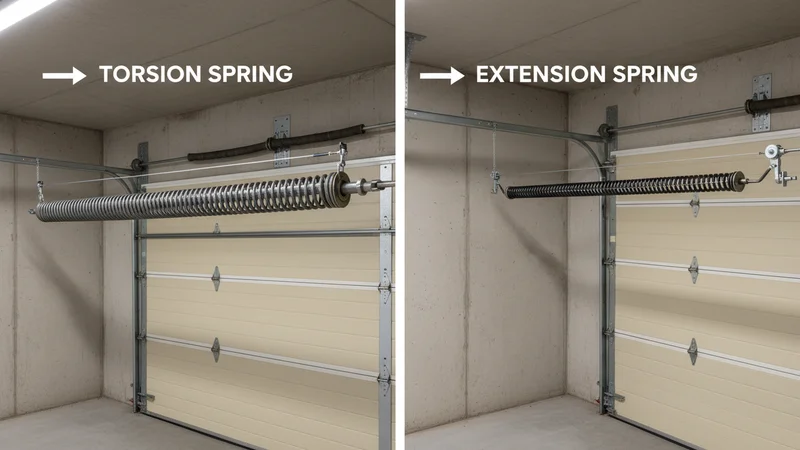
Torsion springs mount horizontally above the door and use twisting (torsion) force to lift it. Extension springs mount on both sides of the door tracks and stretch (extend) to create lifting force. Both store energy when the door closes and release it to help lift the door open.
Side-by-Side Comparison
| Feature | Torsion Springs | Extension Springs |
|---|---|---|
| Location | Above door (horizontal) | Both sides of tracks |
| Lifespan | 15,000-20,000 cycles | 10,000 cycles |
| Safety | Very safe (contained) | Requires safety cables |
| Balance | Excellent balance | Good (can be uneven) |
| Noise | Quieter operation | More noise/vibration |
| Initial Cost | $200-$350 installed | $150-$250 installed |
| Long-term Cost | Better value | More frequent replacement |
| Best For | Most residential doors | Low headroom, budget |
The Verdict: Torsion Springs Win
For most homeowners, torsion springs are the better choice. They're safer, last longer, operate more smoothly, and provide better value over time despite the higher upfront cost.
Torsion Springs Explained
Torsion Springs Recommended
- How they work: Mounted on a shaft above the door, they twist to store energy
- Types: Standard, high-cycle, EZ-SET, steel rolling door
- Cycle life: 15,000-20,000+ cycles
- Typical lifespan: 10-15 years
- Best for: Heavy doors, frequent use, safety-conscious homeowners
Extension Springs Budget Option
- How they work: Mounted along tracks, they stretch to store energy
- Types: Open-looped, double-looped, clipped-end
- Cycle life: ~10,000 cycles
- Typical lifespan: 5-7 years
- Best for: Low headroom, light doors, budget installs
Advantages of Torsion Springs
- Safer failure mode: When torsion springs break, they stay wound around the shaft - no flying metal
- Better balance: Single or dual springs above the door provide even lifting force
- Smoother operation: Consistent torque throughout the lifting cycle
- Longer lifespan: 50-100% more cycles than extension springs
- Less wear on opener: Better-balanced doors put less strain on the motor
- Quieter: Less vibration and noise during operation
Extension Springs Explained
Advantages of Extension Springs
- Lower cost: $50-$100 cheaper for parts and installation
- Low headroom compatible: Work in garages with limited space above the door
- Simpler design: Easier to understand and DIY-friendly (with caution)
- Widely available: Parts found at most hardware stores
Extension Spring Safety Warning
Extension springs MUST have safety cables running through them. Without safety cables, a broken spring can fly across your garage at high speed, causing serious injury or property damage. If your extension springs don't have safety cables, install them immediately or call a professional.
Which Type Do You Have?
Not sure what's on your garage door? See our complete parts diagram to identify all components. Here's how to tell:
You Have Torsion Springs If:
- There's a metal tube/shaft running horizontally above the closed door
- Springs are coiled around this shaft (look like big metal coils)
- Springs are located in the center or slightly off-center above the door
- You see winding cones at the ends of the springs
You Have Extension Springs If:
- Springs run parallel to the horizontal door tracks (on both sides)
- Springs stretch when the door is closed, relax when open
- You can see pulleys and cables at the corners of the door
- Springs are mounted at an angle along the ceiling
How Spring Type Affects Your Opener
Your spring type directly impacts how hard your garage door opener has to work. A properly balanced door with the right springs should feel almost weightless when lifted manually, requiring only 8 to 10 pounds of force.
Torsion Springs and Opener Longevity
Torsion springs provide more consistent lifting force throughout the door's travel. This means your opener motor experiences steady, predictable resistance rather than variable loads. The result is less motor strain, fewer gear and drive failures, and longer opener lifespan.
Extension Springs and Motor Strain
Extension springs can create uneven lifting force between the left and right sides of the door, especially as they age at different rates. This asymmetric load makes the opener work harder to keep the door level during travel.
Toronto Climate Effects on Springs
Toronto's extreme temperature swings between winter and summer significantly affect garage door spring performance.
Cold Weather Impact
When temperatures drop below minus 10 degrees Celsius, steel springs become more brittle and prone to breakage. Both spring types are affected, but the consequences differ. A torsion spring that breaks in cold weather stays wound around the shaft, posing minimal immediate danger.
We see approximately 60 percent of spring failures occur between November and March in the Toronto area. The combination of cold-induced brittleness and increased door cycling creates the perfect conditions for spring failure.
Humidity and Corrosion
Toronto's humid summers and salt-laden air during winter accelerate spring corrosion. For Toronto homeowners, we recommend galvanized springs or applying protective coating to extend spring life in our corrosive climate.
Maintenance Differences
Both spring types require regular maintenance, but the procedures and frequency differ.
Torsion Spring Maintenance
Torsion springs should be lubricated every 6 months with silicone-based lubricant. Apply lubricant along the entire length of the spring coils. Inspect the spring for gaps between coils, rust, or deformation. Never attempt to adjust spring tension yourself.
Extension Spring Maintenance
Extension springs require more maintenance points because the system includes springs, pulleys, cables, and attachment hardware. Lubricate springs every 6 months. Inspect all pulleys for smooth rotation. Check cables for fraying and replace immediately if damaged.
Converting Extension to Torsion Springs
Many homeowners upgrade from extension to torsion springs for improved safety and longevity.
Conversion Requirements:
- Headroom: Need 12+ inches of space above the door
- Header support: Wall above door must support torsion hardware
- Parts needed: Torsion tube, springs, drums, brackets, cables
- Professional installation: Strongly recommended (dangerous DIY)
Conversion Cost:
Expect to pay $300-$500 for a professional extension-to-torsion conversion, including parts and labor.
Pro Tip: Best Time to Convert
The best time to convert from extension to torsion springs is when your current springs need replacement anyway. You'll save on labor costs since the door is already being serviced.
Cost Comparison
| Service | Torsion Springs | Extension Springs |
|---|---|---|
| Single spring replacement | $160-$240 + tax | $100-$150 + tax |
| Double spring replacement | $280-$400 + tax | $150-$250 + tax |
| High-cycle upgrade | +$50-$100 | N/A |
| 10-year cost (avg use) | $280-$400 | $300-$500 (2 replacements) |
Bottom line: While torsion springs cost more upfront, they often cost less over 10+ years because you replace them less frequently.