Quick Answer
Torsion springs are better for most garage doors. They last 15,000-20,000 cycles (vs 10,000 for extension), are safer when they break, provide smoother operation, and better balance heavy doors. Extension-spring sets are discontinued. Existing systems can be assessed for conversion to standard torsion.
Choosing between torsion and extension springs is one of the most important decisions for your garage door system. The right choice affects safety, longevity, noise levels, and long-term costs. This comprehensive guide breaks down everything you need to know to make the best decision for your home.
How They Work
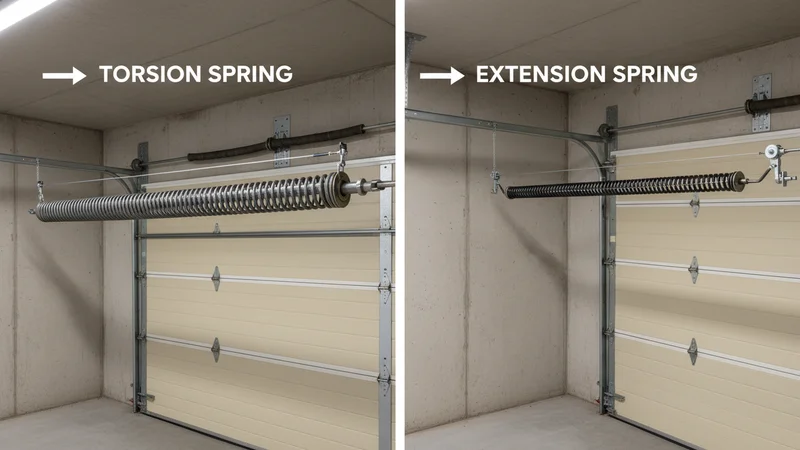
Torsion springs mount horizontally above the door and use twisting (torsion) force to lift it. Extension springs mount on both sides of the door tracks and stretch (extend) to create lifting force. Both store energy when the door closes and release it to help lift the door open.
Side-by-Side Comparison
| Single spring replacement |
$280 + tax | Discontinued |
| Double spring replacement |
$320-$460 + tax | Discontinued |
| High-cycle upgrade |
Discontinued | Discontinued |
| 10-year cost (avg use) |
$320-$460 |
$300-$500 (2 replacements) |
Bottom line: While torsion springs cost more upfront, they often cost less over 10+ years because you replace them less frequently.
Frequently Asked Questions
What is the difference between torsion and extension springs?
Torsion springs mount above the door and twist to lift it, providing smooth, balanced operation. Extension springs mount on both sides of the door and stretch to create lifting force. Torsion springs are safer, last longer, and provide better balance.
Which spring type lasts longer?
Torsion springs last significantly longer - typically 15,000-20,000 cycles compared to 10,000 cycles for extension springs. With average use, torsion springs last 10-15 years while extension springs last 5-7 years.
Can I convert from extension to torsion springs?
Yes, most garage doors can be converted from extension to torsion springs. The conversion requires an on-site assessment because no confirmed generic conversion price was supplied. This upgrade improves safety, lifespan, and door operation. You need at least 12 inches of headroom above the door.
Are torsion springs safer than extension springs?
Yes, torsion springs are significantly safer. They're contained on a shaft above the door, so if they break, they stay in place. Extension springs can fly across the garage when they break unless safety cables are installed. Always ensure extension springs have safety cables.
Do torsion springs work better in cold weather?
Both spring types are affected by cold, but torsion springs handle Toronto winters better. They have fewer moving parts that can freeze or gum up, and if they break in cold weather, they stay safely contained on the shaft.
How do I maintain torsion springs?
Lubricate torsion springs with silicone-based lubricant every 6 months. Visually inspect for rust, gaps between coils, or deformation. Never attempt to adjust spring tension yourself as this requires professional tools and training. Have a technician inspect annually.
Why do my extension springs keep breaking?
Extension springs have shorter lifespans than torsion springs, about 10,000 cycles versus 15,000-20,000. If your springs break frequently, you may have a heavy door that extension springs struggle with, or your springs may be undersized. Consider converting to torsion springs for better reliability.