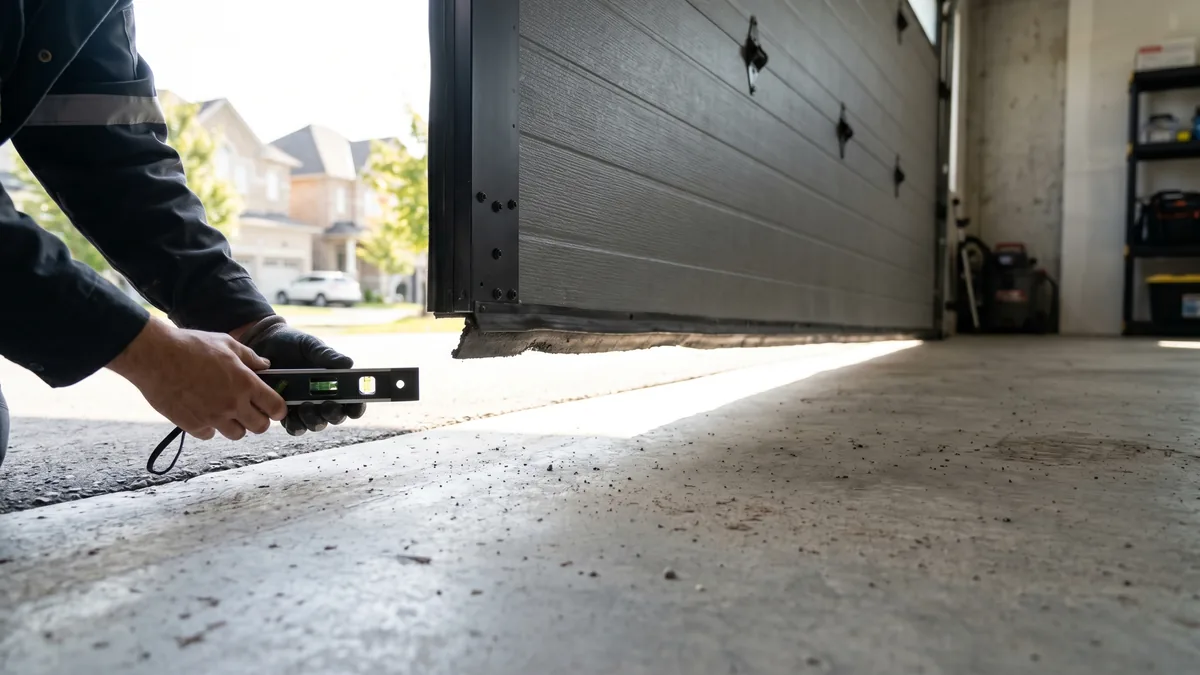
An uneven gap under a garage door means the door is hanging crooked or the floor is not level. The most common causes are a frayed or broken lift cable on the low side, a bent vertical track, a worn bottom roller or bottom bracket, or a settled concrete slab. If one side suddenly drops, stop using the door, disconnect the opener with the red release cord, and have the cables and springs inspected before operating it again.
What Does an "Uneven Gap" Actually Mean?
An uneven gap is a daylight space along the bottom of a closed garage door that is wider on one end than the other, forming a wedge or triangle of light. It is different from a uniform gap (a worn weather seal) and signals that either the door panel is no longer hanging square in the opening, or the concrete floor underneath has sunk or heaved out of level.
A crooked garage door is one of the clearest warning signs your system needs attention. In my 15+ years servicing doors across Toronto and the GTA, an uneven bottom gap almost always traces back to a cable, roller, or track problem — and occasionally to a concrete slab that our freeze-thaw winters have pushed out of level. This guide walks through every cause, how to tell them apart, and what is safe to fix yourself.
Why Is the Gap Under My Garage Door Uneven?
There are two broad categories: the door is crooked, or the floor is crooked. Telling them apart takes 30 seconds. Close the door, then look at the bottom edge of the door against the floor line:
- The door's bottom edge is tilted (not parallel to the floor): The problem is mechanical — a cable, roller, spring, or track issue is letting one side ride lower or higher than the other.
- The door's bottom edge is straight and level, but the floor slopes away: The problem is structural — the concrete slab has settled or heaved, leaving a tapered gap even though the door is hanging perfectly square.
That single check tells you whether you are looking at a repair (door hardware) or a seal upgrade (floor). Below are the specific causes within each category, ranked by how often we see them on GTA service calls.
1. Frayed or Broken Lift Cable (Most Common)
Each garage door has a steel lift cable on the left and right that wraps around a drum at the top and connects to the bottom bracket. If one cable frays, snaps, or jumps off its drum, that side of the door loses support and drops. The result is an instantly crooked door with a wedge-shaped gap on the failed side. You may also notice the cable hanging loose, kinked, or pooled at the bottom of the track. This is the number-one cause of a sudden uneven gap and it should never be ignored — a door under spring tension with one failed cable can come down hard. Learn the warning signs in our guide to a garage door cable that came off.
2. Worn Bottom Roller or Bent Track
The bottom rollers carry the weight of the door at the floor line. A flattened, seized, or broken roller lets one corner sag, and a vertical track that has been bumped by a vehicle or knocked out of plumb does the same thing. If the door scrapes, jerks, or makes a metallic pop as it nears the floor on one side, suspect a roller or track issue. Replacing worn rollers is a straightforward maintenance task — see our garage door roller replacement service for details.
3. A Spring That Is Out of Balance
On a two-spring (double torsion) system, if one spring weakens or breaks while the other stays strong, the door can lift unevenly and settle crooked. A door that feels heavy, slams down, or will not stay halfway open usually has a spring problem. Never adjust or replace torsion springs yourself — they store enormous energy. Our broken garage door spring page explains the safe repair path.
4. Damaged or Loose Bottom Bracket
The bottom bracket anchors the cable to the door at each lower corner. If it pulls loose, bends, or its fasteners back out, that corner sags. Bottom brackets are under the same tension as the cable, so they are a pro-only repair.
5. Settled or Heaved Concrete Slab
In older Toronto, Mississauga, and Brampton homes especially, repeated freeze-thaw cycles and soil movement can lift or sink one corner of the garage slab. The door is fine — it is the floor that is no longer level. According to the Natural Resources Canada guidance on home air sealing, gaps like this are a meaningful source of heat loss in winter, so even a "cosmetic" tapered gap is worth sealing.
How to Diagnose the Cause Yourself (Safely)
Work through these steps in order. Stop immediately if you find a broken cable or spring — those are not DIY fixes.
- Close the door and measure the gap at each end. Note which side is larger and by how much. A 1/4-inch difference is minor; an inch or more is significant.
- Check whether the door edge or the floor is tilted using the level-line test described above. A 4-foot spirit level on the floor confirms a sloped slab.
- Inspect both lift cables from a safe distance. Look for fraying, slack, kinks, or a cable off its drum. Do not touch a loose cable.
- Look at the rollers and tracks on the low side for damage, debris, or a visibly bent rail.
- Do a balance test only if cables and springs look intact: pull the red release cord, lift the door halfway by hand, and let go. A balanced door holds position. If it drops or rises, the springs are the issue.
Causes at a Glance: Symptoms, DIY Risk & Cost
This table helps you match what you are seeing to the likely cause and whether it is safe to handle yourself. GTA repair prices below come from our live pricing page.
| Cause | Telltale Symptom | DIY? | Typical GTA Cost |
|---|---|---|---|
| Broken / frayed cable | One side drops suddenly; cable loose or off drum | No — call a pro | $180–$260 (+$260 with bottom brackets) |
| Worn bottom roller | Scraping or popping near the floor; corner sags | Light DIY / pro | Often part of a tune-up $120 |
| Bent vertical track | Door binds or rubs on one side | Pro recommended | Varies by damage |
| Unbalanced / broken spring | Door heavy, slams, won't stay open | No — pro only | Single spring $280; double $320–$460 |
| Loose / bent bottom bracket | One lower corner sags; bracket visibly moved | No — under tension | $260 (cables + bottom brackets) |
| Settled concrete floor | Door edge level, floor slopes; tapered gap | Yes — seal upgrade | Seal $120–$260 |
DIY Fixes for an Uneven Gap
Two of the causes are genuinely homeowner-friendly: a worn roller and a sloped-floor gap. The rest involve cables, springs, or brackets under tension and should go to a technician.
Fixing a Tapered Gap from a Sloped Floor
If your door hangs level but the floor slopes, the fix is a flexible bottom seal that conforms to the slab:
- Adjustable bottom seal (astragal): A U-shaped or T-style rubber seal that slides into the retainer on the door bottom and compresses to fill an uneven gap up to about 1.5 inches.
- Concrete threshold seal: A rubber strip glued to the floor itself. Because it follows the slab, it seals a tapered gap from the floor side and also blocks water and pests — ideal for GTA driveways that slope toward the door.
- Brush or vinyl side seals: If the wedge runs up one jamb, refreshing the side weatherstripping completes the seal.
For a full walkthrough of options, see our side and top seal replacement guide.
Replacing a Worn Bottom Roller
If a single bottom roller is the culprit and the door is fully closed and resting on the floor (so the bottom roller is out of the curved track), an intermediate roller swap is manageable for a confident DIYer. However, the very bottom roller sits in the bottom bracket, which is under cable tension — that one should be left to a professional. When in doubt, a tune-up covers roller inspection and replacement.
When to Call a Professional
Call a technician right away if any of the following are true. Trying to "muscle" a crooked door level can turn a $200 cable repair into a bent door or a fall hazard.
- A cable is frayed, slack, snapped, or off its drum.
- The door dropped on one side suddenly or will not close evenly.
- A torsion spring is broken, gapped, or the door fails the balance test.
- A vertical track is bent or the door is binding in the tracks.
- The bottom bracket is loose, bent, or pulling away from the panel.
Royal Garage Doors covers Toronto and the entire GTA, including Mississauga and Toronto, with same-day service. If the door is beyond economical repair — rusted panels, repeated cable failures, or a frame that has racked — ask about garage door replacement options instead. You can also reach our team any time to talk through symptoms.
Note that Ontario follows national door safety standards: every modern opener must meet the UL 325 entrapment-protection requirements, which include auto-reverse and photo-eye sensors. A door that hangs crooked can interfere with the bottom seal contact that those safety systems rely on, which is another reason not to keep operating it. You can read the official standard summary from UL Solutions.
Garage Door Hanging Crooked?
A sudden uneven gap usually means a cable or spring problem — both are safety-critical. Royal Garage Doors offers same-day diagnosis with a FREE service call on any repair across Toronto & the GTA.
Call 437-265-9995