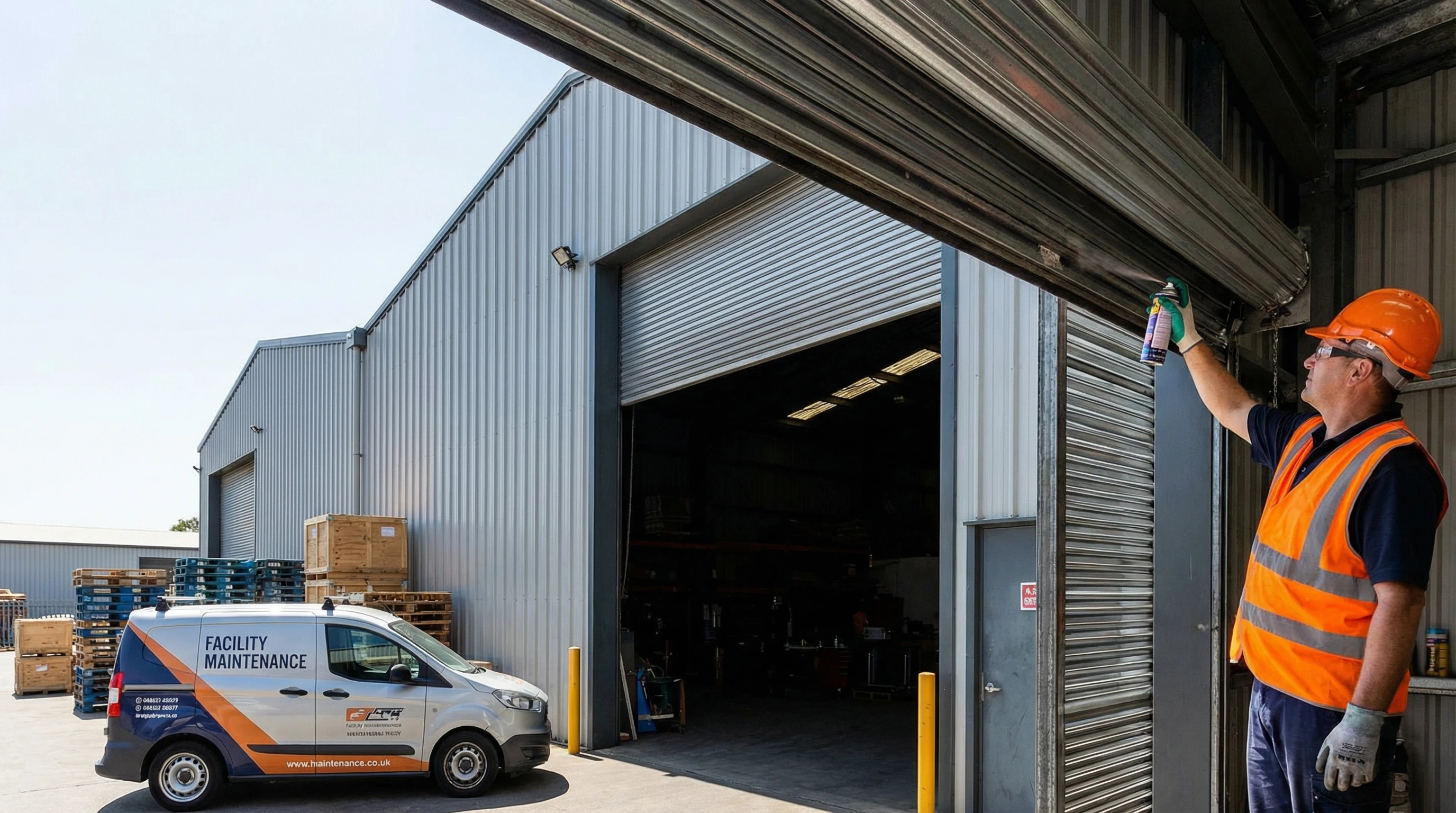
Commercial roll-up doors in Toronto should receive a professional inspection and lubrication every 3-6 months, depending on daily cycle count. High-traffic loading docks (50+ cycles/day) need quarterly service; moderate-use doors need semi-annual visits. Professional maintenance costs $200-$400 per door and prevents costly failures that can shut down operations. Ontario OHSA requires documented safety checks for all commercial doors.
What Is a Commercial Roll-Up Door?
A commercial roll-up door (also called a coiling door or rolling steel door) is an industrial-grade overhead door whose curtain coils around a barrel above the opening rather than folding into horizontal sections like a residential sectional door. They are designed for high-cycle use in warehouses, loading docks, factories, storage facilities, and retail back entrances across Toronto and the GTA.
A commercial roll-up door that fails during business hours can cost far more than the repair bill — think missed deliveries, idle workers, and security exposure. After servicing hundreds of commercial doors across the GTA, I've seen the same preventable failures over and over. This guide gives you a complete maintenance checklist and helps you understand when to call a professional.
Types of Commercial Roll-Up Doors in Toronto
Before building your maintenance routine, it's important to understand which type of commercial door you have. Each type has different service requirements and failure modes.
Rolling Steel Service Doors
The most common commercial roll-up in Toronto warehouses and industrial buildings. These use interlocking steel slats (typically 20-gauge to 22-gauge steel) that coil around a barrel drum above the opening. They are manually operated or motorized, available in insulated and non-insulated versions, and sized from 8x8 ft to 30x30 ft or larger. Standard torsion springs power the counterbalance system.
Coiling Sheet (Corrugated) Doors
Lighter-duty than service doors, coiling sheet doors use corrugated steel sheets rather than slats. Common in retail storage rooms, restaurant back-of-house, and smaller commercial applications. These are typically push-up operated without a spring counterbalance system, though motorized versions exist.
High-Speed Roll-Up Doors
High-speed fabric doors (brands include Rytec, Assa Abloy, and Hormann) open at 40-80 inches per second and are common in cold storage, food processing, and automotive facilities throughout the GTA. These use a fabric curtain on a drum and have their own specialized maintenance requirements, including fabric panel inspection and motor speed calibration.
Fire-Rated Rolling Steel Doors
Fire-rated coiling doors have UL-listed components and fusible link mechanisms that automatically close in a fire. Ontario Fire Code requires annual drop testing of all fire-rated doors. These must only be serviced by technicians familiar with fire door compliance requirements.
Toronto Business Tip: Know Your Cycle Count
A "cycle" is one open-and-close operation. Most commercial roll-up springs are rated for 50,000-100,000 cycles. A loading dock doing 60 cycles per day will exhaust a spring in under 5 years. Track your cycle count and plan spring replacements proactively — a broken spring during peak season costs far more than scheduled replacement.
Monthly Maintenance Checklist
Your facility manager or maintenance staff should complete these tasks monthly. They require no special tools and can prevent many service calls.
| Task | Frequency | DIY or Pro |
|---|---|---|
| Visual inspection of curtain/slats for damage | Monthly | DIY |
| Clean guide tracks (remove debris) | Monthly | DIY |
| Test auto-reverse function | Monthly | DIY |
| Inspect bottom seal/sweep for wear | Monthly | DIY |
| Lubricate guide tracks (silicone spray) | Monthly | DIY |
| Check operator chain/belt tension (visual) | Monthly | DIY |
| Test door balance (disconnect operator) | Quarterly | Pro Recommended |
| Lubricate spring shaft and bearings | Quarterly | Pro |
| Tighten guide track fasteners | Quarterly | DIY |
| Inspect spring coils for fatigue cracks | Semi-annual | Pro |
| Calibrate operator force settings | Semi-annual | Pro |
| Full safety inspection and compliance check | Annual | Pro (Required) |
| Fire door drop test (if applicable) | Annual | Pro (Required by Law) |
| Spring replacement (by cycle count) | As needed | Pro Only |
What to Use for Lubrication
Use a dry silicone lubricant on guide tracks — this won't attract dust and grime the way oil-based products do. For spring shafts, bearings, and hinges, use white lithium grease. Never use WD-40 on commercial door components; it is a solvent and will wash away protective grease rather than adding lubrication.
Annual Professional Inspection: What to Expect
A proper annual inspection by a qualified commercial door technician covers far more than basic lubrication. Here is what Royal Garage Doors includes in a commercial door inspection for GTA businesses.
Structural and Component Assessment
- Curtain/slat inspection: All slats checked for cracks, dents, corrosion, and damaged end locks that could cause jamming or failure
- Spring system evaluation: Torsion spring diameter, wire gauge, cycle count estimate, and visual inspection for fatigue cracks at the spring ends
- Barrel and shaft inspection: Checking for deflection, corrosion, and secure mounting to the brackets
- Guide track alignment: Verifying tracks are plumb, parallel, and properly secured to the building structure
- Bottom bar and seal: Checking the astragal seal and bottom bar for damage and proper weather tightness
Operator System Testing
- Motor and drive inspection: Chain/belt wear, sprocket condition, and gear case oil level on sealed commercial operators
- Limit switch calibration: Verifying open and close limit positions are correctly set for your door
- Force settings: Adjusting motor force to the minimum necessary while ensuring proper operation
- Safety entrapment protection: Testing that the door reverses immediately upon contact with an obstruction
- Control station and wiring: Checking all wall buttons, key switches, loop detectors, and safety edges
Compliance Documentation
Following the inspection, a reputable commercial door service company will provide a written inspection report listing all items checked, any deficiencies found, and recommended repairs. This documentation is important for Ontario OHSA compliance and warranty purposes. Keep all service records in a door maintenance log at the facility.
Common Commercial Door Problems and Early Warning Signs
Catching problems early prevents emergency repair bills and operational downtime. Train your staff to report any of the following warning signs immediately.
Spring Failure Signs
- Door is unusually heavy to lift manually or doesn't stay in the up position
- Door drops quickly when lowered — no spring counterbalance tension
- Visible gaps in the spring coils or visible broken spring wire
- Grinding or banging sound when door operates
- Operator straining or slowing noticeably during opening
Curtain and Track Problems
- Door hesitates, jerks, or makes scraping sounds during travel
- Visible gaps between slats when door is closed
- Slats are bent or deformed — often from a vehicle strike
- Guide tracks are visibly bent, pulling away from wall, or have debris buildup
Operator Warning Signs
- Slow response to open/close commands
- Door reverses for no apparent reason
- Unusual sounds from the motor unit: grinding, clicking, or humming
- Door doesn't fully open or close to its limit position
Commercial Door Maintenance Cost vs Repair Cost
The financial case for preventative maintenance is straightforward. Here are typical costs for commercial door services in Toronto and the GTA.
| Service | Typical Cost (+ tax) | Notes |
|---|---|---|
| Professional maintenance inspection | $200 - $400 | Per door; includes lubrication and report |
| Commercial torsion spring replacement | $300 - $800 | Depending on spring size and quantity |
| Commercial operator repair | $300 - $800 | Varies by component and operator type |
| Curtain slat replacement (per section) | $200 - $500 | Varies by slat gauge and width |
| Guide track repair/realignment | $250 - $600 | Depends on severity and access |
| Emergency after-hours repair | $500 - $1,500+ | Premium pricing; preventable with maintenance |
| Full door replacement | $3,000 - $15,000+ | Depending on door size and type |
A business spending $300-$400 twice per year on professional maintenance can realistically avoid emergency repair calls that routinely run $500-$1,500 each, and extend their door's operating life by 5-10 years.
Schedule Your Commercial Door Inspection
Royal Garage Doors services commercial roll-up doors across Toronto, Mississauga, Brampton, Vaughan, and all GTA locations. Same-day service available.
Call 437-265-9995