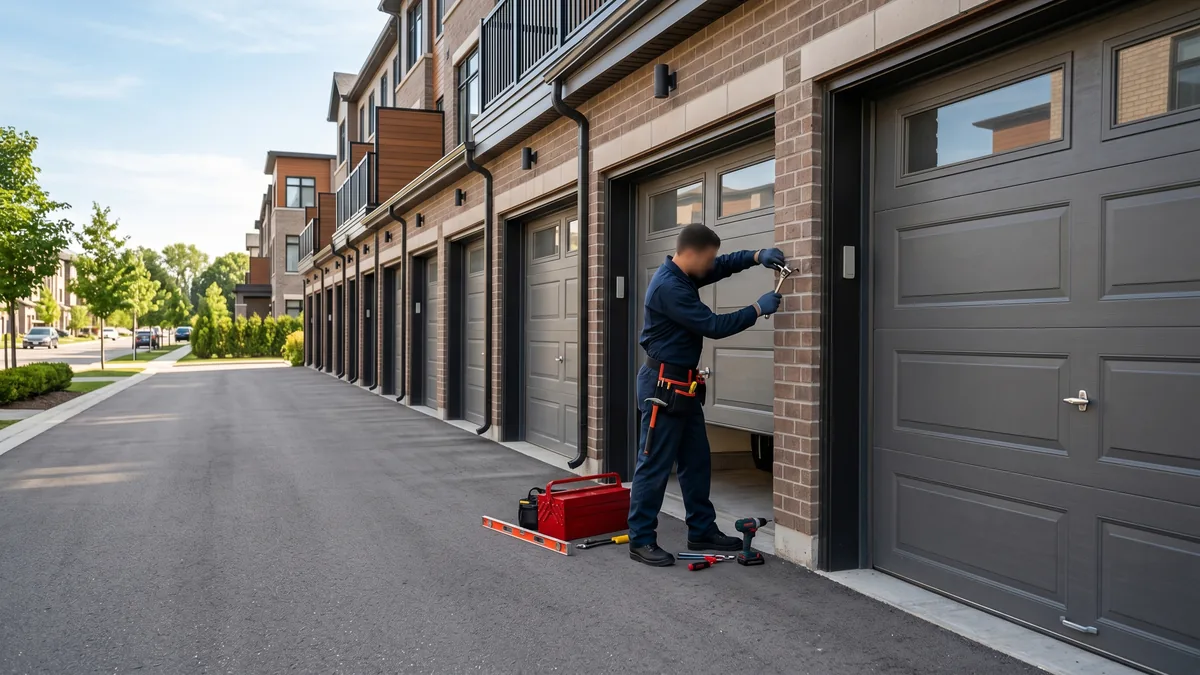
In Ontario condos and townhome corporations, the garage door is usually a common element or exclusive-use common element, so you almost always need written board approval before replacing it — even when you pay for the work. The condo declaration and bylaws control the door’s colour, style, material, and window inserts to keep a uniform streetscape, and they also decide whether the owner or the corporation pays for repairs. Always read your declaration and get approval in writing first.
What Are Condo & HOA Garage Door Rules?
They are the appearance and maintenance requirements a condominium corporation (or, in U.S. terms, a homeowners’ association) places on garage doors that face shared streets. In Ontario these rules live in the declaration, bylaws, and rules registered under the Condominium Act, 1998. They dictate approved colours and styles, whether you can add windows, who is allowed to do the work, and crucially who pays — the unit owner or the corporation’s reserve fund.
If you own a townhouse or condo unit anywhere in Toronto, Mississauga, Brampton, or the wider GTA, your garage door is rarely “just yours” to change. It faces the street, so the corporation has a stake in how it looks — and a surprising amount of authority over what you install. Before you fall in love with a black modern door or a carriage-house style, here is exactly how Ontario condo and HOA garage door rules work, who pays for what, and the approval steps that keep you out of a costly dispute.
Common Element or Unit? Why the Distinction Matters
Everything about condo garage doors flows from one question: how does your declaration classify the door? The answer decides who controls its appearance, who maintains it, and who pays when a spring snaps on a January morning. There are three common classifications across GTA condominium corporations.
1. Common Element
If the garage door is a common element, it belongs to the corporation, not to you individually. The corporation typically maintains, repairs, and eventually replaces it — usually funded from the reserve fund — and controls every aspect of its appearance. You generally cannot change the door at all without the board arranging it.
2. Exclusive-Use Common Element
This is the most common arrangement for GTA townhouse condos. The door is still owned by the corporation, but you have exclusive use of it. In most declarations the owner is responsible for day-to-day maintenance and repair (a broken spring, a worn opener, weather seal), while the corporation retains control over appearance and major replacement. This split is where most confusion — and most billing arguments — happen.
3. Part of the Unit
Less commonly, the declaration defines the garage door as part of your unit. Here you own and maintain the door, but the corporation can still enforce appearance standards through its rules so the building stays uniform. Owning the door does not mean you can paint it lime green.
The Golden Rule: Read the Declaration First
There is no single province-wide answer to “who pays” or “can I change my door.” The registered declaration, bylaws, and rules of your specific corporation govern. Request a current copy from your property manager (you have a right to it as an owner) before you spend a dollar, and read the schedules that list common elements and exclusive-use areas.
Who Pays: Owner vs. Corporation
Money is the part owners care about most. The table below shows the typical responsibility split in Ontario condominium corporations — but remember, your declaration overrides any general rule, so confirm in writing with your property manager.
| Scenario | Door Classification | Who Usually Pays |
|---|---|---|
| Broken spring / cable repair | Exclusive-use | Owner |
| Opener replacement | Exclusive-use | Owner |
| Weather seal / bottom seal | Exclusive-use | Owner |
| Full door replacement (end of life) | Exclusive-use | Often corporation (reserve fund) |
| Any repair or replacement | Common element | Corporation |
| Any repair or replacement | Part of unit | Owner |
| Damage you caused (e.g. backed into it) | Any | Owner / owner’s insurance |
A practical example I see weekly across Mississauga and Brampton townhome complexes: the owner is responsible for a broken garage door spring or a worn opener, while the corporation handles the eventual full replacement when the whole street’s doors are aging out together. If you are unsure who pays before booking a repair, get the answer in writing — a same-day technician can still assess and quote your garage door repair in Mississauga while you confirm responsibility.
Appearance Rules: Colour, Style, Windows & Material
Because the garage door is the largest visible element on most townhome facades, corporations guard its appearance closely. These are the restrictions you are most likely to encounter in the GTA, and every one of them is enforceable under the Condominium Act when it is properly set out in the declaration, bylaws, or architectural guidelines.
- Colour. Almost every corporation specifies an approved colour — commonly white, almond, sandstone, or a single accent like charcoal. You usually cannot deviate, even by a shade.
- Style/pattern. Raised-panel, flush, or carriage-house looks are often standardized so the street stays uniform. Switching from a traditional raised-panel to a modern flush door normally needs board sign-off — see our comparison of carriage versus traditional doors.
- Windows. Adding or removing window inserts changes the facade and almost always requires approval. Window inserts also add to your door cost at about $125 per window.
- Material & finish. Steel versus composite, smooth versus woodgrain, glossy versus matte — corporations may specify all of these to match adjacent units.
- Hardware. Decorative handles and strap hinges (the carriage-house look) may be restricted or required, depending on the complex theme.
How to Get Condo Board Approval (Step by Step)
Getting approval is not complicated, but it does take time, and skipping it is the single most expensive mistake an owner can make. Here is the process I walk GTA clients through before we ever schedule an installation.
- Read your declaration, bylaws, and rules. Confirm the door’s classification and any appearance requirements. Request copies from the property manager if you don’t have them.
- Gather the door details. Collect the proposed make, model, colour code, panel style, window option, and material, plus a spec sheet or brochure. We provide these for any door we supply.
- Submit a written request. Email or letter to the board or property manager. State that you will pay for the work, name your licensed installer, attach the spec sheet and a photo or rendering, and ask for written approval.
- Wait for the board to review. Many GTA boards meet monthly, so allow two to six weeks. Respond quickly if they ask for a sample, a colour chip, or more detail.
- Get approval in writing — and keep it. Do not rely on a verbal “sure, that’s fine.” A written, dated approval protects you if a future board questions the door.
- Book the installation. Only after approval. A reputable installer will ask whether you have board sign-off before scheduling a condo or townhouse replacement.
What to Include in Your Approval Request
The more complete your submission, the faster the yes. A strong request packet includes the door manufacturer and model, the exact colour name and code, panel/window configuration, R-value if insulation matters to the corporation, the installer’s name and licence/insurance, and a clear statement that you bear the full cost. If the corporation has a maintenance standard, note that your new door meets or exceeds it.
Condo-Approved Garage Door Costs in the GTA
Choosing an approved colour or style rarely changes the price — you pay for size, material, and options, not for compliance. The exception is matching a discontinued model exactly, which may require a custom order. Here is current Royal Garage Doors supply-and-install pricing for the GTA, all plus tax, including old door removal, professional installation, and a safety check.
| Door / Service | Price (CAD) |
|---|---|
| Supply + install — 8×7 single | from $1,350 + tax |
| Supply + install — 9×7 single | $1,500 + tax |
| Supply + install — 10×7 single | $1,650 + tax |
| Supply + install — 16×7 double | $2,300 + tax |
| Window inserts | +$125 per window |
| Door only — delivery | from $850 + tax |
| New opener / motor | from $600 + tax |
| Single torsion spring repair | $280 + tax |
| Cables & brackets | $180–$260 + tax |
| Weather seal (bottom/side) | $120–$260 + tax |
| Maintenance / tune-up | $120 + tax |
Warranties on a new door include 1-year labour, 5-year hardware, and a lifetime panel warranty against rust-through perforation. The service call is FREE with any installation or repair — a $120 diagnostic fee applies only if you choose not to proceed after assessment. For the full, current list, see our garage door pricing page, browse door styles on our garage door replacement page, or compare options for overhead garage doors.
A Note for GTA Owners: Condos, Towns & Freehold POTL
The GTA has an unusually high share of townhouse condominiums and freehold POTL (Parcel of Tied Land) communities — freehold homes tied to a small common-element corporation that maintains shared roads and visitor parking. POTL owners are often surprised to learn that even though they own their home and land, a tied condominium corporation may still govern the appearance of street-facing elements, sometimes including garage doors. If you bought a “freehold townhouse” with monthly common-element fees, check whether your POTL corporation has architectural rules before you change your door.
Across Toronto, Mississauga, Brampton, Vaughan, and Hamilton, our installers handle condo and POTL door replacements every week and know how to supply the spec sheets boards ask for. If you manage a complex with many aging doors, our garage door company and commercial garage door repair teams can quote a coordinated multi-door replacement for the whole street. You can read what GTA homeowners and property managers say about us on our reviews page.
Where to Confirm the Rules
For the legal framework, the Ontario government’s overview of the Condominium Act, 1998 sets out owner and corporation responsibilities, and the Condominium Authority of Ontario publishes plain-language guidance on declarations, rules, and dispute resolution. For the specifics that actually bind you, though, nothing replaces reading your own corporation’s registered declaration and bylaws.
Planning a Condo or Townhouse Door Replacement?
Royal Garage Doors supplies board-ready spec sheets and colour samples, then installs your approved door across Toronto & the GTA. FREE service call with any installation, same-day appointments available, and full warranty coverage.
Call 437-265-9995