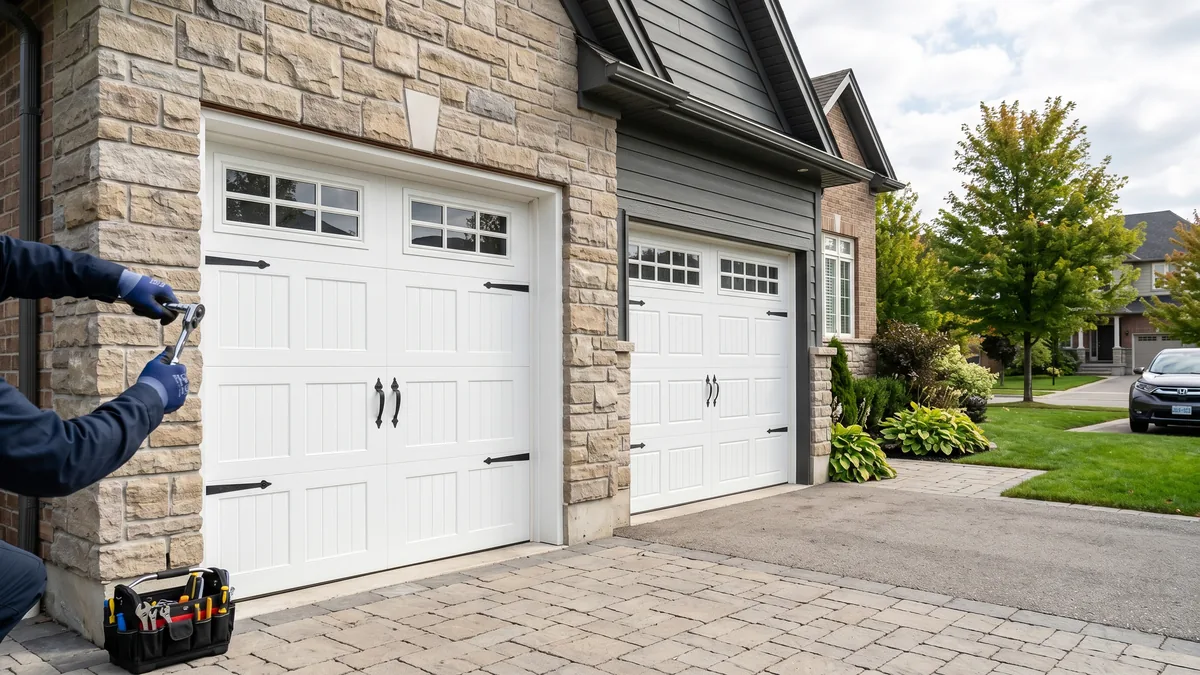
The difference between carriage and traditional garage doors is mostly looks, not mechanics. A carriage door mimics old swing-out barn doors with decorative hardware, plank-style sections, and top windows; a traditional door uses clean horizontal raised or flush panels. Both are modern sectional doors on the same tracks, springs, and openers. Carriage doors cost roughly 15–40% more for the decorative overlays. Choose the style that matches your home’s architecture — that, not the category, drives curb appeal and resale value.
What Is a Carriage House Garage Door?
A carriage house (or “carriage style”) garage door is designed to look like the hinged, swing-out doors that once closed a horse-and-buggy carriage house. On almost every modern home it is actually a standard overhead sectional door that rolls up on tracks, but it wears decorative strap hinges, handles, vertical or X-brace planking, and a row of small windows to recreate the antique swing-out appearance — without sacrificing the convenience of a powered opener.
Replacing a garage door is one of the highest-return upgrades a GTA homeowner can make, and the very first decision is style: the rustic, characterful carriage look or the clean, time-tested traditional panel. Over 15 years installing both across Toronto, Mississauga, Brampton, and Hamilton, I’ve learned the “right” answer depends entirely on your home, your budget, and your winters. Here is an honest, side-by-side breakdown to help you choose with confidence.
Carriage vs Traditional: The Key Differences
It surprises most homeowners to learn that, mechanically, these two doors are nearly identical. Both are sectional overhead doors built from hinged horizontal sections that bend around a curved track and stack against the garage ceiling. The torsion springs, cables, rollers, and openers are the same parts I service every day — the choice is almost entirely aesthetic. Here is where they genuinely differ.
Appearance & Architecture
Carriage doors read as warm, rustic, and characterful. With strap hinges, handles, and either flush plank or X-brace detailing, they suit century homes, farmhouse and craftsman styles, Tudor and English-cottage facades, and custom builds that want a statement entry. Traditional doors — the familiar grid of horizontal raised or flush panels — are clean, symmetrical, and quietly versatile. They flatter the broadest range of GTA houses, from 1980s suburban two-storeys to sleek modern builds, and never look out of place.
Materials & Construction
Both styles come in the same core materials: insulated steel (by far the most popular and practical here), composite/wood-look overlays, real wood, aluminum, and fiberglass. The carriage look is usually achieved one of two ways — a stamped/embossed steel door with the carriage pattern pressed in (most affordable), or an overlay carriage door where real or composite trim boards are mounted onto a steel base (more authentic, more expensive). Traditional doors are most often single- or double-layer steel with optional polyurethane insulation.
Windows & Hardware
Carriage doors lean heavily on decorative details: arched or square top-row windows, wrought-iron-look handles, and pronounced hinges are part of the signature look. Traditional doors can add the same window inserts and hardware but typically keep things minimal. On either style, glass inserts run about +$125 per window here in the GTA, and they add daylight at the cost of a small amount of insulation and privacy.
| Feature | Carriage House | Traditional |
|---|---|---|
| Look | Rustic, swing-out barn style | Clean horizontal panels |
| Best for | Character, custom & century homes | Almost any home style |
| Mechanism | Sectional overhead (rolls up) | Sectional overhead (rolls up) |
| Decorative hardware | Hinges & handles standard | Optional / minimal |
| Relative cost | Higher (+15–40%) | Lower / baseline |
| Insulated steel option | Yes (R-12 to R-18) | Yes (R-12 to R-18) |
| Maintenance | Slightly more (overlays/wood) | Low |
| Springs & opener | Same as traditional | Same as carriage |
Cost: How Much More Is a Carriage Door?
Because the carriage look adds overlays, decorative hardware, and usually window inserts, it almost always costs more than a comparable traditional door — typically 15 to 40 percent, depending on whether you choose embossed steel (least) or a real wood-overlay door (most). The mechanical parts, labour, and removal of your old door are the same. Here is what professional supply-and-install runs in the GTA in 2026, before that style premium:
| Door size (supply + install) | From (CAD) |
|---|---|
| 8×7 single | from $1,350 + tax |
| 9×7 single | $1,500 + tax |
| 10×7 single | $1,650 + tax |
| 15×7 or 16×7 double | $2,300 + tax |
| Window inserts | +$125 / window |
| Door only (delivery, no install) | from $850 + tax |
Install includes the door panels, all hardware, weatherstripping, professional installation, old-door removal, and a safety check. The opener is sold separately — a new opener installed starts from $600 + tax. For exact, current numbers on any configuration see our pricing page and our garage door installation cost guide. Every Royal Garage Doors install is backed by 1-year labour, 5-year hardware, and a lifetime panel warranty against rust-through perforation.
Insulation & Cold-Climate Performance
This is where many homeowners get the priorities backwards. The style of the door barely affects how it performs in a Toronto February — the insulation does. Both carriage and traditional doors are available in single-layer (uninsulated), double-layer (insulated), and premium triple-layer (steel-poly-steel) construction. For an attached garage, a heated workshop, or a room above the garage, you want a triple-layer insulated steel door in the R-12 to R-18 range.
Solid-wood carriage doors are stunning but insulate poorly, swell and crack with our freeze-thaw cycles, and need refinishing every few years. That is why, for cold-climate durability, I steer most clients toward an insulated steel door in whichever style they love. If you want to understand the heating-bill math, read insulated garage door energy savings and our guide to the best garage doors for cold climates. Natural Resources Canada also publishes useful home-insulation guidance you can check at natural-resources.canada.ca.
Insulation Quick Reference
- Detached, unheated garage: single-layer is fine in either style; spend the savings on a nicer overlay.
- Attached garage: double- or triple-layer insulated steel, R-12 minimum.
- Heated garage or room above: triple-layer, R-16 to R-18, with quality bottom and side seals.
- Any GTA winter: add a fresh bottom seal and side and top seals to stop drafts — weather sealing runs $120–$260 + tax.
Durability & Maintenance
Insulated steel — in either style — is the lowest-maintenance choice: wipe it down a couple of times a year, and it resists dents, rot, and rust for decades. Carriage doors add a few extra things to watch: decorative hardware can loosen, and any real-wood or composite overlay benefits from periodic inspection and re-sealing. Traditional steel doors have the fewest cosmetic parts and the least upkeep of all.
Regardless of style, the parts that actually wear out are the moving components — springs, cables, rollers, and the opener — and they are identical on both door types. A door lasts longest when those parts are kept tuned. Our how long a garage door lasts guide covers realistic lifespans, and a yearly professional tune-up ($120 + tax) keeps either door quiet and balanced.
Resale Value & Curb Appeal
Replacing a garage door consistently ranks among the top home-improvement projects for return on investment, often recouping the large majority of its cost at resale. Both carriage and traditional doors deliver that boost — the key is matching the door to the house. A carriage door on a craftsman bungalow or a century home in Toronto’s older neighbourhoods can transform the facade; the same door on a stark modern build can look mismatched, where a flush traditional or contemporary panel shines.
If your garage faces the street and takes up a third of your home’s front elevation — as it does on most GTA properties — the door is a major part of first impressions. Spend a little time with our door designer to preview styles on a photo of your home, and browse real installs in our gallery. You can also see why neighbours trust us on our reviews page.
Which Style Should You Choose?
After hundreds of installs, my decision framework is simple. Start with your home’s architecture, then layer in budget and climate. Use this to narrow it down:
Choose a Carriage Door If…
- Your home is a craftsman, farmhouse, Tudor, English-cottage, century, or custom build.
- You want the door to be a standout design feature, not blend in.
- You have room in the budget for the 15–40% style premium (or choose embossed steel to keep it down).
- You love decorative hardware, plank texture, and top-row windows.
Choose a Traditional Door If…
- Your home is contemporary, suburban two-storey, modern, or builder-grade.
- You want the safest-bet look that suits almost any facade and resells easily.
- You want the lowest upfront cost and the least maintenance.
- You prefer clean lines over rustic detail.
The Bottom Line
There is no “better” door — only the better door for your house. Both carriage and traditional sectional doors use the same proven mechanics, both come in insulated steel built for Canadian winters, and both add strong curb appeal and resale value. Pick the style that flatters your architecture, prioritize insulation over aesthetics for an attached garage, and choose embossed steel if you want the carriage look without the premium. Royal Garage Doors supplies and installs every major brand in both styles across the GTA.
Brands & What Royal Installs
We supply and install carriage and traditional doors from every major North American manufacturer — including Clopay, Wayne Dalton, Amarr, Garaga, and Steelcraft — so you are never locked into one brand. Each maker offers both styles in insulated steel; the right pick comes down to the exact panel design, colour, and window options you want. If you are comparing brands, these honest reviews help:
- Clopay vs Wayne Dalton — two of the most common doors we install.
- Wayne Dalton vs Amarr — comparing build, warranty, and value.
- Garaga garage doors review — a Canadian-made favourite for our winters.
- Steelcraft garage doors review — another Ontario-friendly option.
Whichever brand and style you choose, the opener is independent of the door — we install and service LiftMaster, Chamberlain, and Genie units. Down the road, panels can be swapped without replacing the whole door; see garage door panel replacement ($500–$1,000 + tax). Explore everything we offer on our garage door company page or for new doors, garage door replacement.
Ready to Choose Your New Garage Door?
Not sure whether carriage or traditional suits your home? Our IDEA-certified team will show you options, give you an exact quote, and handle installation start to finish — with a FREE consultation across Toronto & the GTA.
Call 437-265-9995