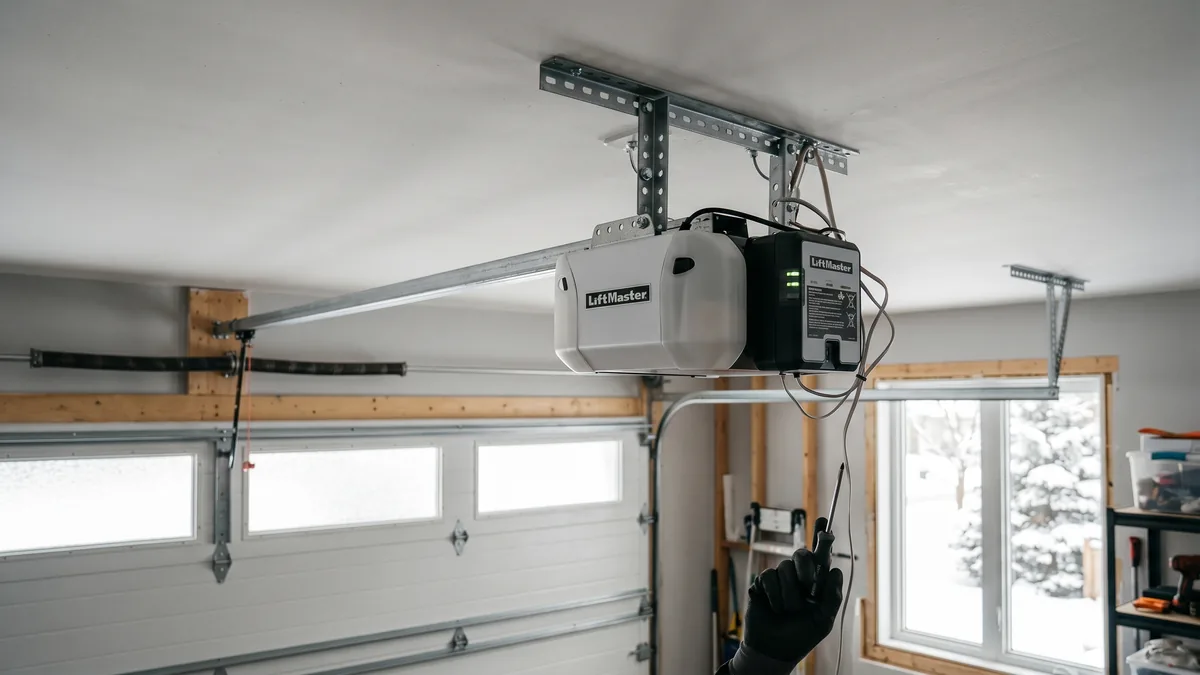
A garage door battery backup is not required by law in Canada. The famous mandate is California’s SB-969, a U.S. state law that does not apply to Ontario or any Canadian province as of 2026. That said, a backup is strongly recommended in the GTA: it lets your opener still raise and lower the door (about 20 cycles or up to ~24 hours) during the ice-storm and grid outages we get every winter, so you are never trapped or locked out of your garage.
What Is a Garage Door Battery Backup?
A garage door battery backup is a rechargeable battery built into (or wired to) your opener’s motor head. When household power is lost, the opener automatically switches to battery and continues to operate the door by remote, keypad, or wall button — no manual lifting required. The battery recharges itself once grid power returns.
Every GTA winter brings the same calls: a freezing-rain storm knocks out power, and a homeowner can’t get their car out because the opener is dead. After 15 years installing openers across Toronto and Mississauga, I can tell you battery backup is the single most underrated upgrade — and there’s a lot of confusion about whether the law even requires it here. Let’s clear it up.
Is Battery Backup Required by Law in Canada?
The short answer is no. There is no federal Canadian law and no Ontario provincial law that requires a battery backup on a residential garage door opener as of 2026. The confusion almost always comes from a single American law that gets quoted online without context.
The California Law People Confuse With Canada
In 2018, California passed Senate Bill 969 (SB-969), which requires that any automatic garage door opener sold or installed in California after July 1, 2019 include a battery backup. The reason was tragic: during wildfire evacuations, people died because they couldn’t open powered garage doors after the grid failed. SB-969 is a California state statute. It is excellent policy, but it has no legal force in Canada. Florida and a few other U.S. states have since adopted similar rules; none of them are Canadian.
What Actually Governs Garage Doors in Ontario
In Ontario, residential garage door safety is shaped by the Ontario Building Code (which adopts the National Building Code framework) and by CSA/UL product safety standards rather than by a battery-backup mandate. The rules that are enforced here focus on entrapment protection:
- Automatic reverse (entrapment protection): Openers must reverse when the door contacts an obstruction.
- Photoelectric safety sensors: The photo eyes near the floor must reverse the door if the beam is broken. If yours act up, see our guide on a garage door sensor blinking red.
- UL 325 compliance: Openers sold in Canada follow the UL 325 safety standard for residential door operators.
For the official federal energy and home-systems context, you can review Natural Resources Canada’s guidance at Natural Resources Canada. Product-level electrical and safety standards are published by the CSA Group.
How Battery Backup Openers Work
A battery-backup opener constantly trickle-charges a sealed rechargeable battery pack while the house has power. The moment a power cut is detected, an internal relay seamlessly switches the motor over to the battery. You generally won’t even notice the transition — the door still responds to your remote, exterior keypad, and wall console.
What to Expect During an Outage
- Cycle count: A healthy battery delivers roughly 20 full open/close cycles, or about 24 hours of standby, depending on door weight and battery age.
- Reduced features: To conserve power, many openers dim or disable the courtesy light and may slow the motor slightly on battery.
- Status indicator: Most units show an amber light or beep periodically to remind you that you’re running on battery.
- Auto-recharge: Once grid power returns, the battery recharges in a few hours with no action needed from you.
Battery Backup vs Manual Release: Know the Difference
Every opener — backup or not — has a red emergency-release cord. People often assume the manual release makes a backup unnecessary, but the two serve different needs.
| Factor | Battery Backup | Manual Release Cord |
|---|---|---|
| Operates by remote/keypad | Yes | No (manual lift only) |
| Physical effort to open | None — motor does the work | You lift the full door by hand |
| Works for seniors / limited mobility | Yes | Often difficult or unsafe |
| Re-secures the door behind you | Yes, full close & lock | Door is unpowered until re-engaged |
| Cost | Battery or backup-ready opener | Built in, free |
| Works if springs are broken | No | No (and dangerous to attempt) |
Best Battery Backup Options for Canadian Homes
You have three practical paths to outage-proof your garage in the GTA. Here’s how they compare for a typical Ontario home.
1. Buy a New Opener With Integrated Backup
The cleanest, most reliable option. Most current LiftMaster and Chamberlain openers — especially their quiet belt-drive and wall-mount (jackshaft) models — ship with a sealed battery built into the motor head, or are “battery-ready” for a snap-in pack. Several Genie models include it too. At Royal Garage Doors a new opener supplied, installed, and programmed starts from $600 plus tax. Always confirm the exact model number includes backup, because it is not standard on every unit.
2. Add a Battery to a Backup-Ready Opener
If your opener was sold “battery-ready” (common on LiftMaster units from the last several years), you simply buy the matching battery pack and clip it in. A replacement or add-in battery typically runs $40–$90. This is the cheapest route — if your model supports it. Check the motor head for a battery compartment or a port labelled for backup.
3. Replace an Aging Backup Battery
If you already have a backup opener but it no longer holds a charge, the fix is just a fresh battery. Backup batteries are consumables: they wear out every 1–3 years, faster in an unheated GTA garage where winter cold shortens battery life. A dead backup battery often shows up as a flashing indicator or a chirping motor head.
| Option | Typical Cost (CAD) | Best For |
|---|---|---|
| Replacement backup battery | $40–$90 | Existing backup-ready opener |
| New opener with backup (installed) | from $600 + tax | Old/dead opener, no backup |
| Opener tune-up & safety check | $120 + tax | Keeping the whole system reliable |
Not sure which path fits your setup? Our team at Royal Garage Doors can identify your opener model on a free service call and tell you the cheapest reliable option. See full pricing on our pricing page.
Why Battery Backup Matters in the GTA Climate
Ontario’s winter is exactly the scenario battery backup was designed for. The 2013 Toronto ice storm left some neighbourhoods without power for days, and freezing-rain events that drop tree limbs onto lines are an almost annual occurrence across Mississauga, Brampton, Vaughan, and the broader GTA. Add the fact that many GTA homes use the garage as the primary entrance, and a dead opener becomes more than an inconvenience.
Cold-Weather Battery Realities
- Cold shortens life: Lead-acid and lithium backup packs both lose capacity in sub-zero temperatures. Expect a backup battery in an unheated garage to need replacing on the shorter end of the 1–3 year range.
- Heavier doors drain faster: An insulated double door pulls more current, so cycle counts on battery run lower than on a light single door.
- Frozen doors compound the problem: If your door is iced to the slab, even a backup battery can’t help — and forcing it can damage the opener. See our advice on stopping a garage door freezing to the ground.
Pair Backup With a Healthy System
A battery backup only powers the motor — it does nothing for worn mechanical parts. The most reliable winter setup combines a backup opener with sound springs, lubricated rollers, and good weather sealing. If you’re upgrading the opener anyway, it’s the perfect time to inspect the whole system, or even consider a full door replacement if your current door is old and poorly insulated. Homeowners exploring new doors can also use our online door designer to picture insulated options.
Key Takeaways
- Not the law here: Canada and Ontario do not legally require garage door battery backup — that is a California (SB-969) rule.
- Still worth it in the GTA: Ice storms and grid outages make backup a genuine safety and access upgrade, not a luxury.
- Runtime: Expect roughly 20 cycles or up to about 24 hours of standby before the battery is depleted.
- Battery is a consumable: Plan to replace the pack every 1–3 years, sooner in a cold, unheated garage.
- It is not a spring fix: Backup powers the motor only; broken springs still require professional repair first.
- Cheapest path: If your opener is “battery-ready,” a $40–$90 battery is all you need; otherwise a new backup opener installs from $630 + tax.
Outage-Proof Your Garage Before Winter
Whether you need a new backup battery or a modern opener with integrated backup, Royal Garage Doors installs and programs it across Toronto & the GTA — FREE service call with any repair or installation.
Call 437-265-9995