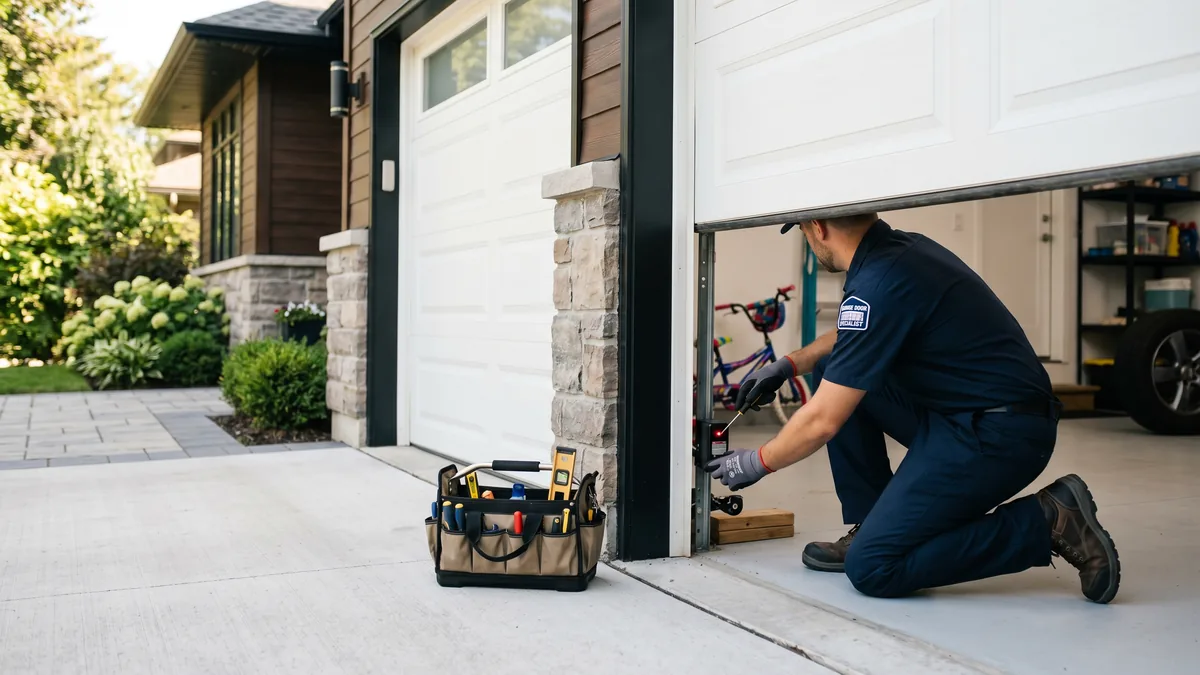
To keep children and pets safe around a garage door: make sure your opener has working photo-eye sensors and auto-reverse, mount the wall button at least 5 feet high and out of reach, keep remotes and keypad PINs away from kids, never let anyone stand or play under a moving door, and replace a broken spring immediately. Test the auto-reverse every month using a 1.5-inch object under the door, it must reverse within 2 seconds of contact.
What Makes a Garage Door a Safety Risk for Kids?
A garage door is the largest and heaviest moving object in most homes, typically 130 to 350 pounds, powered by a motor strong enough to lift it. For a small child or pet, the hazards are being struck or crushed by the closing door, having fingers pinched between sections, or being hit by a door that drops suddenly when a counterbalance spring fails. Modern auto-reverse safety systems exist specifically to prevent these injuries.
If you have toddlers, school-age kids, or pets, the garage is one of the most overlooked danger zones in the home. The good news: nearly every garage door injury is preventable with safety features that are already required by law on modern openers, plus a few simple habits. Here is exactly what every GTA family should check, from the team at Royal Garage Doors in Mississauga.
The Real Dangers: What Actually Hurts Kids and Pets
Understanding the specific ways a garage door causes injury makes the safety steps below far easier to take seriously. There are three main hazards, and they are very different from one another.
1. Entrapment Under a Closing Door
This is the danger that drove the entire safety-sensor mandate. Before auto-reverse was required, children were seriously injured or killed each year when a closing door came down on them as they ran underneath to "beat" it, or while they were lying or sitting in the doorway. A door closing on a small child does not feel an obstruction the way an adult does, so without sensors it keeps pushing. Pets are at even greater risk because they are low to the ground and may freeze in the beam path.
2. Pinch Points Between the Sections
As a sectional door rolls up, the gaps between panels open and then snap shut where the sections fold over the curve of the track. A curious child who places fingers in the gap between two panels, or against the hinges and roller brackets, can suffer a serious crush or amputation injury in an instant. Older flat-panel doors are the worst offenders. This is why pinch-resistant section design (covered below) matters so much for family homes.
3. A Falling Door From a Broken Spring
The torsion or extension springs above your door hold its entire weight in balance. If a spring snaps while the door is open, the only thing left holding several hundred pounds is the opener's small trolley, or nothing at all on a manual door. The door can crash down with enough force to break bones or worse. Never allow a child or pet to stand under a door that is showing spring warning signs such as a loud bang, a crooked door, a gap in the spring coil, or a door that suddenly feels extremely heavy. A broken garage door spring is a same-day repair, not something to live with.
Auto-Reverse and Photo-Eye Protection: Your First Line of Defense
Since 1993, every garage door opener manufactured for sale in North America has been required under UL 325 to include two independent reversal systems. Together they are the single most important reason garage door fatalities have dropped sharply.
- Photo-eye (non-contact) reversal: Two small sensors are mounted about 6 inches above the floor on each side of the opening. They project an invisible infrared beam across the doorway. If a child, pet, ball, or any object breaks the beam while the door is closing, the opener instantly stops and reverses, before the door ever touches them. Because the sensors sit low, they are positioned exactly where a crawling baby or a dog would be.
- Mechanical (contact) reversal: If the door physically contacts an obstruction on the way down, the opener senses the resistance and reverses. This is the backup if the photo-eyes are blocked, dirty, or out of alignment.
For these systems to protect your family, the sensors must be clean, aligned, and powered. A blinking sensor light usually means misalignment. If your sensors are misaligned, blocked by sunlight, or not reversing properly, see our guide to aligning garage door sensors, or call us, sensor service is fast and inexpensive compared to the risk. Never disable or bypass safety sensors to "fix" a door that won't close; that removes the exact protection your kids depend on.
Wall-Button Height: Mount It High and In Sight
The wall control (the button inside the garage) is also governed by UL 325. It must be mounted at least 5 feet (60 inches) above the floor for two reasons:
- Out of a child's reach. At 5 feet or higher, toddlers and young children cannot press the button and operate the door on their own. The door becomes something only adults and older kids can activate.
- Within sight of the door. The button must be positioned so the person pressing it can see the entire door and the area beneath it, so they can confirm no child or pet is in the path before activating.
If your wall button is mounted low (a common issue in older or DIY installations), relocating it higher is a quick fix that immediately removes a major temptation for curious kids. Many modern wall consoles also include a lock or "vacation" toggle that disables remotes entirely, an extra layer for households with children.
Pinch-Resistant Section Design
If you are buying a new door for a family home, pinch-resistant panels are worth specifying. On a standard door, the joint between two sections forms a V-shaped gap that closes to a sharp pinch point as the door rolls. Pinch-resistant (also called "tamper-resistant" or "safe-edge") sections are engineered so the panel profiles roll past each other without ever creating a finger-sized gap, eliminating the crush point between sections.
Other family-friendly design features to ask about:
- Tamper-resistant bottom brackets that hide the high-tension cable and require a tool to remove, so a child cannot loosen them.
- Enclosed track and roller hardware that keeps small fingers away from moving rollers.
- Shielded torsion springs mounted on a continuous shaft above the door, out of reach.
If you are weighing a new door, our pricing page lists current rates: a supply-and-install single door starts from $1,350 + tax, and pinch-resistant panel options can be specified at quote.
Teaching Kids and Pets to Stay Safe
Hardware does most of the work, but habits close the gap. Build these rules into your family routine:
- The door is not a toy. Explain that the garage door is heavy and can hurt, the same way you teach respect for the stove or a hot tap.
- Never run under a moving door. No racing the door, no ducking under as it closes. Wait until it is fully open or fully closed before walking through.
- Keep hands off the panels. Teach kids never to touch the door sections, hinges, or the gaps between panels while it moves.
- Watch the button-presser, not the door. Whoever operates the door confirms all kids and pets are clear first, every time.
- Pets clear the doorway. Train dogs and cats to wait inside or outside the threshold, not in the opening, before you press the button. Pets are low and silent, exactly where the beam and the door's edge are.
Keypad and Remote Childproofing
A garage remote in a child's hands is a door they can open or close at will, and a security risk if a remote is lost or stolen. Treat remotes like car keys:
- Don't store remotes within reach. Keep them off low counters, out of unzipped backpacks, and away from the bottom of a car visor a child can grab from a booster seat.
- Set a private keypad PIN. Use a code your kids don't know, and change it if it gets out. Many keypads also support a temporary guest code you can delete later.
- Use lock or vacation mode. When you're away or overnight, engage the wall console's lock toggle so remotes can't open the door. See our guide to vacation lock mode.
- Store spare remotes high. Keep extras in a cabinet or drawer out of children's reach, not in the junk drawer by the door.
- Delete lost remotes. If a remote goes missing, clear the opener's memory and reprogram your remaining remotes so the lost one stops working.
The Monthly Garage Door Safety Test
Safety features only protect you if they still work. UL and the door industry recommend testing both reversal systems at least once a month, and after any power outage, sensor bump, or storm. Here is the full checklist, it takes about five minutes.
- Test the photo-eye (non-contact) reversal. Start to close the door, then wave a long object (a broom handle) through the beam near the floor. The door should immediately stop and reverse without anything touching it.
- Test the mechanical (contact) reversal. Lay a 1.5-inch object flat on the floor in the door's path, a roll of paper towel or a 2x4 laid flat works well. Close the door. When it contacts the object, it must reverse within 2 seconds. If it doesn't reverse, or pauses then keeps pushing, stop using the opener and call a technician.
- Check the sensor lights. Both sensor indicator lights should be solid (not blinking). Wipe the lenses clean and confirm alignment.
- Confirm wall-button height. Verify the button is still mounted at 5 feet or higher and within sight of the door.
- Do a balance test for the springs. Pull the red emergency release, lift the door manually to waist height, and let go. A balanced door stays put. If it slams down or shoots up, the spring is failing, keep kids away and book a repair.
- Inspect the hardware. Look for frayed cables, loose bottom brackets, and worn rollers. Tighten what's loose; call a pro for cables and springs.
Want a Professional Safety Inspection?
Not sure your auto-reverse, sensors, or springs are family-safe? Royal Garage Doors will test every safety system and tune up your door. FREE service call with any repair across Toronto & GTA.
Call 437-265-9995Frequently Asked Questions
Further reading: the U.S. Consumer Product Safety Commission publishes a safety alert on automatic garage door opener reversal requirements, and CPSC's home safety guides cover related household hazards for children.