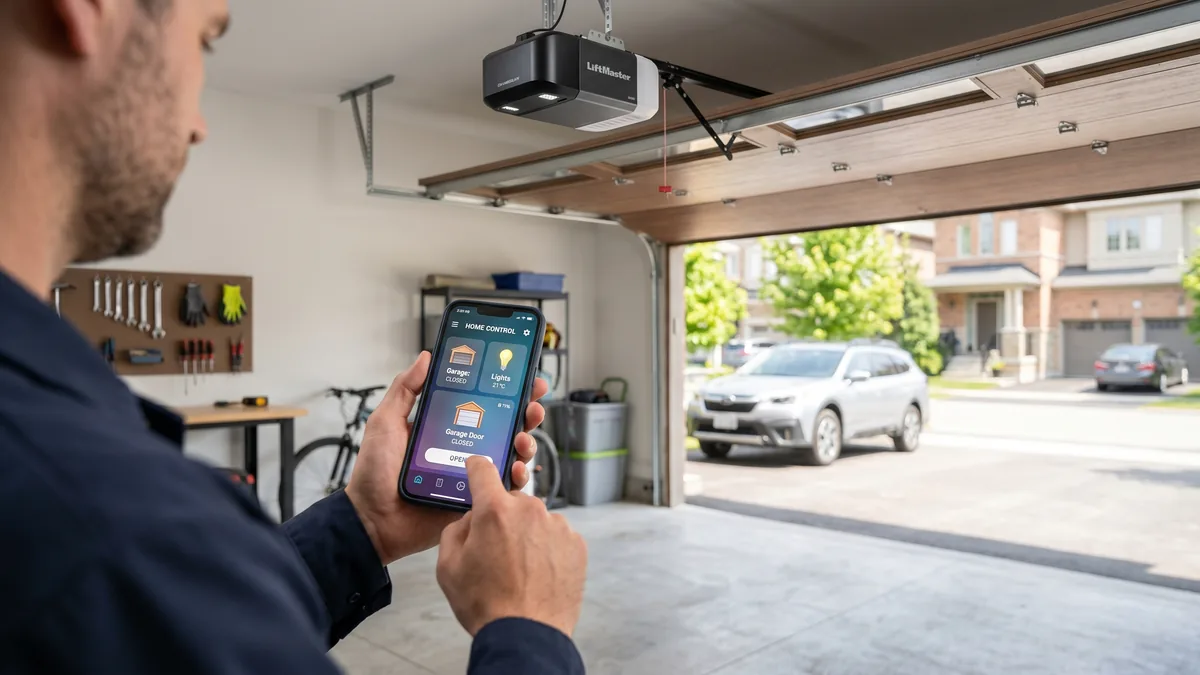
A Matter smart garage opener lets you open, close and monitor your door from Apple Home, Google Home, Alexa and SmartThings at the same time, with no vendor lock-in. In 2026, most setups use a Matter-over-Wi-Fi or Matter-over-Thread controller (Meross, Tailwind, Aqara) wired to your existing LiftMaster, Chamberlain or Genie opener — not a fully native Matter motor. Thread is the low-power mesh radio Matter can ride on, and it improves range and reliability in detached or far GTA garages when paired with a Thread border router.
What Are Matter and Thread?
Matter is an open smart-home standard (backed by Apple, Google, Amazon, Samsung and the Connectivity Standards Alliance) that lets devices work across ecosystems instead of being locked to one app. Thread is a low-power, self-healing wireless mesh network that Matter devices can communicate over. Matter is the “language” devices speak; Thread is one of the “roads” (alongside Wi-Fi and Ethernet) they can speak it on.
Homeowners across Toronto and the GTA increasingly ask us whether their next garage door opener will “just work” with Apple, Google and Alexa instead of being trapped in one app. The short version: Matter and Thread make that possible in 2026, but the real-world setup is more nuanced than the marketing suggests. Here is exactly how it works, what to buy, and what to watch for in a cold-climate garage.
Matter vs Thread: How They Actually Relate
People constantly confuse these two terms, and manufacturers do not always help. They are related but separate layers of the smart-home stack:
- Matter is the application-layer standard — the shared vocabulary that makes a garage controller readable by Apple Home, Google Home, Amazon Alexa and Samsung SmartThings without separate integrations.
- Thread is a transport — a mesh radio protocol based on the same low-power 802.15.4 radio family as Zigbee. Matter can also run over plain Wi-Fi or Ethernet, so Matter does not require Thread.
- A Thread border router bridges your Thread mesh to your home Wi-Fi/Internet. Common border routers include Apple HomePod and Apple TV, Google Nest Hub (2nd gen), Amazon eero routers and some Echo devices.
In 2024 the Matter 1.4 specification from the Connectivity Standards Alliance formally added a garage door device type, which is why hub-free, cross-ecosystem garage control finally became realistic. But specification support and shipping products are not the same thing — which is the most important caveat in this guide.
What Is a Matter Garage Door Controller?
A Matter garage door controller is a small wall-mounted device that wires into your existing opener’s low-voltage wall-button terminals and adds a door-position sensor (tilt or magnetic contact). It momentarily “presses” the opener button on command and reports whether the door is open or closed — then exposes that as a standard Matter garage door endpoint to every connected ecosystem.
Native Matter Openers vs Add-On Controllers
There are two ways to get a Matter or Thread garage door in 2026, and understanding the difference saves money and frustration.
1. Add-on Matter/Thread controller (the practical route)
This is what the vast majority of GTA homeowners will use. You keep your current opener and add a controller that handles the smart logic. It works with most existing openers we repair and service — LiftMaster, Chamberlain, Genie, Craftsman and others — as long as the unit has accessible wall-control terminals. Brands offering Matter or Thread garage controllers include Meross, Tailwind, Aqara and SwitchBot.
2. Native Matter opener (still rare)
A fully native Matter opener has the Matter radio and garage device type built into the motor head, so no extra control box is needed. As of mid-2026 these are still uncommon; most major openers (including LiftMaster’s myQ line) remain Wi-Fi/app-first and lean on bridges rather than shipping as out-of-the-box Matter devices. If a salesperson tells you an opener is “Matter ready,” ask specifically whether it is Matter-certified as a controller or merely myQ/Wi-Fi with a future promise.
Matter/Thread vs myQ vs Plain Wi-Fi: Comparison
Here is how the three common 2026 smart-garage approaches stack up for a typical GTA home:
| Feature | Matter / Thread Controller | myQ (LiftMaster/Chamberlain) | Plain Wi-Fi Controller |
|---|---|---|---|
| Cross-ecosystem (Apple/Google/Alexa together) | Yes (multi-admin) | Limited — partner-by-partner | Usually one app only |
| Local control if Internet drops | Yes (Thread/Matter local) | No — cloud dependent | No — cloud dependent |
| Best for detached/far garage | Thread mesh extends range | Needs strong Wi-Fi | Needs strong Wi-Fi |
| Works with old openers | Third-party controller only | No — myQ hub retrofit discontinued | Third-party controller only |
| Vendor lock-in risk | Low | Higher | Higher |
| Setup complexity | Medium | Easy | Easy |
The headline advantage of Matter is multi-admin: one controller shared across every household member’s preferred app and assistant. The headline advantage of Thread specifically is local, low-power reliability — useful when the garage sits at the edge of Wi-Fi coverage, which is common in detached GTA garages and long suburban lots.
How to Set Up a Matter/Thread Garage Controller
The exact app screens differ by brand, but the wiring and commissioning flow is consistent. Here is the general process Michael Thompson and our team follow on service calls:
- Confirm opener compatibility. Check that your opener has two accessible low-voltage wall-button terminals. Security+ 2.0 (yellow learn button) LiftMaster/Chamberlain units may require a controller model that explicitly supports them.
- Power off the opener at the outlet before wiring anything.
- Wire the controller to the wall-button terminals (parallel with the existing wall button) following the manufacturer diagram. Mount the controller near the motor head.
- Install the door-position sensor. Attach the tilt sensor to the top panel of the door or the magnetic contact to the door and frame, so the system knows open vs closed.
- Commission in Matter. Scan the device’s Matter QR/setup code in your hub app (Apple Home, Google Home, Alexa or SmartThings). If using Thread, the hub will auto-pair through your Thread border router.
- Share to other ecosystems (optional). Generate a new Matter pairing code from the first app to add the same controller to additional ecosystems — this is the multi-admin step.
- Test thoroughly. Open and close from each app and voice assistant, confirm the status reads correctly, and verify the door’s auto-reverse safety still triggers when obstructed.
GTA Climate, Safety and Code Considerations
Smart hardware is only as reliable as the door it controls, and Ontario winters are unforgiving. A few local realities matter:
- Cold-weather sensor drift: Battery-powered tilt sensors can slow or drop offline in deep cold. Choose a controller wired to mains power where possible, and replace sensor batteries before winter.
- Frozen or unbalanced doors: If the door is iced to the slab or the springs are weak, the opener may strain or the status sensor may misreport. Remote closing a door you cannot see is risky if the balance is off — keep up with maintenance. A door that is hard to lift by hand likely needs a spring inspection before you trust remote control.
- Auto-reverse is non-negotiable: Matter does not replace mechanical safety. The photo-eye sensors and force-reverse must work regardless of how you trigger the door.
- Standards: Garage door openers sold in North America must meet entrapment-protection requirements. See the U.S. CPSC standard for automatic garage door openers for the reasoning behind auto-reverse and warning beeps.
For homeowners considering a full upgrade rather than an add-on box, a modern door and opener replacement can be specified with smart-ready wiring from day one. If your opener is aging or noisy, see our notes on diagnosing common faults under opener repair, and weigh a smart controller against the cost of a new unit (a new opener at Royal Garage Doors starts from $600 + tax, separate from any controller you choose).
Should You Upgrade to Matter or Thread in 2026?
Here is the practical decision framework we give clients:
- Upgrade now if you use more than one ecosystem in your home, want local control that survives Internet outages, or have a detached garage where Thread mesh helps reliability.
- Stay put if your myQ or Wi-Fi setup works fine, everyone in the house uses one ecosystem, and you do not want another control box on the wall.
- Wait only if you specifically want a fully native Matter opener with zero add-on hardware — those will become more common but are not the norm yet.
Our Verdict
For most GTA homeowners in 2026, a Matter-over-Thread add-on controller paired to an existing healthy opener is the smartest buy: it future-proofs your home against vendor lock-in, adds local reliability, and works with the LiftMaster, Chamberlain or Genie unit you already own. Just make sure the door itself is balanced, serviced and safety-tested before you trust any device to close it remotely.
Want a Smart-Ready, Safety-Tested Garage Door?
Before you trust any Matter or Thread controller to close your door, make sure the door is balanced, the springs are healthy and the auto-reverse works. Royal Garage Doors provides FREE service calls with any repair across Toronto & the GTA.
Call 437-265-9995