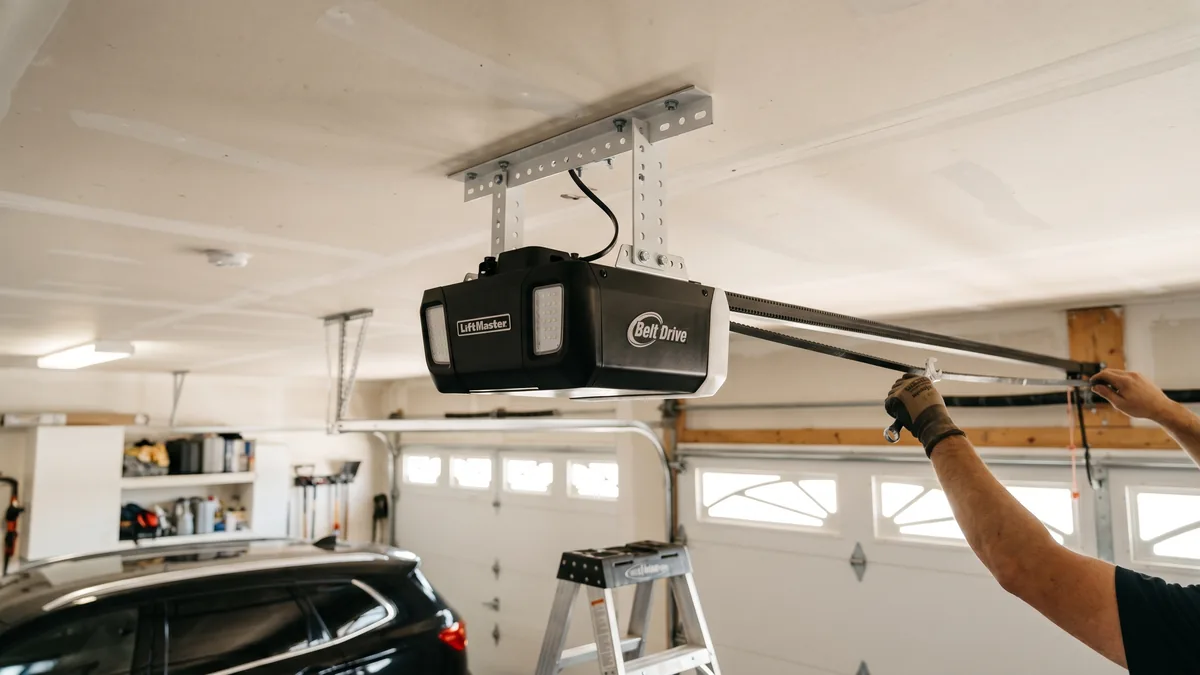
A garage door opener that buzzes or hums but does not move almost always has a failed run capacitor — the part that gives the AC motor its starting torque. An opener that clicks but does nothing usually points to a logic-board relay, a stuck capacitor, or low voltage. First, release the red emergency cord and lift the door by hand: if it is heavy or jammed, the problem is mechanical (springs or binding), not electrical. If the door moves freely by hand, the fault is inside the opener — most commonly the capacitor, motor, or circuit board.
What Causes a Garage Door Opener to Buzz or Click?
A buzz or hum is the sound of an electric motor receiving power but failing to start rotating — typically because the capacitor that supplies starting torque has failed. A click is the sound of a relay or solenoid on the logic board switching, while no power (or insufficient power) reaches the motor. Both symptoms mean the opener is “trying” but a single component in the electrical chain is interrupting the cycle.
Few sounds are more frustrating than an opener that hums, clicks, or grinds but refuses to lift the door — usually on the coldest morning of a GTA winter when you are already late. The good news: the sound itself is a reliable clue. After 15+ years diagnosing openers across Toronto and the GTA, I can usually narrow the fault to one part just by listening. This guide walks you through what each noise means and how to fix it safely.
Garage Door Opener Buzzing or Humming But Not Moving
This is the single most common opener complaint we get. The motor is energized (you hear the hum), but the drive shaft never turns. There are three usual suspects, listed from most to least likely.
1. Failed Run Capacitor (Most Common)
Almost every residential opener uses a single-phase AC motor, and single-phase motors cannot start on their own. They rely on a run capacitor — a small cylindrical or oval can wired to the motor — to create the phase shift that produces starting torque. When the capacitor dries out or shorts internally, the motor still gets power and hums, but it has no “push” to begin turning. Capacitors are a consumable part; heat, age, and our wide GTA temperature swings shorten their life.
How to confirm: Unplug the opener. With the power off, you can often give the drive sprocket a gentle spin by hand and then, after restoring power, see if the motor catches and runs. If it runs only when you help it start, the capacitor is the culprit. A failed capacitor sometimes also shows a bulged top or a faint burnt-electrical smell.
2. Burned-Out or Seized Motor
If the capacitor is good but the motor still only hums, the motor windings may be burned out or the motor bearings seized. A motor that has been left humming and stalled for long periods (because someone kept holding the button) can overheat and cook its own windings. On most openers older than 12–15 years, a dead motor means it is time for a new opener rather than a motor swap.
3. Stripped or Jammed Drive Gear
On chain and belt openers, a plastic main drive gear can strip, especially after years of service or after the door has been forced against an obstruction. The motor spins freely and hums, but the stripped gear no longer transfers that motion to the chain or belt. You will often see plastic shavings inside the motor housing. A worn trolley or a jammed chain/belt can produce a similar straining hum.
Garage Door Opener Clicking But Not Opening
Clicking is a different signature than humming and points more toward the control circuitry than the motor itself.
Single Click, No Motor Sound
A single “click” when you press the button is the logic-board relay firing — the board is trying to send power to the motor, but the motor never responds. This can mean a failed relay contact, an open capacitor, a broken motor winding, or a loose/corroded wire between the board and motor. If the courtesy light still works and the LED is normal, the board has power, so the fault is downstream toward the motor.
Rapid Clicking or Chattering
Fast repetitive clicking usually means the relay is chattering because the board keeps resetting — commonly from low incoming voltage, a failing transformer, or a short on the low-voltage wiring (for example, a pinched safety-sensor wire or a shorted wall-button cable). Disconnect the safety sensors and wall control one at a time to see if the chattering stops; if it does, you have found the shorted accessory circuit.
Clicking From the Wall Button or Remote Only
If the click comes from the wall console and nothing happens, the logic board may not be registering the signal. Try operating the opener from the learn button on the motor head. If it works there but not from remotes, the issue is programming or a dead remote battery rather than the opener itself. Our guide to an opener that will not learn a remote walks through that scenario in detail.
Step-by-Step: Diagnose the Noise Yourself
Before calling anyone, run through this safe sequence. It takes about five minutes and tells you whether you are facing an electrical or a mechanical problem.
- Pull the red emergency release cord to disconnect the door from the opener trolley.
- Lift the door by hand to about waist height and let go. A balanced door stays put. If it slams down, flies up, or is extremely heavy, you have a spring or balance problem — see our broken garage door spring page and stop using the opener.
- If the door moves freely by hand, the fault is inside the opener. Reconnect the trolley.
- Listen carefully while a helper presses the button: a steady hum = capacitor/motor; a single click = relay/motor circuit; rapid clicks = voltage/short; grinding = stripped gear.
- Check the LED indicator on the motor head. Many LiftMaster and Genie units flash a diagnostic code — count the flashes and match them in your owner’s manual or the manufacturer’s support pages.
- Verify the power. Plug a lamp into the same outlet. No power could be a tripped GFCI or breaker rather than the opener at all.
Noise-to-Cause Quick Reference
Use this table to match the exact sound your opener makes to its most probable cause and the typical fix.
| Sound | Door Moves by Hand? | Most Likely Cause | Typical Fix |
|---|---|---|---|
| Steady hum, no movement | Yes | Failed run capacitor | Capacitor replacement |
| Hum then nothing, hot smell | Yes | Burned-out motor | Motor or full opener replacement |
| Hum + grinding, no movement | Yes | Stripped drive gear | Gear kit or new opener |
| Hum + straining, then reverses | No (heavy) | Broken/weak spring, binding | Spring repair (call a tech) |
| Single click, silent motor | Yes | Relay or motor circuit fault | Logic board or motor repair |
| Rapid clicking / chatter | Yes | Low voltage or shorted wire | Find short, repair wiring/board |
| No sound at all | Yes | Tripped GFCI/breaker or dead board | Reset power or replace board |
Repair the Capacitor or Replace the Opener?
The economics of an opener repair hinge on two things: the age of the unit and which part has failed. Here is how we advise GTA homeowners.
- Capacitor failure on a unit under ~10 years: Worth repairing. The capacitor is an inexpensive part and the rest of the opener has years of life left.
- Logic board failure: Boards are the most expensive single part. On an older opener, a board often costs a large fraction of a new unit — replacement usually wins.
- Motor or stripped gear on a 12+ year unit: Replace the opener. Parts and labour rarely justify rebuilding an aging motor.
- Any opener that lacks UL 325 auto-reverse (pre-1993): Replace immediately for safety, regardless of the symptom.
At Royal Garage Doors, a new opener with installation and programming starts from $600 + tax (LiftMaster, Chamberlain, or Genie). That includes the unit, mounting, safety-sensor setup, and remote programming. If a quick capacitor or wiring repair will get you years more service, we will tell you that first — and the service call is FREE with any repair. You can review all rates on our pricing page, and our full garage door opener repair service covers every brand we install. For homes in our core service area, see garage door repair in Mississauga for same-day availability.
When to Stop and Call a Professional
Diagnosing the noise is safe DIY. Opening the motor housing to test or replace a charged capacitor, replacing a logic board, or doing anything while the door is unbalanced is not. Call a technician immediately if you smell burning, see smoke, the breaker keeps tripping, or the door is heavy to lift by hand. If you are weighing a fix against a fresh unit, our garage door replacement team can pair a new opener with a new door so the whole system is matched and warrantied together.
Opener Buzzing, Clicking, or Dead?
If the noise won’t go away — or you smell burning or keep tripping the breaker — stop and let a certified technician diagnose it safely. Royal Garage Doors offers a FREE service call with any repair across Toronto & the GTA, with same-day appointments.
Call 437-265-9995Frequently Asked Questions
Sources: LiftMaster diagnostic LED flashing codes · UL 325 safety requirements for garage door operators