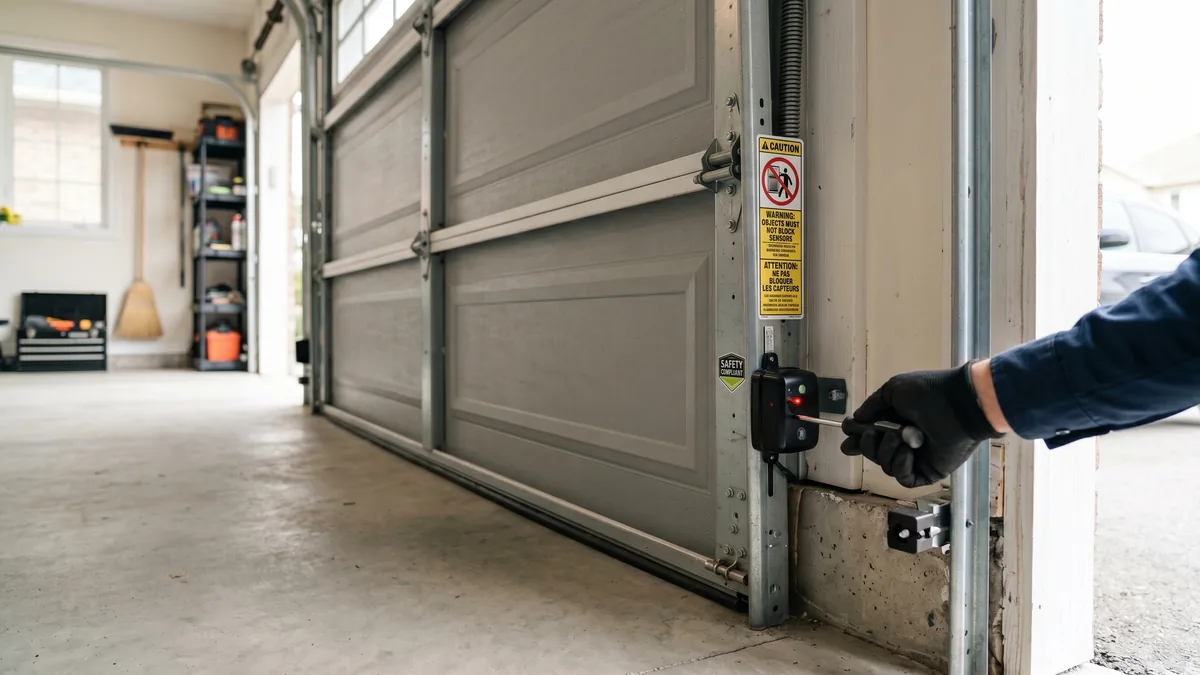
UL 325 is the safety standard that requires residential garage door openers to have automatic reversal and photo-eye entrapment protection. Published by Underwriters Laboratories, it mandates two independent safety systems: an inherent auto-reverse feature that reverses the door if it contacts an obstruction, plus a secondary photo-eye sensor (or edge sensor) that stops and reverses the door before contact. UL 325 has been mandatory on every opener manufactured in North America since January 1, 1993. Any opener made before that date is non-compliant and should be replaced.
What Is UL 325?
UL 325 is the Underwriters Laboratories “Standard for Door, Drapery, Gate, Louver, and Window Operators and Systems.” For garage doors, it defines the entrapment-protection requirements an opener must meet to be safely sold and installed. A UL 325 listed residential opener must include inherent (force-based) reversal and at least one secondary entrapment-protection device — almost always a pair of infrared photo-eye sensors mounted near the floor on each side of the door.
If you have ever wondered why your garage door reverses the instant your foot breaks the invisible beam near the floor, the answer is UL 325. This single standard is the reason modern garage doors are dramatically safer than the openers of the 1980s — and understanding it helps you recognize when an older opener has quietly become a hazard in your own garage.
Why UL 325 Exists: The History Behind the Standard
Before the early 1990s, garage door openers relied on a single, primitive safety mechanism. The opener sensed resistance: if the closing door pressed against an object, the motor was supposed to reverse. But that contact-only system had a fatal flaw. The reversing force could be set high, the sensitivity could drift out of calibration, and a small child or pet could be pinned under the door before the motor registered enough resistance to stop.
The U.S. Consumer Product Safety Commission (CPSC) documented a tragic pattern of children being trapped and killed under automatic garage doors. In response, the 1990 Consumer Product Safety Improvement Act directed the creation of a mandatory federal performance standard. Underwriters Laboratories expanded UL 325 to require a second, independent layer of protection that does not depend on the door physically touching anything.
The result was the photo-eye requirement: an infrared beam projected across the bottom of the opening. If anything breaks that beam while the door is closing, the door instantly stops and reverses — before contact is ever made. The rule took effect for all residential openers manufactured on or after January 1, 1993. Garage door injuries to children dropped sharply in the years that followed.
What UL 325 Actually Requires
UL 325 is often summarized as “the auto-reverse rule,” but compliance actually demands two distinct and independent safety systems working together. An opener must pass both to earn its listing.
1. Inherent (Primary) Reversal
The opener must monitor the force it applies while closing. If the door meets unexpected resistance — an object, a curb, a stuck section — the opener must stop and reverse within two seconds. UL 325 also limits how much downward force the door is permitted to exert during this test, and the door must fully reverse to the open position. This is the “2x4 board test”: lay a flat board on the floor in the door’s path, and a compliant opener reverses the moment the door touches it.
2. Secondary Entrapment Protection
Because force-sensing alone proved unreliable, UL 325 requires a second, non-contact system. Manufacturers satisfy this in one of two ways:
- Photo-eye sensors (most common): A matched pair of infrared sensors mounted no higher than about six inches above the floor. One transmits a beam, the other receives it. Break the beam and the door cannot close — or reverses if already closing.
- Edge sensors (door edge / sensing edge): A pressure-sensitive strip along the bottom edge of the door that triggers reversal on contact. More common on commercial and gate systems, but UL 325 accepts it for residential use.
Why Two Systems Instead of One
The genius of UL 325 is redundancy. The two systems fail in completely different ways, so it is extremely unlikely that both fail at the same moment. Photo-eyes are line-of-sight devices — they can be knocked out of alignment, blinded by direct sunlight, or fooled by a low obstruction that sits below the beam. Inherent force reversal, by contrast, does not care about light or alignment; it only reacts to physical resistance. A child crawling under a closing door breaks the beam first; an object lying flat on the floor that the beam clears is still caught by the contact reversal. By stacking a non-contact sensor on top of a contact sensor, UL 325 covers the blind spots of each. This is also why a technician will never “just disable the sensors” to stop a door from reversing — doing so collapses the redundancy and leaves a single point of failure.
How to Tell If Your Opener Is UL 325 Compliant
You do not need a technician to perform a first-pass compliance check. Three quick observations tell you most of what you need to know.
- Look for photo-eyes. Stand inside the garage and look at the bottom of the door track on both sides, roughly six inches off the floor. You should see two small sensors facing each other, usually with a green and a red (or amber) indicator light. No photo-eyes means the opener pre-dates 1993 and is not compliant.
- Run the beam test. Start the door closing, then wave a broom handle or your foot through the invisible beam near the floor. A compliant opener immediately stops and reverses to fully open.
- Run the 2x4 reversal test. Lay a flat 2x4 board on the floor directly under the door. Close the door. When the bottom edge touches the board, a compliant opener must reverse within two seconds. If it grinds, pauses, or keeps pushing, the inherent reversal is failing.
You can also check the manufacturer date label on the motor head — usually a sticker inside the light-bulb cover or on the back of the unit. A manufacture date of 1993 or later, combined with working photo-eyes, indicates a compliant opener. For a full walkthrough of the reversal test, see our guide on the garage door balance and safety test, and our broader checklist of garage door safety tips.
What UL 325 Means for Pre-1993 Openers
If your opener was manufactured before January 1, 1993, it has no photo-eyes and relies entirely on contact-based reversal. There is no upgrade kit that retrofits a pre-1993 opener to full UL 325 compliance — the control board, force logic, and sensor circuitry were never designed for it. The standing recommendation across the industry, and ours, is the same: replace it.
Beyond the safety risk, pre-1993 openers are a maintenance dead end. Replacement gears, capacitors, and logic boards are discontinued or scarce, the motors are well past their service life, and they lack rolling-code security, meaning older remotes are vulnerable to code-grabbing. A modern UL 325 listed opener solves the safety, reliability, and security problems at once.
| Feature | Pre-1993 Opener | Modern UL 325 Opener |
|---|---|---|
| Photo-eye sensors | None | Required, mounted ~6″ off floor |
| Entrapment protection | Contact reversal only | Inherent reversal + photo-eye |
| Auto-reverse on obstruction | Unreliable, force-dependent | Reverses within 2 seconds |
| Remote security | Fixed code (grab-able) | Rolling code encryption |
| Replacement parts | Discontinued / scarce | Widely available |
| Recommended action | Replace | Keep & maintain |
A new UL 325 compliant opener at Royal Garage Doors starts from $630 + tax, including the unit, professional installation, and programming for LiftMaster, Chamberlain, or Genie. You can review full pricing on our pricing page, or learn about diagnostics and repair on our garage door opener repair service page.
UL 325 and Canadian / CSA & Ontario Code
Homeowners in the GTA sometimes ask whether a “UL” standard even applies in Canada. It does, in functional terms. Garage door openers sold in Canada must carry recognized certification — commonly CSA C22.2 or a dual UL/CSA listing — and reputable openers are certified to UL 325 alongside the Canadian electrical requirements. The two frameworks share the same core safety provisions: inherent reversal plus a secondary, non-contact entrapment device.
Under Ontario’s Electrical Safety Code, electrical products must be approved by an accredited certification body, and a UL/CSA dual-listed opener satisfies that requirement. In practice, any modern opener you buy from a Canadian retailer or installer already meets both the UL 325 entrapment-protection rules and Ontario’s approval requirements. The photo-eyes mounted on a Mississauga garage are doing exactly what UL 325 specifies, and they keep your installation compliant with provincial expectations.
Is Your Opener UL 325 Compliant?
If your opener has no photo-eyes, fails the 2x4 reversal test, or was made before 1993, it is time to replace it. Royal Garage Doors installs modern UL 325 compliant openers from $630 with a FREE service call across Toronto & the GTA.
Call 437-265-9995Frequently Asked Questions
Authoritative references: Underwriters Laboratories (UL Standards) and the U.S. Consumer Product Safety Commission.