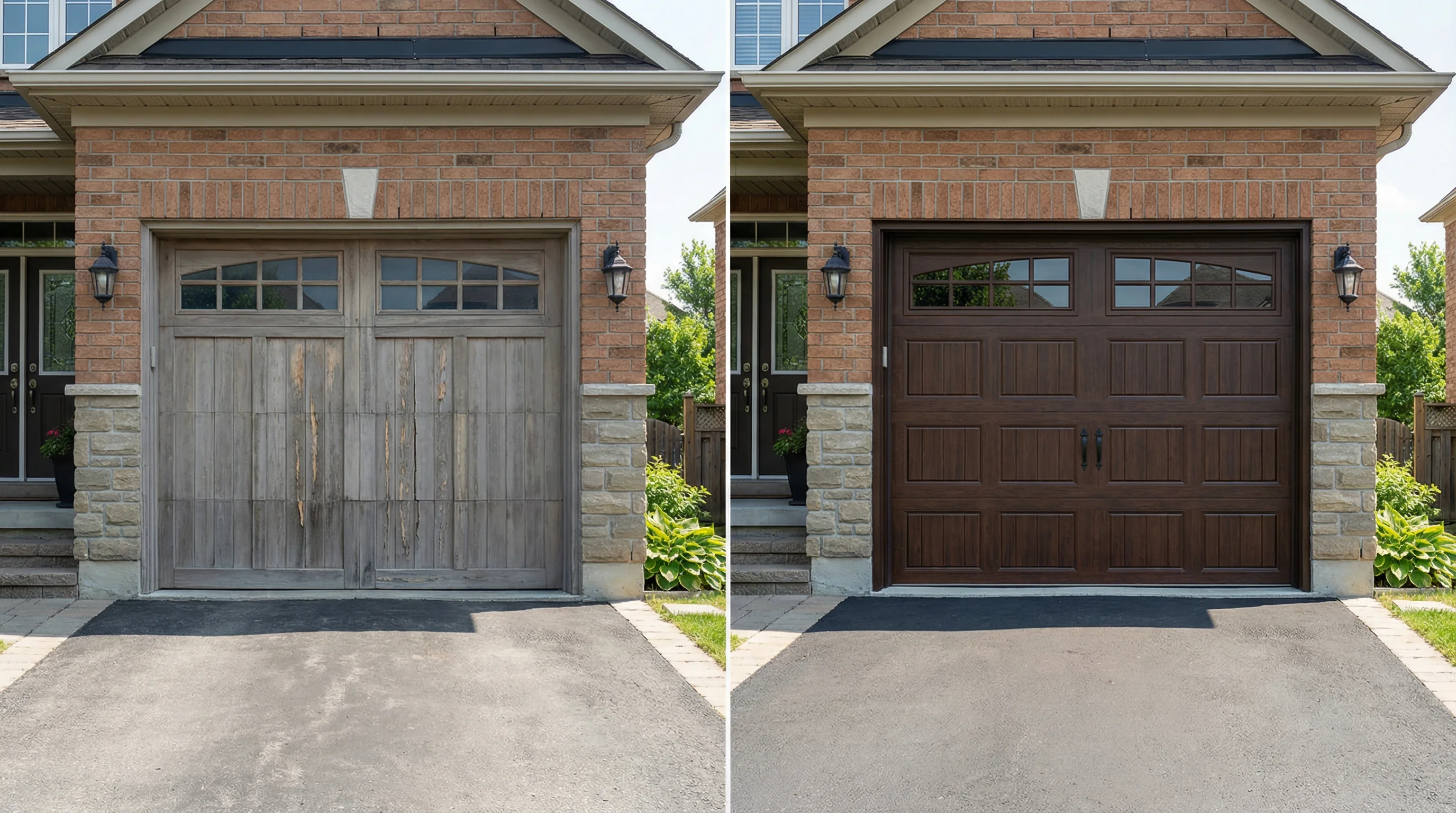
For GTA homeowners, composite faux wood doors are the better practical choice in almost every category except authenticity. Faux wood costs $1,800–$4,000 installed vs $3,000–$8,000+ for real wood, requires minimal maintenance vs repainting every 2-3 years, and is significantly more dimensionally stable through Toronto's freeze-thaw cycles. Real wood remains the premium choice for homeowners who want authentic materials and are prepared for the maintenance commitment.
What Is Faux Wood (Composite) for Garage Doors?
Faux wood garage doors use galvanized steel, fiberglass, or composite polymer panels finished with a woodgrain-textured surface and wood-toned paint or vinyl overlay. The result looks like wood from standard viewing distance but is made of materials that don't warp, rot, or require periodic repainting. Real wood garage doors are constructed from solid wood (typically cedar, mahogany, or Douglas fir) or wood composites, providing authentic material but requiring regular maintenance to stay functional and attractive.
Every month I talk to Toronto homeowners who love the look of wood garage doors but wince at the maintenance stories their neighbours tell. And every month I also talk to homeowners who bought a composite faux wood door five years ago and are delighted with how it still looks. The technology has genuinely become excellent. But real wood isn't irrelevant either — here's the honest comparison.
Real Wood vs Faux Wood: What's the Difference?
Real Wood Garage Doors
Traditional real wood garage doors are built from:
- Western red cedar: The most common choice for Canadian garages — naturally rot-resistant, dimensionally stable compared to other species, and takes paint and stain well. Still requires maintenance in Canadian climates.
- Mahogany: Dense, durable tropical hardwood with beautiful grain. More expensive and requires import, but excellent durability when maintained.
- Douglas fir: Strong, dimensional stability better than cedar, less expensive, takes paint well.
- Reclaimed wood: Custom bespoke doors using reclaimed timber — the highest-end option, typically custom-made.
Faux Wood (Composite) Garage Doors
Modern composite faux wood doors are available in several constructions:
- Steel with woodgrain emboss: Galvanized steel panels with deep embossed woodgrain texture and wood-toned factory finish. The most affordable option. Good appearance from street distance.
- Steel with composite overlay: Steel panels with a factory-applied composite overlay layer that provides a more realistic wood texture and can be painted. Clopay's Coachman series uses this approach — extremely convincing appearance.
- Fiberglass: Fiberglass-reinforced panels that can be stained to look like natural wood grain. Better moisture resistance than steel, lighter weight.
- High-Density Polyurethane composite: Used in some premium faux wood doors — very realistic appearance with built-in insulation.
Maintenance Requirements in Toronto's Climate
This is the category where the two types diverge most dramatically:
| Maintenance Task | Real Wood | Faux Wood (Composite) |
|---|---|---|
| Painting/staining | Every 2-3 years (exterior exposure) | Never (factory finish lasts 10+ years) |
| Caulking joint checks | Annually (expansion/contraction) | Every 3-5 years |
| Washing | Annually (gentle soap) | As needed (simple hose-down) |
| Rot inspection | Annual inspection required | Not applicable (no rot) |
| Hardware adjustment | More frequent (wood swells/shrinks) | Standard intervals |
| Overall effort | High (significant annual time investment) | Low (minimal) |
Toronto's climate is particularly hard on real wood garage doors. The city sees significant temperature swings — from -25°C in January to +35°C in July — plus humidity cycling from very dry winter conditions to humid summer air. Wood absorbs and releases moisture with these changes, causing repeated expansion and contraction that eventually cracks paint, opens joints, and can lead to panel warping.
A cedar garage door that's properly maintained (painted or stained every 2-3 years, caulked annually) can last 25-30 years in Toronto's climate. One that's neglected will deteriorate rapidly — visible cracking, joint separation, and rot at the bottom rail within 5-8 years.
Cost Comparison: Real vs Faux Wood
| Feature | Real Wood | Faux Wood (Composite) |
|---|---|---|
| Single door (installed) | $3,000-$8,000+ | $1,800-$4,000 |
| Double door (installed) | $5,000-$15,000+ | $2,800-$6,000 |
| Maintenance (per 10 years) | $1,500-$4,000 (3-4 repaints) | $0-$200 (washing only) |
| True 10-year cost | $4,500-$12,000+ | $1,800-$4,200 |
When you account for ongoing maintenance costs, the total cost gap between real wood and composite widens substantially over a 10-20 year ownership period. A cedar door that requires three repaints in 10 years at $500-$1,000 each (professional exterior painting) adds $1,500-$3,000 to the already higher purchase price.
Insulation: Which Performs Better in Canadian Winters?
Wood is a natural insulator — better than steel — but an uninsulated solid wood door still performs poorly compared to a polyurethane-core composite door. Here's the comparison:
- Uninsulated solid cedar door: R-2 to R-4 (wood's natural insulation value)
- Cedar door with polystyrene insulation added: R-8 to R-10
- Cedar door with polyurethane insulation added: R-12 to R-16
- Steel faux wood door with polyurethane core: R-13 to R-18 (factory-injected, superior thermal performance)
For attached garages in Toronto, where insulation directly affects heating costs, steel-based composite doors with factory-injected polyurethane foam insulation consistently outperform real wood doors in thermal performance at equivalent or lower cost.
Which One Looks Better and Lasts Longer?
Appearance
This is the one area where real wood wins unconditionally for homeowners who know what they're looking for. The natural grain variation, the way light catches the stained surface, and the warmth of real wood is impossible to perfectly replicate. High-end composite doors with wood overlays are convincing from the street, but up close, a real cedar door with quality hand-applied stain is clearly superior in appearance.
However, after 5-10 years of Toronto weather, a real wood door that hasn't been consistently maintained often looks worse than a well-maintained composite door. The comparison isn't just between new doors — it's between their long-term appearance.
Longevity
Both types, when well-maintained, can last 20-30 years. The key difference is the maintenance required:
- Real wood: 25-30 years with consistent maintenance (repainting every 2-3 years). 10-15 years with inconsistent maintenance.
- Quality composite: 20-30 years with minimal maintenance (washing). The factory finish lasts 10+ years without repainting.
Choosing Your New Garage Door?
We help GTA homeowners find the right door for their style, budget, and climate requirements. Whether you want the authenticity of real wood or the practicality of premium composite, we supply and install throughout Toronto and the GTA. New single doors from $800 installed.
Call 437-265-9995 — Get a Free Quote