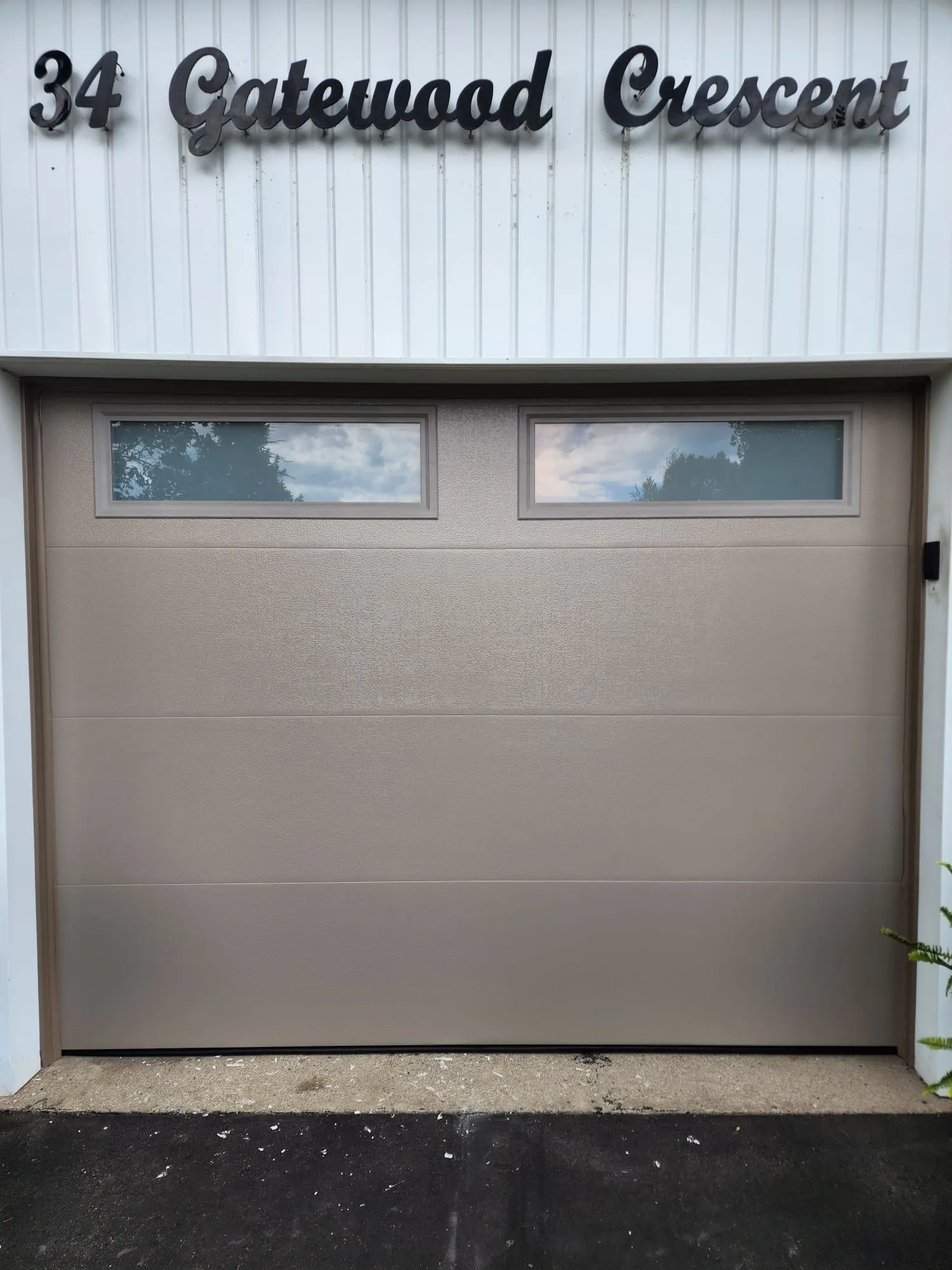
Understanding Common Garage Door Failure Modes in Newmarket
Garage doors are complex mechanical systems with over 300 moving parts, and when something goes wrong the root cause is rarely obvious. In Newmarket, where inland winters average -13°C in January with 120–140 cm of snow and no lake-effect moderation, components experience stress from both temperature cycling and daily wear. Our technicians have repaired thousands of doors across Summerhill Estates, Stonehaven, Bristol-London, Woodland Hill, Glenway, and the Davis Drive corridor and have identified the most common failure patterns so homeowners can catch problems early.
The Six Most Frequent Garage Door Problems
- Broken torsion springs — The single most common failure in Newmarket, concentrated in the 1980s–90s Summerhill, Stonehaven, and Bristol-London builds whose original springs are now 25–35 years old and well past their 10,000–15,000 cycle rating. They fail without warning, leaving the door immovable. Never attempt to operate a door with a broken spring as cables can snap and cause serious injury.
- Snapped or frayed lift cables — Cables carry the full weight of the door and endure thousands of cycles. Fraying usually begins at the drum end where the cable makes a tight bend. In Newmarket's inland -13°C winters, accelerated by temperature contraction, cable failures spike in January and February.
- Misaligned or bent tracks — Tracks guide the rollers through the opening cycle. Even a 1/4-inch misalignment creates binding, grinding noises, and accelerated roller wear. A common cause is vehicle impact in the single-car townhome garages along the Davis Drive and Yonge Street corridors.
- Worn or broken rollers — Nylon rollers last 5–7 years under normal use; steel rollers last longer but are noisier. When rollers crack or seize, the door jumps the track. Lubrication extends roller life significantly.
- Damaged bottom seal — The rubber seal across the bottom keeps out rain, wind, insects, and cold air. In Newmarket's climate the seal hardens and cracks, allowing drafts and water intrusion that damages stored items and raises heating costs.
- Opener motor or logic board failures — Modern openers contain circuit boards vulnerable to power surges. After a summer thunderstorm, opener failures are among the most frequent service calls we receive across Newmarket. When an opener stops responding, the cause is usually one of three things in order of likelihood: a dead remote or keypad battery (the cheapest fix), a misaligned or dirty photo-eye safety sensor, or a worn drive gear or logic board — we diagnose all three on-site so you only pay for what actually needs fixing. A related complaint is a door that starts down then reverses before it closes, which is almost always a photo-eye sensor that is misaligned, dirty, or blocked, or a close-limit and down-force setting that needs adjustment; both are quick fixes on the first visit.
When to Repair vs. When to Replace
The general rule is: repair when the door panel and frame are structurally sound and the total repair cost is less than 50% of replacement cost. Replace when panels are cracked or dented beyond aesthetic repair, when the door lacks modern safety features (entrapment protection, auto-reverse), or when repeated repairs indicate systemic component aging. Many original Summerhill, Stonehaven, and Bristol-London doors from the 1980s and 1990s now benefit from a full replacement evaluation, since parts availability decreases for older proprietary systems like the Wayne Dalton Torquemaster.
Our Diagnostic Process
Every Royal Garage Doors repair call in Newmarket starts with a systematic 12-point inspection: spring tension and cycle count, cable condition and drum seating, track alignment and fastener torque, roller condition, panel integrity, bottom and side seal integrity, opener force and limit settings, sensor alignment and function, safety reverse test, manual disconnect test, lubricant condition, and weather-seal condition. We document findings and provide a written quote before any work begins — no surprise charges.
The great majority of Newmarket's roughly 34,000 homes are detached with attached garages, most built in the 1980s and 1990s. Whether your home is in Summerhill Estates, Stonehaven, or Glenway, our technicians arrive stocked with the most common replacement parts so the majority of repairs are completed on the first visit without a return trip.