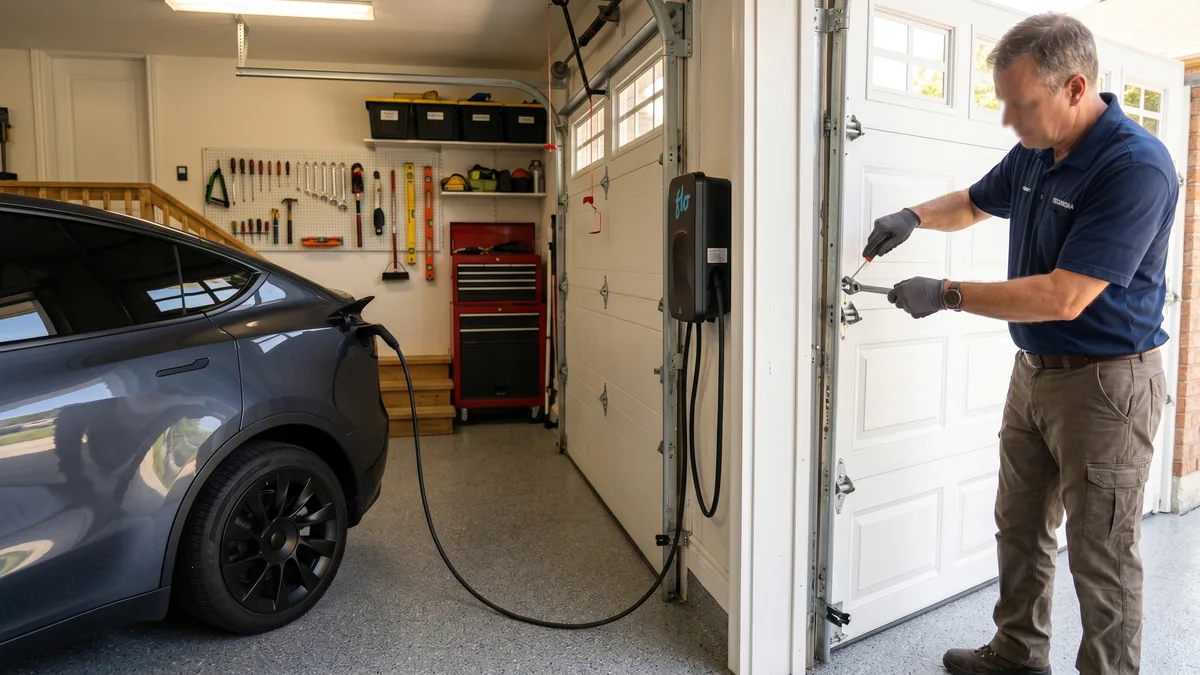
Charging an EV in the garage does not touch the door mechanically, but it turns the garage into a climate-sensitive room. For GTA homes, the three upgrades that matter most are: an insulated steel door (around R-12 to R-18) with fresh weather seals to keep the space warmer for the battery, a charger and cable routed clear of the door tracks, springs and opener rail, and a door and charger on separate electrical circuits. If you switch to a heavier insulated door, have a technician recheck spring balance and opener force.
What Does EV Charging Change About Your Garage?
An EV charger draws a dedicated 240-volt circuit and parks an expensive, cold-sensitive battery inside your garage every night. That shifts the garage from a vented storage space to a semi-conditioned room you actually want to keep at a stable temperature. The garage door is the single largest uninsulated surface in that room, so it has an outsized effect on how well your EV charges and lasts through a GTA winter.
More GTA homeowners are plugging in every month, and one of the most common questions I hear on installation calls is what an electric car means for the garage door. After 15 years installing and servicing doors across Toronto, Mississauga and the wider GTA, here is the practical, code-aware breakdown of how an EV and your garage door interact — and where the small upgrades pay off.
Why Door Insulation Matters More with an EV
Lithium-ion batteries hate the cold. Below freezing, an EV charges more slowly, accepts less regenerative braking, and shows reduced range until the battery warms. A garage that stays a few degrees above the outdoor temperature gives the battery and the charger a milder place to work, which is exactly what a GTA winter calls for.
The garage door is usually the weakest link in that envelope. A bare single-layer steel door is essentially a large cold panel. Swapping it for an insulated, polyurethane-core door is the highest-impact change most EV owners can make. If your current door is single-layer or has cracked seals, a garage door replacement with an insulated model is the upgrade I recommend first.
How Much Warmer Will the Garage Be?
In an attached GTA garage, a quality insulated door combined with tight perimeter and bottom seals typically holds the space 5–10°C warmer than outside on a cold night, even without active heating. That difference is enough to keep a battery out of its harshest charging range and to cut condensation on the vehicle. For the building-science background on door R-values and heat loss, Natural Resources Canada’s guidance on energy-efficient building components is a solid reference (NRCan energy efficiency for homes).
There is a practical range angle too. Many EV owners use scheduled or pre-conditioning charging overnight in winter, and a warmer garage means the car spends less stored energy heating its own battery pack before it can accept a fast charge. Over a full GTA winter, that is real range you keep instead of burning to warm a cold battery in an unheated bay. The door upgrade is not just about comfort — it directly supports how efficiently the vehicle charges from late November through March.
Attached vs Detached Garages
If your EV charges in an attached garage, you also share heat with the house, so an insulated door pays back twice: it protects the battery and it reduces heat loss from the living space sharing that wall. In a detached garage, the door is doing almost all the work, since there is no heated structure behind it. Detached-garage EV owners should be even more aggressive about door insulation and seal quality, and many add a small heat source. Either way, an overhead sectional door with a polyurethane core is the practical choice; we cover the construction differences on our overhead doors page.
Choosing the Right Door for an EV Garage
Not every door behaves the same once an EV lives behind it. Here is how the common GTA options compare for an electric-vehicle garage.
| Door Type | Approx. R-Value | EV Garage Fit | Notes |
|---|---|---|---|
| Single-layer steel (non-insulated) | ~R-0 to R-2 | Poor | Large cold panel; battery and charger see near-outdoor temps |
| Double-layer (polystyrene core) | ~R-6 to R-10 | Good | Solid budget upgrade; quieter operation |
| Triple-layer (polyurethane core) | ~R-12 to R-18 | Best | Warmest, strongest, best for attached EV garages |
| Full-view aluminum and glass | Low | Limited | Looks great but loses heat; pair with a heated garage |
For most attached GTA garages where an EV charges overnight, I steer owners toward a triple-layer polyurethane door. It is the warmest, it is dramatically quieter (helpful when the door cycles late at night), and the dense core resists the dents that come from manoeuvring a larger vehicle in a tight bay. A new insulated door installed starts from $1,350 + tax, with larger double doors running higher; you can see the full breakdown on our pricing page.
Opener and Spring Considerations for a Heavier Door
This is the step EV owners most often miss. An insulated door is meaningfully heavier than the single-layer door it replaces, and your counterbalance system has to match that new weight.
- Spring balance: The torsion springs are sized to the door’s weight. Put a heavier insulated door on springs sized for a light door and it will be unbalanced, hard on the opener, and unsafe. After any door change, the springs should be re-rated or replaced. A single torsion spring replacement is $280 + tax, and a double-spring setup runs $320–$460 + tax.
- Opener capacity: A 1/2 HP opener that handled a light door may strain under an insulated double door. An undersized motor will run hot, wear early, or trigger safety reversals. If you are upgrading, ask about opener force and lift capacity — a new opener with installation starts from $600 + tax.
- Force re-check: Even if the opener is fine, its open and close force settings must be re-tuned for the new door weight so the auto-reverse safety still works correctly.
If your existing opener is older or already noisy, pairing the new insulated door with a fresh motor is the cleaner solution — see our garage door opener repair guidance for when to repair versus replace.
Charger Placement and Cable Routing Around the Door
Where the charger lives matters as much as which door you choose. The moving parts of a garage door — the vertical tracks, the springs and cables overhead, and the opener rail down the centre — are all hazards for a charging cable.
- Mount clear of the door swing: Place the wall unit so the charger body and its cable never cross the door’s travel path or the opener rail. Keep clearance from the vertical tracks and the counterbalance hardware above.
- Route the cable along the wall, not the ceiling rail: A cable draped over the opener rail can be pinched or yanked when the door moves. Use cable hooks along the wall instead.
- Park with the door in mind: Position the charger so you plug in without the cable lying where the bottom of the door seals to the floor.
- Use a dedicated circuit: The EV charger needs its own dedicated 240-volt circuit installed by a licensed electrician. The garage door opener stays on its own separate circuit. Do not share them.
- Mind the door header: Many home chargers want wall space; the area directly above the door (the header) is occupied by the spring shaft and opener bracket, so plan the mount to one side.
A severed charging cable is both a shock and fire hazard, and the impact of a cable caught in a closing door can crack panels and damage the opener. If a door panel does get damaged in a tight EV bay, our panel replacement service can usually swap a single section rather than the whole door.
Ventilation, Moisture and Ontario Code
A common worry is whether charging an EV indoors needs special ventilation. The good news for battery electric vehicles is that they produce no exhaust fumes while charging, so the carbon-monoxide danger that comes with running a gas engine simply is not present during charging. That said, two things still deserve attention.
Heat and Humidity Management
The charger and the vehicle’s onboard charging system give off heat, and a car coming in wet with snow adds humidity. Intact door seals keep slush and meltwater out, while good airflow keeps moisture from collecting on electrical equipment. If you already battle a damp garage, our notes on garage door condensation apply directly to EV bays.
Electrical and Building Code
EV charger installation is governed by the Ontario Electrical Safety Code and must be done by a licensed electrical contractor with the proper permit and inspection — the Electrical Safety Authority outlines the requirements for home EV charging (Electrical Safety Authority). The garage door itself is governed separately under the building code for things like the safety reversing system. Keep the two trades coordinated so the charger conduit and the opener wiring do not interfere.
- Insulate the door first — it is the biggest cold-weather win for your battery.
- Re-check springs and opener force whenever the door gets heavier.
- Keep the charger, cable and door tracks physically separate.
- Dedicated 240V circuit for the charger; the opener stays on its own.
- Maintain seals to keep slush, salt and humidity off your equipment.
Going Electric? Upgrade Your Door to Match
Royal Garage Doors installs insulated doors, re-rates springs and tunes openers for EV garages across Toronto & the GTA. FREE service call with any repair or installation.
Call 437-265-9995