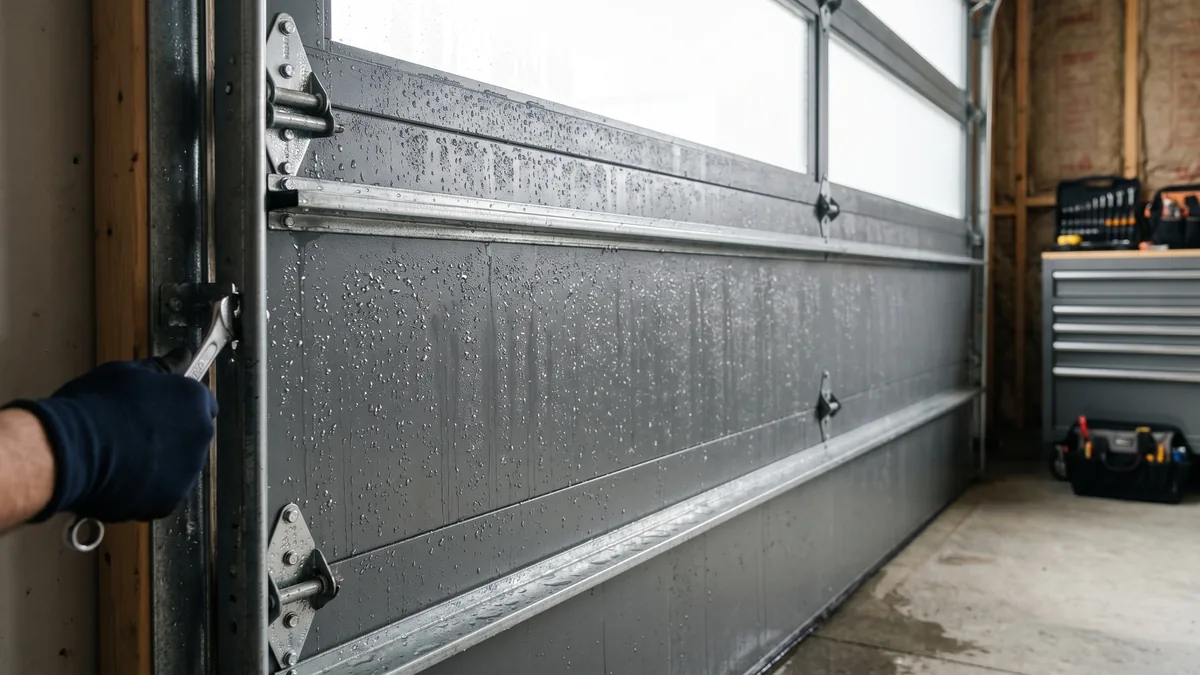
Garage door condensation happens when warm, humid air inside the garage hits the cold inner surface of the door and cools below its dew point, leaving water, frost, or drips. To stop it: (1) reduce indoor humidity (don’t park a dripping car or store wet items inside), (2) add door and garage insulation to keep the inner surface warmer, (3) improve ventilation, and (4) fix worn weather seals so warm moist air doesn’t meet cold metal. In the GTA, an insulated door plus moisture control solves most cases.
What Is Garage Door Condensation?
Condensation is water that forms when humid air touches a surface colder than the air’s dew point. The single-skin steel of an uninsulated garage door is usually the coldest surface in the building during a Toronto winter, so airborne moisture collects there first — appearing as a film of water, beads, frost, or actual dripping. It is a physics problem (warm wet air + cold surface), not a defect in the door itself.
If the inside of your garage door is sweating, frosting over, or dripping onto the floor, you are not alone — it is one of the most common cold-weather complaints we hear from homeowners across Mississauga, Brampton, and the wider GTA. The good news: condensation is predictable, and once you understand the dew-point mechanism behind it, the fixes are straightforward and mostly permanent.
Why Your Garage Door Sweats: The Dew-Point Mechanism
Three ingredients have to line up for condensation to form on your door: humid air, a cold surface, and a surface temperature that drops below the air’s dew point. Remove any one of them and the sweating stops. In a GTA garage, all three are easy to satisfy in winter, which is why the problem is so widespread here.
Warm air holds more moisture than cold air. When that warm, moisture-laden air drifts against the frigid steel of the door, the air right at the surface cools rapidly. Once it cools past its dew point, it can no longer hold all its water vapour, so the excess condenses out as liquid on the metal. If the steel is below 0°C, that liquid freezes into frost instead.
Where the humidity actually comes from
Homeowners are often surprised how much moisture a closed garage traps. In our experience across thousands of GTA service calls, the biggest contributors are:
- A wet or snow-covered vehicle: A single car driven home in a slush storm can shed several litres of water as the snow melts off the body, wheels, and undercarriage.
- Melting snow and road salt brine tracked in on the floor and boots.
- A damp or unsealed concrete slab wicking ground moisture upward.
- Drying laundry, a chest freezer, a water heater, or a hobby area that releases vapour.
- Air leaking from the house into an attached garage through gaps around the entry door.
Why the Door Is the Coldest Surface in the Garage
A standard non-insulated steel garage door is essentially a thin metal sheet separating you from outdoor air. It has almost no thermal resistance, so its inner face sits within a few degrees of the outdoor temperature. On a –15°C January morning in Vaughan or Richmond Hill, that inner steel skin can be far colder than the walls or ceiling, which usually have batt insulation behind drywall.
That is why the door — and the metal track, hinges, springs, and fasteners — sweats before anything else. It is the path of least resistance for heat to escape, and the first place humid air gives up its moisture. Raising that surface temperature is the most effective long-term fix, which is where insulation comes in.
Dew Point in Plain English
The dew point is the temperature at which air becomes saturated and water starts to condense. If your garage air is 8°C with high humidity, its dew point might be around 5°C — meaning any surface colder than 5°C will start collecting moisture. Keep the door’s inner surface above the dew point and it stays dry.
7 Proven Garage Door Condensation Solutions
The right combination depends on whether your garage is attached or detached, heated or unheated, and how much moisture you bring in. Here is the order we recommend tackling them, from cheapest to most involved.
1. Stop adding moisture to the air
The fastest free fix is to reduce the humidity load. Let snow and slush drip off your car in the driveway before pulling in when you can, squeegee or sweep standing water off the floor, move laundry drying and wet gear out of the garage, and don’t store firewood or damp materials inside. This alone resolves a surprising number of mild cases.
2. Improve ventilation
Trapped humid air condenses; moving air does not get the chance. Crack the door a few inches periodically on milder days, add a passive vent or a small exhaust fan, or open a window briefly to swap saturated air for drier outdoor air. In detached garages, a low-and-high vent pair encourages natural cross-flow.
3. Insulate the door
This is the highest-impact upgrade. Insulation keeps the inner steel skin warm enough to stay above the dew point. You have two paths: add a foam insulation kit to your existing door, or replace it with a factory-insulated polyurethane door. We cover the trade-offs in our guide on insulation kits vs a new insulated door, and the real comfort and energy results in insulated vs non-insulated doors.
4. Seal the gaps
A cracked or shrunken bottom seal, missing side seals, and gaps around the frame let cold air and warm moist air mix right at the door. Replacing worn weatherstripping keeps the warm humid air away from the cold steel. Our side and top seal replacement guide walks through it; weather sealing through Royal Garage Doors runs $120–$260 + tax depending on door size.
5. Manage the floor
A bare, damp slab is a constant moisture source. An epoxy or sealer coating, plus quickly clearing meltwater, cuts the humidity feeding the door.
6. Add gentle, steady heat (insulated garages only)
If the garage is already insulated and air-sealed, a small thermostatically controlled heater that keeps the space a few degrees above freezing will hold surfaces above the dew point. Never do this in an uninsulated garage — you will simply pour warm moist air against cold steel and make it worse.
7. Use a dehumidifier in the right season
In a heated or shoulder-season garage, a dehumidifier removes airborne moisture directly. Note that most units stop working below roughly 5°C, so in an unheated GTA garage they are a spring/fall tool, not a deep-winter one.
Comparing the Main Fixes
Each solution targets a different part of the warm-air-meets-cold-steel equation. This table summarizes what each one does, roughly what it costs, and how effective it is on its own in a typical GTA garage.
| Solution | What It Targets | Typical Cost | Effectiveness Alone |
|---|---|---|---|
| Reduce moisture habits | Humidity source | Free | Low–Moderate |
| Ventilation | Trapped humid air | $ low | Moderate |
| Door insulation kit | Cold surface temp | $ moderate (DIY) | High |
| New insulated door | Cold surface temp | From $1,350 + tax | Very High |
| Weather seals | Air mixing at door | $120–$260 + tax | Moderate |
| Garage heat (insulated only) | Surface above dew point | $$ + running cost | High (if insulated) |
| Dehumidifier (warm seasons) | Airborne moisture | $$ | Moderate |
Frost, Dripping & the Damage Condensation Causes
When the door surface drops below freezing, condensation becomes frost. As temperatures swing during the day, that frost melts and drips, then can re-freeze on the slab — sometimes freezing the bottom of the door to the floor (a separate but related winter headache we cover in our piece on stopping a garage door from freezing to the ground).
Left unmanaged, repeated wetting is genuinely hard on a door system. The components most at risk in the GTA’s freeze-thaw climate are:
- Springs: Standing moisture accelerates corrosion on torsion and extension springs, shortening cycle life. If yours are already showing rust or have failed, see our broken spring service.
- Rollers, hinges & tracks: Rust causes binding, noise, and uneven movement; replacing corroded rollers restores smooth travel.
- Steel panels: Persistent moisture leads to surface rust and eventually perforation, which may mean panel replacement.
- Drywall, framing & stored items: Mould and rot on anything the moisture reaches.
The GTA Climate Factor
Southern Ontario is a near-perfect condensation environment in winter: long stretches of sub-zero outdoor air against the door, frequent freeze-thaw cycles, and lots of road salt brine and slush that homeowners drive home daily. That combination is exactly why we see far more sweating-door calls between November and March than in summer.
Building codes and energy guidance reflect this. Ontario’s building requirements and energy programs increasingly emphasize the building envelope, and resources like Natural Resources Canada’s home energy efficiency program highlight insulation and air-sealing as the foundation of a dry, comfortable space. The same principles that lower your heating bill — keeping interior surfaces warm and limiting air leakage — are what keep your garage door from sweating. Manufacturer maintenance documentation, such as the homeowner guidance published by the Door & Access Systems Manufacturers Association (DASMA), also recommends regular inspection of seals and hardware in cold, wet climates.
When to Handle It Yourself vs Call a Pro
Reducing humidity, improving ventilation, and installing a DIY insulation kit are all reasonable homeowner tasks. Call a professional when the condensation has already caused damage or when the fix involves the door’s tensioned components.
- DIY-friendly: Moisture habits, venting, off-the-shelf insulation kits, simple bottom-seal swaps.
- Call us: Rusted or failing springs, corroded rollers/hinges/tracks, panels showing rust-through, persistent dripping despite the basics, or if you’re ready to upgrade to a factory-insulated door.
Our technicians inspect the whole system — balance, seals, hardware, and insulation — so you fix the cause, not just the symptom. You can book online, review our transparent pricing, or learn about the team behind Royal Garage Doors. Homeowners searching for help nearby can also start at our repair near me page or our Mississauga garage door repair hub.
Sweating Door Already Causing Rust?
If condensation has rusted your springs, rollers, or panels — or you’re ready for an insulated upgrade — Royal Garage Doors inspects the full system and offers FREE service calls with any repair across Toronto & GTA.
Call 437-265-9995