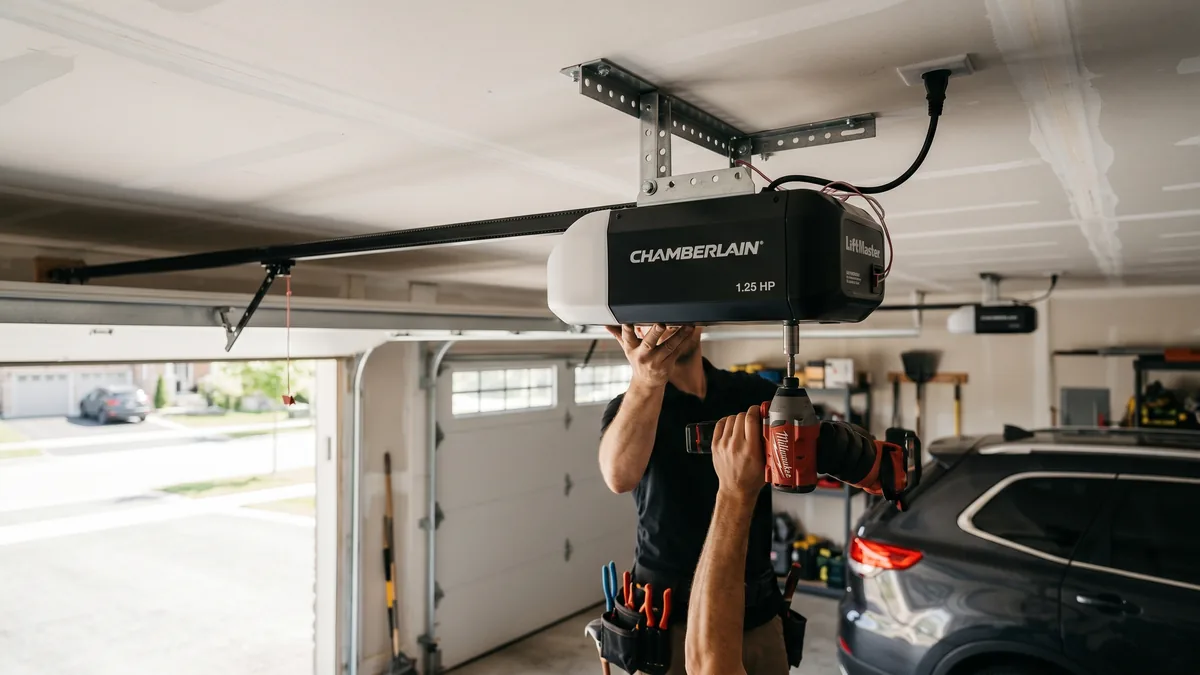
Most homeowners need a 1/2 HP opener for a single garage door and a 3/4 HP opener for a standard 16x7 double door. Step up to 1 HP for heavy insulated, solid-wood, full-view glass, or oversized carriage doors. Horsepower is not about speed — it is about lifting the door without strain. Because the springs carry most of the weight, a correctly balanced door lets a mid-range opener last far longer than an undersized one running flat-out.
What Does HP Mean on a Garage Door Opener?
HP (horsepower) is a rating of an opener motor’s pulling power — how much load it can lift before it strains. A higher HP rating moves a heavier door with less effort and runs cooler over thousands of cycles. On modern DC openers, makers list HPc (“horsepower comparable”) because a DC motor produces torque differently than the older AC motors the original HP scale was built around.
“What HP do I need?” is one of the most common questions I get when a GTA homeowner is replacing a worn-out opener. The honest answer is that horsepower matters less than people think — and door balance matters far more. After 15 years installing openers across Mississauga, Toronto, and the surrounding region, here is exactly how to size one correctly the first time.
Garage Door Opener HP Ratings Explained
Residential openers are sold in a handful of standard power tiers. The number tells you how much door the motor can move comfortably, not how fast it goes. Here is how the common ratings break down:
- 1/3 HP: Entry-level and now rare. Suitable only for light single doors. I generally steer customers away from these — the small savings is not worth the shorter lifespan.
- 1/2 HP: The default residential workhorse. Handles a typical single 8x7 or 9x7 steel door, including most lightly insulated ones, for years.
- 3/4 HP: The sweet spot for double doors and heavier single doors. More torque means the motor loafs along well within its limits, which translates directly into a longer service life.
- 1 HP and up: For genuinely heavy doors — solid wood, full-view aluminum-and-glass, oversized carriage doors, or 18-foot double doors on larger GTA homes.
Two openers with the same HP label can also perform very differently depending on drive type and motor technology, which is why the rating alone never tells the whole story. The U.S. Department of Energy publishes guidance on how electric-motor horsepower is actually defined, and it explains why marketing numbers can be misleading.
It Is About Door Weight, Not Horsepower
Here is the part most buying guides skip: your opener does not lift the full weight of the door. The torsion or extension springs counterbalance almost all of it. A correctly balanced door — one you can lift with two fingers and that stays put halfway open — only asks the opener to overcome friction and momentum. That is why a 1/2 HP motor can move a 150-pound door that you could never lift comfortably by hand.
The practical consequence: oversizing the opener cannot rescue a door with bad springs or worn rollers. If your door binds, drags in the tracks, or feels heavy because a spring is broken, a bigger motor just forces it — accelerating wear on the door, the opener gears, and the cables, and creating a real safety risk. Fix the balance first. We cover the warning signs in our guide to a noisy door when closing.
How to Estimate Your Door’s Weight
You do not need an exact figure, just a ballpark to land in the right tier:
- Single steel, non-insulated (8x7–9x7): roughly 80–110 lb → 1/2 HP
- Single insulated steel: roughly 110–150 lb → 1/2 to 3/4 HP
- Double steel insulated (16x7): roughly 150–220 lb → 3/4 HP
- Solid wood or full-view glass: 250 lb and up → 1 HP
Recommended HP by Door Type
Use this table as a starting point. When a door sits between two tiers, I almost always recommend rounding up — the cost difference is modest and the longevity gain is real.
| Door Type & Size | Typical Weight | Recommended HP | Why |
|---|---|---|---|
| Single steel, non-insulated (8x7) | 80–100 lb | 1/2 HP | Standard residential match |
| Single insulated steel (9x7) | 110–150 lb | 1/2–3/4 HP | 3/4 HP for added longevity |
| Double steel insulated (16x7) | 150–220 lb | 3/4 HP | Best all-around for GTA homes |
| Existing extra-wide double door | 220–280 lb | 3/4–1 HP | Extra width and weight |
| Solid wood / carriage | 250–400 lb | 1 HP+ | Heaviest residential doors |
| Full-view aluminum & glass | 250–350 lb | 1 HP+ | Dense glass panels |
Planning a new door entirely? Matching the opener to the door is far easier when you choose both together — see our garage door replacement options, or explore styles in the door designer.
DC vs AC Motors and HPc Ratings
Drive type and motor technology affect real-world performance as much as the HP number. Here is how the two motor types compare:
| Feature | AC Motor (older) | DC Motor (modern standard) |
|---|---|---|
| Noise | Louder, abrupt start/stop | Quiet, soft start and soft stop |
| Battery backup | Not supported | Supported (and required in many jurisdictions) |
| Speed control | Single speed | Variable; slows near open/close |
| Heat & lifespan | Runs hotter under load | Cooler, longer-lasting |
| Rating shown | True HP | HPc (horsepower comparable) |
For nearly every home I service today, a 3/4 HPc DC opener is the best-value choice: quiet enough for an attached bedroom-above-garage layout, strong enough for a double door, and able to accept a battery backup. That backup is not just a convenience — in many areas it is now a code requirement. We break it down in our battery backup laws in Canada guide, and the safety standard behind modern openers is covered by CSA Group, which certifies opener compliance in Ontario.
Drive Type Still Matters
HP and motor type aside, the drive mechanism shapes noise and maintenance: belt drives are the quietest (ideal above living space), chain drives are the most affordable and durable, and wall-mount jackshaft units free up ceiling space for car lifts or storage. A heavier door is one more reason to favor a smooth belt-drive DC unit rather than pushing a budget chain drive to its limit.
Signs Your Opener Is Undersized for the Door
Plenty of homeowners only discover their opener is too small after it has already started failing. If you are deciding whether to size up on a replacement, watch for these tell-tale symptoms on your current unit:
- The motor strains, hums, or slows near the top of travel. A correctly matched opener should accelerate smoothly and finish the cycle without a noticeable lag — especially on a cold morning.
- The opener overheats and stops mid-cycle. Many motors have a thermal cut-off; if yours quits after a few back-to-back cycles, it is working past its comfortable load.
- The door creeps back down after closing. While this is often a limit or spring issue, an underpowered motor that cannot hold tension contributes too.
- Premature gear wear. Stripped plastic drive gears are the classic failure of a 1/2 HP unit asked to move a double or insulated door for years. If you are on your second gear kit, size up instead.
That said, these same symptoms appear when springs are tired or rollers are dry — which is why we always diagnose the door before recommending a bigger motor. If your unit is showing its age, our breakdown of an opener that gets louder over time helps separate a power problem from a maintenance one.
Smart Features and Future-Proofing
Horsepower is only one column on the spec sheet. When you are already replacing an opener, it is worth choosing a unit that will serve you for the next decade, not just clear today’s door. A few features genuinely add value:
- Battery backup: Built into most quality DC openers and, as noted, increasingly mandated. It keeps the door working through a GTA outage.
- Wi-Fi / smartphone control: Lets you open, close, and confirm door status remotely — handy for deliveries and for confirming you actually closed it.
- Soft start and soft stop: A DC-motor perk that dramatically cuts noise and reduces shock load on the door hardware, extending the life of rollers and hinges.
- Integrated LED lighting: Brighter, longer-life garage lighting from the opener head itself.
None of these change the HP you need, but they explain why a slightly higher-spec 3/4 HPc DC unit is usually the smarter buy than the cheapest 1/2 HP chain drive on the shelf. If you want help comparing real models for your specific door, our team can spec the whole job — book a free assessment through our online booking page and we will match the opener, drive type, and accessories to your home.
GTA-Specific Considerations
Our climate changes the math slightly. In a Toronto-area winter, weatherstripping can freeze to the slab and door grease thickens in the cold, so the opener briefly works harder on the first cycle of a frigid morning. That extra resistance is exactly when an undersized motor labours and an oversized-by-one-tier motor shrugs it off. For homes in older neighbourhoods with original wood doors — common across parts of Toronto and Mississauga — that weight alone often justifies stepping up to 3/4 or 1 HP.
Battery backup is the other GTA factor. Power flickers during summer storms and winter ice events; a DC opener with backup keeps you from being stranded outside (or trapped inside) when the grid drops. If you are weighing a full upgrade, our opener installation cost guide walks through pricing, and a new chain-drive opener starts at $600, while belt-drive DC starts at $630 installed and programmed.
Not Sure Which Opener Fits Your Door?
Our IDEA Certified technicians size the right opener to your exact door weight and balance — no guesswork, no upselling. Royal Garage Doors provides FREE service calls with any repair or installation across Toronto & the GTA.
Call 437-265-9995