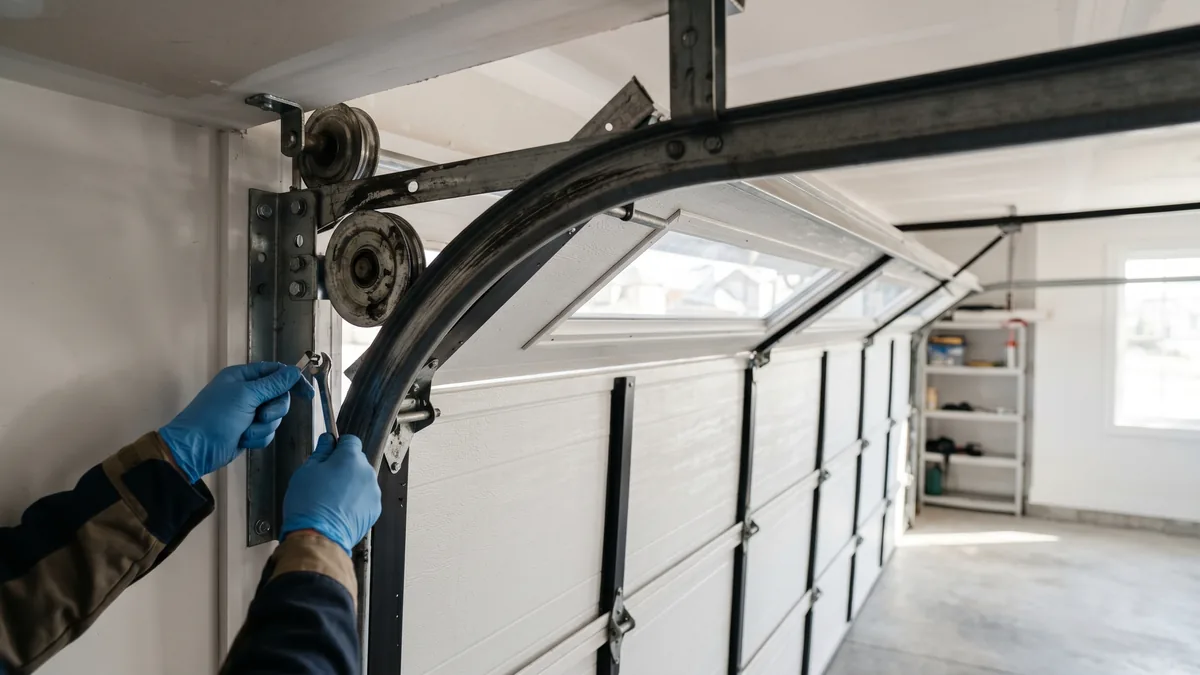
A garage door is loud when closing mainly because of dry or worn rollers, loose hardware, and worn hinges that rattle and grind as the door drops. Noise is louder on the way down because gravity helps the door move, amplifying friction and vibration. Lubricating the rollers, hinges, and springs and tightening every bolt quiets most doors. But grinding, a metallic bang, or a hard slam at the floor points to bad bearings, an opener travel setting, or a weak spring that needs a professional technician.
Why Is a Garage Door Louder Closing Than Opening?
On the way up, the opener and springs work against gravity, so the door moves under controlled tension. On the way down, gravity assists the motion — any worn roller, loose bracket, or dry hinge gets driven harder and resonates louder. That is why many homeowners notice their door is quiet opening but suddenly loud, rattly, or banging when closing. The closing stroke simply exposes wear that the opening stroke masks.
A garage door that is loud when closing is one of the most common service calls we field across Toronto, Mississauga, and the wider GTA — and the good news is that most cases are cheap, quick fixes. The bad news is that a few of the sounds (a metallic bang, a hard slam, a grinding screech) are early warnings of a spring or balance failure. This guide walks through every cause, how to tell a harmless rattle from a dangerous one, what you can fix yourself in 15 minutes, and what it costs if you need a pro.
7 Reasons Your Garage Door Is Loud When Closing
Closing noise is rarely one failing part — it is usually a stack of small wear points that all resonate together as the door drops. Here are the seven causes I diagnose most often, ranked roughly from most to least common, with the sound each one makes.
1. Dry or Worn Rollers (Rattling, Chattering)
Rollers are the small wheels that ride inside the tracks. Builder-grade steel rollers have exposed bearings that dry out, rust, and seize over 5–10 years; nylon rollers develop flat spots. A roller that no longer spins freely drags and skips inside the track, producing a chattering, rattling noise that is loudest as the door accelerates downward. This is the single most common cause of a loud closing door. Upgrading to sealed nylon rollers is one of the most cost-effective fixes — see our garage door roller replacement service.
2. Loose Hardware (Rattling, Buzzing)
A garage door cycles thousands of times a year, and that movement gradually loosens nuts, bolts, hinge screws, and track brackets. Loose hardware lets the panels and tracks shift independently, creating a rattle and buzz that is most noticeable on the downward stroke when the panels stack and bounce. This is the easiest cause to fix and to prevent.
3. Worn Hinges (Squealing, Grinding)
Sectional doors pivot on hinges between each panel. As hinge pins wear, the holes elongate and the metal squeals and grinds with every cycle. You will often see a fine metal dust below a worn hinge. Lubrication buys time, but badly worn hinges should be replaced before the panel holes wallow out and crack the steel — a precursor to panel replacement.
4. Dry or Failing Bearings & Bearing Plates (Screeching)
The torsion shaft above the door rides in bearings at each end plate and often a center bearing. When these dry out or wear, they screech and grind loudly — a high-pitched sound that seems to come from above the door rather than the tracks. Bearings are inexpensive parts, but replacing an end-bearing plate means relieving spring tension, so it is a job for a technician.
5. Spring Slamming or a Weak Counterbalance (Banging at the Floor)
The torsion or extension springs counterbalance the door’s weight so it lands gently. When a spring weakens, stretches, or partially breaks, the door becomes heavier than the springs can hold and it drops fast, banging hard at the floor. A sudden, gunshot-like bang can mean a spring has actually snapped. This is the most serious cause on the list. If your door feels heavy by hand or slams shut, read our guide on a broken garage door spring and do not attempt the repair yourself.
6. Opener Down-Travel & Down-Force Set Too Aggressively (Hard Slam)
Every opener has adjustable down-travel (how far it drives the door) and down-force (how hard it pushes). If down-travel is set too far, the opener keeps driving after the door reaches the floor, slamming it shut. Too much down-force does the same and can defeat the safety reverse. This is a common cause after a power outage or opener reset. See our garage door opener repair page, or our brand guides for LiftMaster, Chamberlain, and Genie openers.
7. Loose Chain or a Worn Drive Gear (Slapping, Grinding)
A chain-drive opener that has stretched will whip and slap as the door changes direction, and a worn plastic main drive gear grinds while the chain barely moves. Both transmit a metallic clatter through the rail and ceiling. A belt-drive opener is dramatically quieter if the noise truly originates in the opener — but confirm the door hardware is quiet by hand first.
How to Diagnose a Loud Closing Garage Door
Before you reach for tools, spend five minutes locating the source. Work through these steps in order — they separate door problems from opener problems and flag anything that needs a pro.
- Listen for the type of sound. Rattling and buzzing point to loose hardware and rollers; squealing and grinding point to hinges and bearings; a bang or slam at the floor points to springs or opener travel settings.
- Disconnect the opener and test by hand. With the door closed, pull the red emergency release and lift the door manually. A balanced door rises smoothly and stays put when raised halfway. If it slams down or feels heavy, the problem is a spring — not the opener.
- Inspect the rollers and hinges. Look for worn bearings, rust, flat spots, metal dust, and elongated hinge holes. Spin each roller by hand; a healthy one spins freely.
- Check the bearing plates. With the opener disconnected, listen near the end plates and center bearing while moving the door slowly; a dry bearing screeches.
- Watch the opener at the floor. If the door lands hard and the opener keeps pushing, your down-travel or down-force is set too aggressively.
- Test the safety reverse. Place a roll of paper towel under the door and close it; the door must reverse on contact. If it does not, stop and call a technician — this is a critical safety issue.
DIY Fixes vs. When to Call a Pro
Some causes of a loud closing door are genuinely homeowner-friendly. Others involve high-tension components that send technicians to the hospital every year. Use this table to decide.
| Cause | Typical Sound | Safe to DIY? | Action |
|---|---|---|---|
| Dry rollers & hinges | Rattle / squeal | Yes | Lubricate with silicone spray |
| Loose nuts & bolts | Rattle / buzz | Yes | Tighten with a socket wrench |
| Opener down-travel / force | Hard slam | Yes (with care) | Adjust travel & force, test reverse |
| Loose chain tension | Slapping | Yes | Adjust trolley tension nut |
| Worn rollers | Chatter / grind | Caution | Replace (bottom roller needs care) |
| Worn hinges | Grind / metal dust | Caution | Replace before panels crack |
| Dry / worn bearings | Screech from above | No | Call a technician |
| Weak or broken spring | Bang at floor / snap | No | Call a technician immediately |
The 15-Minute DIY Tune-Up
If your door lifts smoothly by hand and the noise comes from dry parts and loose hardware, you can usually quiet it yourself in about 15 minutes:
- Tighten everything. From a stable ladder, snug every hinge screw, roller bracket bolt, and track bracket with a socket wrench. Do not overtighten.
- Lubricate the moving parts. Apply a garage-door-specific or silicone-based lubricant to rollers, hinges, springs, and bearing plates. The DASMA trade association and most manufacturers recommend regular lubrication and inspection — see the DASMA homeowner resources and the CPSC garage door safety guide. Avoid WD-40, which is a degreaser, not a lubricant.
- Wipe the tracks clean. Remove dirt and old grease from inside the tracks with a rag; never lubricate the inside of the tracks themselves.
- Check opener travel and force. If the door slams shut, reduce the down-travel and down-force so it lands gently, then confirm the safety reverse still works.
- Re-test. Run the door a few cycles. If noise persists, the cause is worn rollers, bad bearings, or a spring — time to call a pro.
How to Keep Your Garage Door Quiet
Most noise problems are the result of skipped maintenance. A garage door is the largest moving object in most GTA homes, and our freeze-thaw winters are hard on metal parts — cold thickens lubricant and contracts steel, which is why doors often get loudest in January. A little routine care keeps the door quiet and the springs and opener lasting years longer.
- Lubricate every 3–6 months. Silicone or garage-door lubricant on rollers, hinges, springs, and bearings is the single most effective preventive step.
- Tighten hardware twice a year. A 10-minute pass with a socket wrench catches loosening bolts before they rattle.
- Replace worn rollers proactively. Swapping aging steel rollers for sealed nylon ones eliminates the most common noise source and runs much quieter.
- Add isolation pads and a belt drive if needed. Rubber pads between the opener bracket and joist, plus a belt-drive opener, cut transmitted noise into living spaces above the garage.
- Book an annual professional tune-up. A technician checks spring tension, balance, cables, bearings, and safety sensors — the parts you should not service yourself. Our garage door company covers the whole GTA.
What a Loud Garage Door Repair Costs in the GTA
A complete maintenance package — lubrication, balance check, safety-sensor alignment, and hardware tightening — runs $120 + tax and resolves the majority of noise. If diagnosis turns up a deeper issue, here is what the underlying repairs typically cost:
| Repair | Typical Cost (CAD) |
|---|---|
| Maintenance & tune-up | $120 + tax |
| Safety sensor service | $120–$180 + tax |
| Cables & brackets | $180–$260 + tax |
| Single torsion spring | from $280 + tax |
| Double spring setup | $320–$460 + tax |
| New belt-drive opener / motor | from $630 + tax |
| Panel replacement | $500–$1,000 + tax |
The service call is FREE with any repair; a $120 diagnostic applies only if you choose not to proceed. Every repair is backed by our 1-year labour, 5-year hardware, and lifetime panel warranty. For full, up-to-date pricing see our pricing page, browse customer reviews, or book online. If the door is beyond economical repair, consider a garage door replacement or new overhead garage door. Same-day technicians are available in Toronto, Mississauga, Brampton, and Hamilton. Businesses with high-traffic doors should see our commercial garage door repair service.
Door Still Loud After a Tune-Up?
Persistent grinding, screeching, or a slam at the floor usually means worn rollers, dry bearings, or a spring out of balance — jobs best left to a pro. Royal Garage Doors provides FREE service calls with any repair across Toronto & the GTA, with same-day appointments available.
Call 437-265-9995