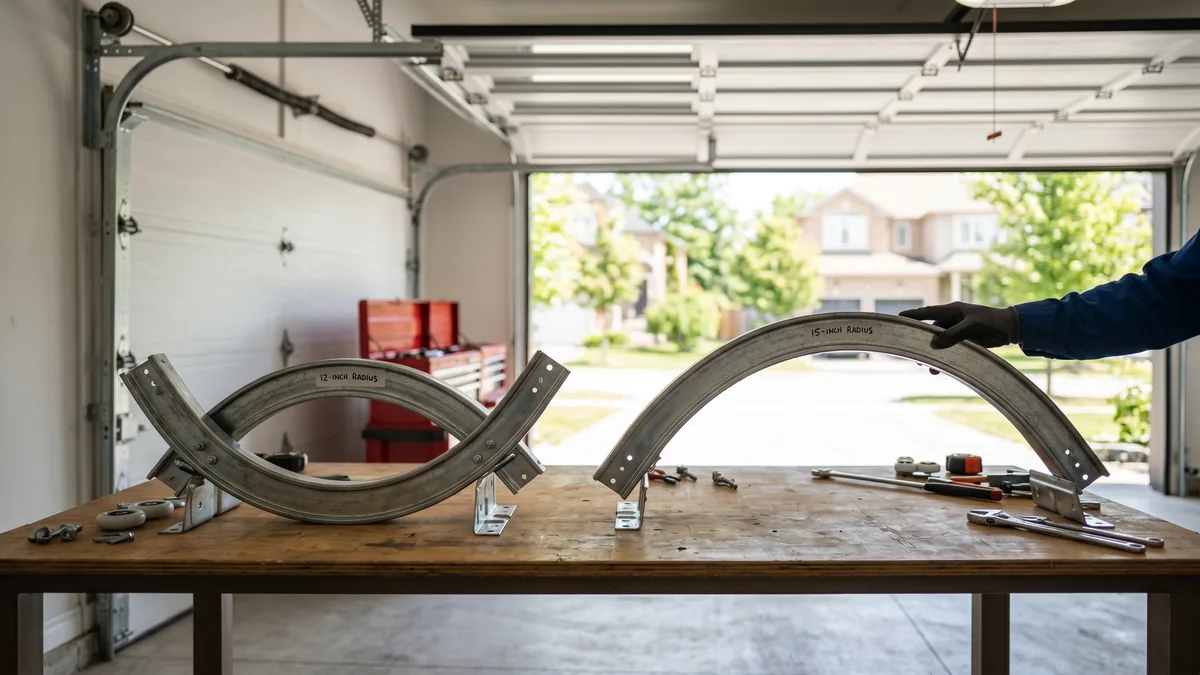
Garage door track radius is the size of the curved section where the vertical track turns to meet the horizontal track at the ceiling. The two common sizes are 12 inch and 15 inch radius. A 12-inch radius makes a tighter turn and needs only about 12–14 inches of headroom; a 15-inch radius makes a wider, smoother turn and needs roughly 15–18 inches. Heavier insulated and double doors run better on a 15-inch radius, while tight ceilings may require a 12-inch or a low-headroom conversion.
What Is Garage Door Track Radius?
Track radius is the measured radius of the curved “elbow” that connects the vertical track running up the door jamb to the horizontal track that runs back under the ceiling. A larger radius (15″) sweeps the rollers through a gentler arc; a smaller radius (12″) bends them through a tighter, faster turn. The right radius depends on your door’s weight, height, and the headroom available above the opening.
If you are shopping for a new garage door in Toronto or the GTA, “track radius” is one of those specs that quietly decides which doors will actually fit your garage. Get it wrong and the door binds, runs loud, or simply won’t clear the ceiling. In this guide I’ll explain the difference between 12 and 15 inch radius track, how to tell which one you have, the headroom each needs, and what to do when your ceiling is too low for either.
What Track Radius Actually Means
Every sectional garage door rides on two pairs of tracks: vertical tracks that guide the door straight up, and horizontal tracks that carry it back overhead. The two are joined by a curved section — the radius track. As the door opens, the rollers travel up the vertical track, around that curve, and onto the horizontal track. The tightness of the curve is the “radius,” named for the radius of the arc it forms.
Because the curve sits above the door opening, its size directly controls how much space you need between the top of the opening and the ceiling. That space is called headroom, and it is the single most important measurement when choosing track. A wider 15-inch curve eats more headroom but treats the rollers gently; a tighter 12-inch curve fits low ceilings but works the rollers, hinges, and bearings harder on each cycle.
12 Inch vs 15 Inch Radius: Side-by-Side
Both radii are standard, code-compliant, and widely used across the GTA. Neither is “better” in the abstract — the right one depends on your door and your ceiling. Here is how they compare on the factors that matter.
| Factor | 12″ Radius | 15″ Radius |
|---|---|---|
| Headroom required (torsion) | ~12–14″ | ~15–18″ |
| Turn shape | Tighter, faster | Wider, gentler |
| Best for door weight | Lighter / single doors | Heavier insulated & double doors |
| Smoothness & noise | Slightly more wear | Smoother, quieter |
| Roller stress | Higher | Lower |
| Common use | Low-ceiling garages | Standard new installs |
In practice, most new doors we install for GTA homeowners with standard ceiling height use a 15-inch radius because it runs quieter and is easier on the hardware over the long Canadian winters. A 12-inch radius is the go-to when headroom is tight but still above the low-headroom threshold.
When a 12-Inch Radius Makes Sense
Choose a 12-inch radius when your headroom falls in the 12–14 inch range and you cannot gain more. It is also common on lighter, non-insulated single doors where the extra smoothness of a 15-inch curve isn’t needed. The trade-off is that the tighter turn places more stress on rollers, so upgrading to sealed nylon rollers pays off — see our garage door roller replacement service.
When a 15-Inch Radius Is Worth It
If you have 15″ or more of headroom, the wider radius is usually the better long-term choice, especially for heavier doors. Insulated steel doors and 15×7 or 16×7 double doors are noticeably smoother and quieter on a 15-inch curve, and the reduced stress means fewer roller and hinge replacements down the road. If you’re planning a new garage door replacement or buying an overhead garage door, ask for 15-inch track when space allows.
How to Tell Which Radius You Have
You don’t need a technician to make an educated guess. Work through these steps:
- Look for a stamp. Many curved track sections are stamped R12 or R15 right on the elbow. Grab a flashlight and check the inside and outside of the curve.
- Measure your headroom. With the door closed, measure from the top of the door opening straight up to the lowest ceiling obstruction. Roughly 12 inches points to a 12-inch radius; 15–18 inches points to a 15-inch radius.
- Eyeball the curve. A tight, abrupt bend is a 12-inch radius; a long, sweeping arc is a 15-inch radius.
- Check the spring type. Low-headroom setups often pair a small radius with a rear-mounted torsion shaft or double horizontal track — a sign you have less than standard clearance.
Headroom Requirements at a Glance
Headroom is the deciding factor. Here are the typical clearances each setup needs. Exact numbers vary slightly by manufacturer and spring system, so always confirm against your specific door’s installation sheet.
| Track / System | Headroom Needed | Typical Use |
|---|---|---|
| 15″ radius (torsion) | ~15–18″ | Standard new installs, heavy doors |
| 12″ radius (torsion) | ~12–14″ | Low ceilings, lighter doors |
| 12″ radius (extension spring) | ~10–12″ | Older single-spring setups |
| Low-headroom track | ~4.5–6″ | Very tight ceilings, double horizontal track |
The Door & Access Systems Manufacturers Association publishes the industry standards behind these clearances; you can review the technical background through DASMA. When in doubt, the safest move is to measure twice and have a professional verify before ordering panels and hardware.
What If My Ceiling Is Too Low?
Plenty of GTA garages — especially older Toronto and Hamilton homes, and garages with finished ceilings, ductwork, or storage platforms — have less than 10 inches of headroom. That doesn’t mean you can’t have a working sectional door. A low-headroom conversion uses a double horizontal track and a special low-headroom curved section, sometimes paired with a rear-mounted torsion spring or a TorqueMaster-style system, so the door still rolls back overhead in as little as 4.5 to 6 inches.
Low-headroom track is more complex to install and costs more than standard track, but it is the right answer when raising the ceiling or relocating the opener isn’t practical. If your home runs a Wayne Dalton TorqueMaster system and you’re weighing options, our technicians can convert it — a TorqueMaster conversion to standard torsion runs $530 + tax.
What Track and Door Work Costs in the GTA
Track radius changes rarely happen in isolation — they usually go hand in hand with a new door, a spring job, or a cable repair. Here is what the related work typically costs in Toronto and the GTA, including parts and labour.
| Service | Typical Cost (CAD) |
|---|---|
| Cables & brackets (track-related) | $180–$260 + tax |
| Single torsion spring | from $280 + tax |
| Double spring setup | $320–$460 + tax |
| TorqueMaster conversion to standard torsion | $530 + tax |
| Supply + install (8×7 single door) | from $1,350 + tax |
| Supply + install (16×7 double door) | $2,300 + tax |
A professional installation always includes the correct track radius for your door and headroom — you should never have to spec it yourself. For full, up-to-date numbers see our pricing page and our garage door installation cost guide. New doors come with a 1-year labour, 5-year hardware, and lifetime panel warranty. The service call is FREE with any repair or install — a $120 diagnostic applies only if you choose not to proceed.
The Bottom Line for GTA Homeowners
Track radius isn’t something you fuss over day to day, but it quietly determines which doors fit your garage and how smoothly they run. If you have standard headroom, a 15-inch radius is the better choice for most insulated and double doors common across the GTA. If your ceiling is tight, a 12-inch radius or a low-headroom conversion keeps a sectional door on the table. The key takeaway: measure your headroom before you buy, look for the R12 or R15 stamp, and let a professional match the track to the door and re-balance the springs.
Not Sure Which Track Radius You Need?
We measure your headroom, confirm your radius, and spec the right track and door — with a FREE service call on any repair or install across Toronto & the GTA. Same-day appointments available.
Call 437-265-9995