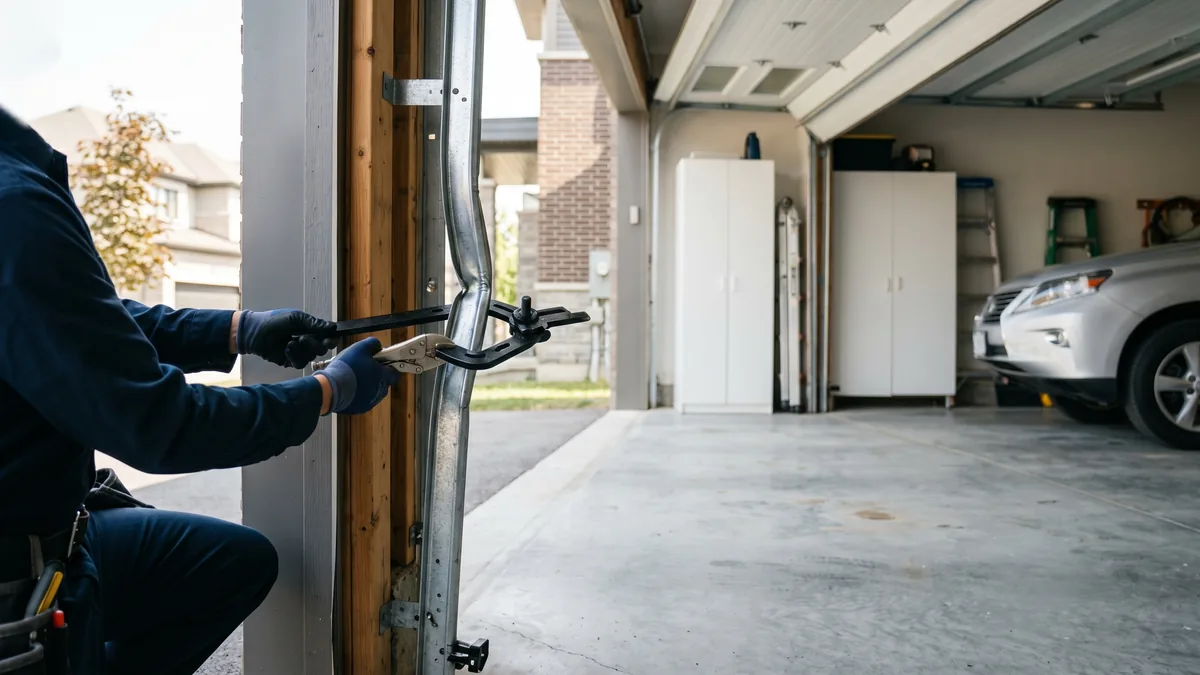
To fix a bent garage door track, close the door, disconnect the opener, and clamp the door in place with locking pliers so it cannot move. Then grip the bent section with Vise-Grips or tap it with a rubber mallet against a block to work the metal gently back to shape, checking the rollers run freely as you go. Realign the track with a level and re-tighten the brackets. A small dent is a safe DIY repair, but a crushed, kinked, or curved-section bend, or a door that has come off its tracks, needs a professional technician.
What Is a Garage Door Track?
The track is the pair of galvanized-steel rails that guide the door’s rollers as it opens and closes. Each side has a straight vertical section, a curved section, and a horizontal section bolted to the ceiling. The rollers must travel through these rails along a precise path; even a slight bend narrows or warps that path, forcing the rollers to bind, scrape, and skip — which is why a bent track makes the door catch, jerk, or come off entirely.
A bent garage door track is one of the most common repairs I see across Toronto and the GTA, and it almost always starts the same way — a car bumps the track, a snow shovel or ladder gets leaned against it, or a roller jumps and gouges the rail. The good news is that a minor bend is often a straightforward fix you can handle in under an hour. The key is knowing which bends are safe to straighten yourself and which ones mean it is time to call a technician before the door comes off its tracks.
Signs Your Garage Door Track Is Bent
A bent track rarely fails all at once. It usually announces itself with a handful of warning signs that get worse as the rollers chew at the deformed metal. Watch for these:
- The door catches or jerks at the same spot every time it passes a certain point in its travel — that point is where the track is bent.
- A visible bend, dent, kink, or flat spot in the rail when you sight straight down it from top to bottom.
- Scraping or grinding noise as a roller squeezes through the narrowed section. (For a deeper look at door noise, see our guide on why a garage door shakes or vibrates.)
- A gap between the track and the door that grows or shrinks along the track’s length, instead of staying even.
- The track is pulling away from the wall or a bracket has worked loose, letting the rail flex.
- A roller riding at the edge of the track or partially jumped out — a sign the door is about to come off entirely.
If the door has already jumped the track or is hanging crooked, skip the DIY steps below — that is a job for a technician, because relieving the spring and cable load safely is part of reseating the door.
What Causes a Garage Door Track to Bend
Knowing the cause helps you decide whether straightening will hold or whether you need a new track section. In 15+ years across the GTA, these are the culprits I run into most:
- Vehicle impact. By far the most common cause. Backing into or nudging the vertical track even at low speed bends the rail and often loosens the brackets.
- Stored items leaning on the track. Ladders, bikes, shovels, and lumber stacked against the rail slowly push it out of line.
- Loose or rusted brackets. When the lag bolts holding the track to the wall back out — accelerated by road-salt corrosion and our freeze-thaw winters — the unsupported rail flexes and bends.
- A roller that jumped the track. Once a roller pops out, it can gouge and deform the rail as the door keeps moving.
- Forcing the door over an obstruction. A trash bin, a frozen-down door, or a stuck panel can buckle the track when the opener keeps pushing.
- Thin builder-grade tracks. Light-gauge track installed on new builds bends more easily than the heavier commercial-gauge rail.
Repairable vs. Replace: How to Tell the Difference
Not every bent track can — or should — be straightened. Steel that is bent back and forth work-hardens and becomes brittle, so a track that has already been straightened once tends to fail again. Use this table to judge before you pick up any tools.
| Track Condition | Repairable? | Recommended Action |
|---|---|---|
| Minor bend or dent in straight section | Yes | Straighten with pliers/mallet (DIY) |
| Track pulled off wall, rail intact | Yes | Realign and re-anchor brackets |
| Sharp crease or kink in the metal | No | Replace the track section |
| Bend in the curved/transition section | No | Replace (radius must be exact) |
| Rusted-through or perforated rail | No | Replace the track section |
| Crushed track or door off its tracks | No | Call a technician immediately |
If your situation lands in a "No" row, do not try to wrestle it back into shape — you will likely damage the door panels or end up with a brittle track that bends again. A technician can match the correct gauge and curve radius and swap the section properly.
Tools You Will Need
A straightforward bent-track repair needs only basic hand tools — no power tools and no spring work:
- Locking pliers (Vise-Grips) — one pair to clamp the door, one to grip and bend the track.
- Rubber mallet — to tap dents out without scratching or further denting the galvanized rail.
- Adjustable wrench and a socket set — for the track bracket bolts (typically 7/16").
- A level — to confirm the vertical track is plumb after straightening.
- A sturdy step ladder and safety glasses.
- A scrap wood block — to back the track when you tap a dent, spreading the force.
How to Fix a Bent Garage Door Track: Step by Step
Work slowly, and stop the moment anything feels heavier than it should or the door starts to shift. Here is the exact sequence I follow on a minor bend.
Step 1 — Close the Door and Disconnect the Opener
Lower the garage door fully so the springs are at their most relaxed and the door’s weight is resting down. Pull the red emergency release cord to disconnect the opener so the door cannot be powered while your hands are near the track.
Step 2 — Clamp the Door in Place
Lock a pair of Vise-Grips onto the vertical track just below a roller on each side. This stops the door from creeping or sliding while you work and keeps tension off the section you are about to straighten.
Step 3 — Inspect and Mark the Bend
Sight straight down the vertical and horizontal track to find every bend, dent, and flat spot. Mark the affected area with a marker or tape. Spin the rollers nearest the bend by hand to feel exactly where they bind — that tells you precisely how much metal needs to move.
Step 4 — Straighten the Bend
For an inward bend, grip the deformed lip of the track with locking pliers and gently work it back to its original shape, a little at a time. For a dent, place your scrap wood block behind the rail and tap the dent out from the back with the rubber mallet. Check the rollers move freely after each adjustment — the goal is a smooth, even channel, not perfection. Avoid over-bending; steel only tolerates so much before it cracks.
Step 5 — Check Alignment and Bracket Spacing
Hold a level against the vertical track to confirm it is plumb, and verify the horizontal track keeps its correct slight downward slope toward the door. The track should sit roughly a quarter inch from the edge of the door panel along its full length. If it is too close or too far, loosen the bracket bolts slightly and tap the rail into position with the mallet.
Step 6 — Tighten Brackets and Test
Snug every track bracket bolt — firm, not over-torqued. Remove the Vise-Grip clamps, reconnect the opener, and cycle the door several times. It should run smoothly and quietly through the repaired spot with no catching or scraping. If it still binds, the bend is likely beyond a clean DIY fix and the section should be replaced.
When the Door Has Come Off Its Tracks
A door that has fully jumped its tracks is a different and more dangerous job than straightening a small bend. Reseating a heavy sectional door usually means relieving spring and cable load, lifting the panels back into alignment, and re-engaging every roller in sequence — all while a few hundred pounds of door wants to fall. Getting it wrong can release stored spring energy, drop the door, or bend the panels.
If only a single top or middle roller has popped out and the door is otherwise straight, you may be able to ease the roller back into the track by hand with the door clamped. But if the door is hanging crooked, jammed partway, or the cables have come off the drums, leave it where it is and call a technician. Forcing it almost always turns a $150 fix into a panel replacement.
What It Costs to Fix a Bent Garage Door Track in the GTA
Most minor track straightening and realignment is folded into a standard maintenance visit. Here is what the related work typically costs across Toronto, Mississauga, Brampton, and the rest of the GTA:
| Service | Typical Cost (CAD) |
|---|---|
| Maintenance / tune-up (incl. minor track realignment) | $120 + tax |
| Track section replacement (per side) | $150–$300 + tax |
| Cables & brackets (if affected) | $180–$260 + tax |
| Cables & brackets with bottom brackets | $260 + tax |
| Single torsion spring (if damaged in the same incident) | from $280 + tax |
| Panel replacement (if a panel is damaged) | $500–$1,000 + tax |
Royal Garage Doors charges a FREE service call with any repair or installation — a diagnostic fee of $120 applies only if you choose not to proceed after we assess the door. See full, current pricing on our pricing page, or book a same-day appointment online. Our repairs are backed by a 1-year labour and 5-year hardware warranty.
If the track damage came alongside a tired or damaged door, sometimes the smarter spend is a fresh door rather than repeated repairs — explore options on our garage door replacement and overhead doors pages. We supply and install doors from multiple trusted brands.
How to Prevent a Bent Track in the Future
Tracks bend because of preventable accidents and skipped maintenance. A few habits keep yours straight for the life of the door:
- Park with a buffer. Leave clearance between your bumper and the vertical tracks; a tennis ball on a string or a parking mat makes it foolproof.
- Keep the tracks clear. Never lean ladders, bikes, or lumber against the rails.
- Tighten brackets twice a year. A 10-minute pass with a socket wrench catches loosening lag bolts before the rail can flex — the most common silent cause of a slow bend.
- Lubricate every 3–6 months. Smooth-running rollers are far less likely to jump the track and gouge it. The Door & Access Systems Manufacturers Association recommends routine inspection and lubrication — see DASMA for owner guidance.
- Book an annual professional tune-up. A technician spots a leaning track, a worn roller, or a loose cable drum long before it becomes a bend or an off-track door.
- Replace worn rollers proactively. Sealed nylon rollers track straighter and quieter — learn more on our roller replacement page.
When to Call a Professional
Straightening a small dent in a straight track section is a fair weekend job. But call a technician right away if any of these apply: the track is creased, kinked, crushed, or rusted through; the bend is in a curved or transition section; the door has come off its tracks or is hanging crooked; a cable has slipped off its drum; or the door feels heavy and uneven when you lift it by hand (a spring symptom that a bent track can hide). Forcing a damaged track risks dented panels, a dropped door, and a far bigger bill.
Royal Garage Doors serves Toronto, Mississauga, Brampton, Hamilton, and the wider GTA with same-day service. Find your local team in Toronto, Mississauga, Brampton, or Hamilton, read what neighbours say on our reviews page, or learn more about our company.
Bent Track or Door Off Its Rails?
A bent track only gets worse — and a door off its tracks is a safety hazard. Royal Garage Doors offers FREE service calls with any repair across Toronto & the GTA, with same-day appointments and a 1-year labour warranty.
Call 437-265-9995