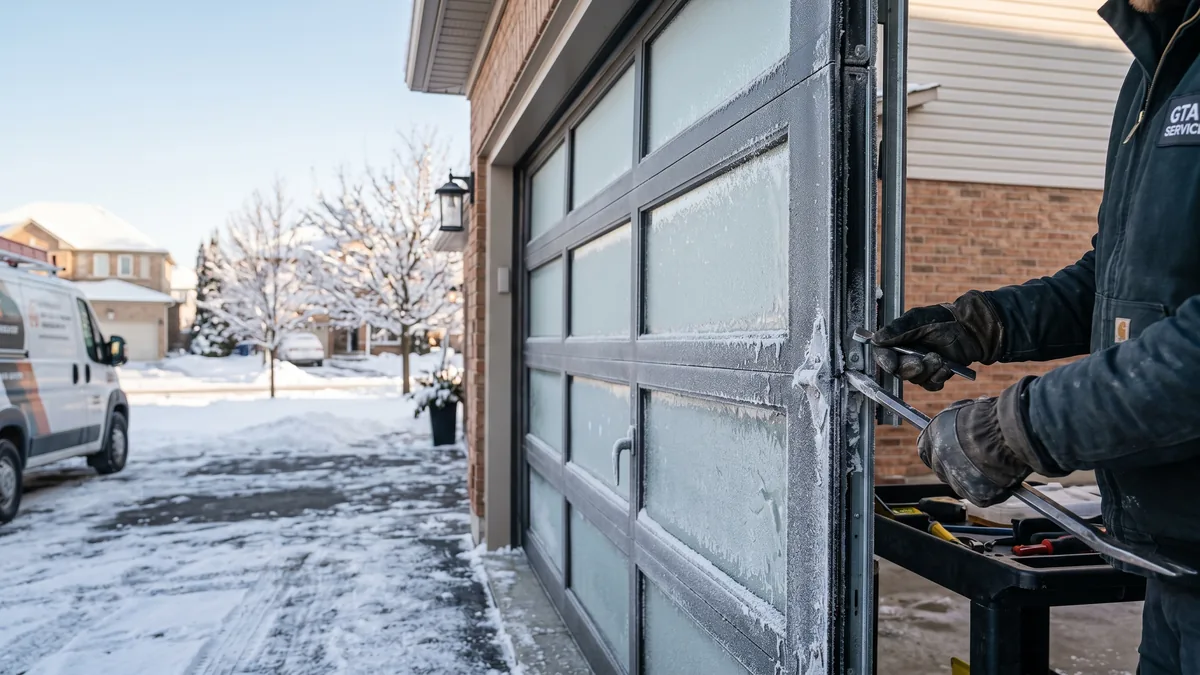
GTA winters affect a garage door by freezing the bottom seal to the concrete, thickening the lubricant in rollers and hinges, contracting the metal so tolerances tighten, and making steel torsion springs brittle and prone to snapping. Openers then strain against the extra resistance and battery backups lose capacity in the cold. The fixes are simple: switch to a silicone lubricant, keep the seal and floor ice-free, and book a pre-winter tune-up so worn springs and stiff seals are caught before the first hard freeze.
Why Cold Is So Hard on a Garage Door
A garage door is the largest moving object in most GTA homes, and nearly every part is metal, rubber, or grease — materials that behave differently below freezing. Steel contracts and grows brittle, rubber stiffens and bonds to ice, and lubricants thicken into a paste. When Toronto temperatures swing from a daytime thaw to an overnight deep freeze, those changes happen repeatedly, stressing springs, cables, and seals far more than a steady cold would.
Every January and February our phones light up across Toronto, Mississauga, Brampton, and the rest of the GTA with the same winter complaints: doors frozen shut, springs that snapped overnight, and openers that suddenly cannot lift a door they handled fine in October. After 15 years of GTA winters, I can tell you almost all of it is predictable — and preventable. Here are the eight ways our cold winters attack a garage door, and exactly how to stay ahead of each one.
8 Ways GTA Winter Affects Your Garage Door
Cold weather rarely causes a brand-new problem out of nowhere. Instead, it exposes and accelerates wear that was already there. Here are the eight winter effects I diagnose most often, roughly from most to least common.
1. The Bottom Seal Freezes to the Concrete
This is the number-one winter call. Meltwater, slush, or condensation under the rubber bottom seal refreezes overnight and glues the door to the garage floor. When the opener tries to lift, it meets a door that will not budge, hits its force limit, and reverses — or worse, tears the seal. A cracked or hardened seal makes it far more likely. Keeping the seal supple and the floor clear is the simplest prevention.
2. Torsion Springs Become Brittle and Snap
Steel loses ductility as it gets colder, so a spring already weakened by thousands of open-close cycles is much more likely to fail on a cold morning. That is why broken-spring calls in the GTA cluster in deep winter. A spring near the end of its rated life will often choose the first hard freeze to break. If you hear a loud bang from the garage on a cold day and the door will not open, suspect a spring — and read our guide to garage door spring warning signs before the next cold snap.
3. Lubricant Thickens and Gums Up Moving Parts
Standard oils and old factory grease turn into a sticky paste below freezing. Rollers stop spinning freely, hinges resist, and the door drags up the tracks. This added friction makes everything else worse — it overworks the opener and stresses the springs. Switching to a silicone-based or garage-door-specific lubricant that stays flexible in the cold solves it.
4. Metal Contracts and Tolerances Tighten
As temperatures drop, steel tracks, rollers, and hardware all shrink slightly. Gaps that allow smooth travel in summer can become tight binding points in a deep freeze, producing grinding, sticking, and uneven movement. This is normal physics, but it stacks on top of thick grease and a stiff seal to make a door feel sluggish.
5. The Opener Strains and Hits Its Force Limit
Your opener does not measure temperature — it measures resistance. A frozen seal, thick grease, contracted metal, and a slightly unbalanced door all add up to more force needed to move the door. The opener compensates until it reaches the safety limit set to protect people and pets, then stops or reverses. Forcing it repeatedly burns out the motor or strips the drive gear. Our opener troubleshooting guide walks through the force-limit reset.
6. Battery Backup and Remote Performance Drop
Lithium and lead-acid batteries lose a noticeable share of their capacity in sub-zero cold, so opener battery backups and keypad and remote batteries weaken in winter. A remote that works fine in the fall may need to be much closer to the door in January, and a backup that ran the door five times in summer may manage only one or two.
7. Cables Stiffen and Drums Bind
Lift cables and the grease in the cable drums and bearings stiffen in the cold, raising the risk that a cable jumps the drum or frays at a tight bend. A door that lifts crookedly or with a jerk on a cold morning may have a cable starting to slip. Cable and bracket service is a job for a technician because of the spring tension involved.
8. Condensation, Rust, and Weather-Strip Cracking
Warm, humid air inside an attached garage meets cold metal and condenses, feeding rust on springs, hinges, and hardware over the winter. Meanwhile UV and cold cycle the perimeter weather stripping until it cracks, letting in drafts and snow. Both are slow, cumulative effects that a fall inspection catches early.
How to Winter-Proof Your Garage Door
Almost every winter failure traces back to a part that was already worn going into the cold. A short autumn routine and a few in-winter habits prevent the vast majority of emergency calls.
- Switch to silicone lubricant. Before the first freeze, clean and re-lubricate rollers, hinges, springs, and bearings with a silicone or garage-door-specific product that stays flexible in the cold. Avoid WD-40, which strips lubrication.
- Inspect and replace the bottom seal. A supple, intact seal will not bond to the floor. Replace a cracked or hardened seal in the fall — new bottom and side seals run $120–$260 depending on door size.
- Keep the floor and seal ice-free. Clear slush and snow from under the door, wipe water away after parking a wet car, and apply a thin silicone coat to the seal so it will not freeze down.
- Test the balance before winter. Pull the red release cord and lift the door by hand; it should rise smoothly and stay put halfway. An unbalanced door overworks the opener all winter and signals a tiring spring.
- Book a pre-winter tune-up. A technician checks spring tension, balance, cables, seal condition, and opener force settings — catching the parts most likely to fail when the temperature drops.
What to Do If Your Door Is Frozen Shut
If you wake up to a door that will not open on a cold GTA morning, work through these steps calmly rather than forcing the opener.
- Stop pressing the button. Repeated attempts against a frozen door can strip the opener gear or snap a brittle spring. One attempt is enough to confirm it is stuck.
- Check whether it is frozen to the floor. Look along the bottom seal for an ice bond. This is the most common cause and the easiest to clear.
- Break the ice seal gently. Use a plastic ice scraper or a hair dryer / heat gun on low along the seal line — never an open flame, and never boiling water.
- Clear slush from the threshold. Chip away ice on the concrete the seal sits against so the door has a clean lift path.
- Disconnect and test by hand. Pull the red release cord and lift gently. If it still will not move or feels far heavier than normal, suspect a spring or cable — stop and call a technician.
What Winter Repairs Cost in the GTA
If the freeze exposed a worn part, here is what the common winter repairs run. A pre-winter tune-up is by far the cheapest insurance.
| Service | Typical Cost (CAD) |
|---|---|
| Winter tune-up (lube, balance, seal check) | $120 + tax |
| Bottom / side weather seal | $120–$260 + tax |
| Cables & brackets | $180–$260 + tax |
| Single torsion spring | from $280 + tax |
For full, current pricing on every service see our garage door pricing page, or book online for a same-day winter visit. If your spring has already gone, our broken spring service and spring replacement cost guide explain the next steps. Looking for the latest weather guidance for your city? The Environment Canada forecast is the official source for GTA cold-snap warnings.
When to Call a Pro This Winter
You can handle lubrication, ice clearing, and seal care yourself. But anything involving the spring system, cables, or a door that will not lift by hand is a job for a technician — these components are under extreme tension and are the most dangerous parts on the door, especially when the steel is cold and brittle. If your door will not open after you have cleared the ice, lifts crookedly, feels far heavier than usual, or you heard a loud bang, stop and get professional help rather than risking injury or a more expensive failure.
Royal Garage Doors serves the entire GTA — including Toronto, Mississauga, and Hamilton — with same-day winter appointments and a FREE service call on any repair. As a local garage door company, we know exactly what GTA cold does to a door.
Door Frozen, Stuck, or a Spring Snapped?
Don't fight a frozen door and risk a broken spring or burned-out opener. Royal Garage Doors offers same-day winter service across Toronto & the GTA, with a FREE service call on any repair.
Call 437-265-9995