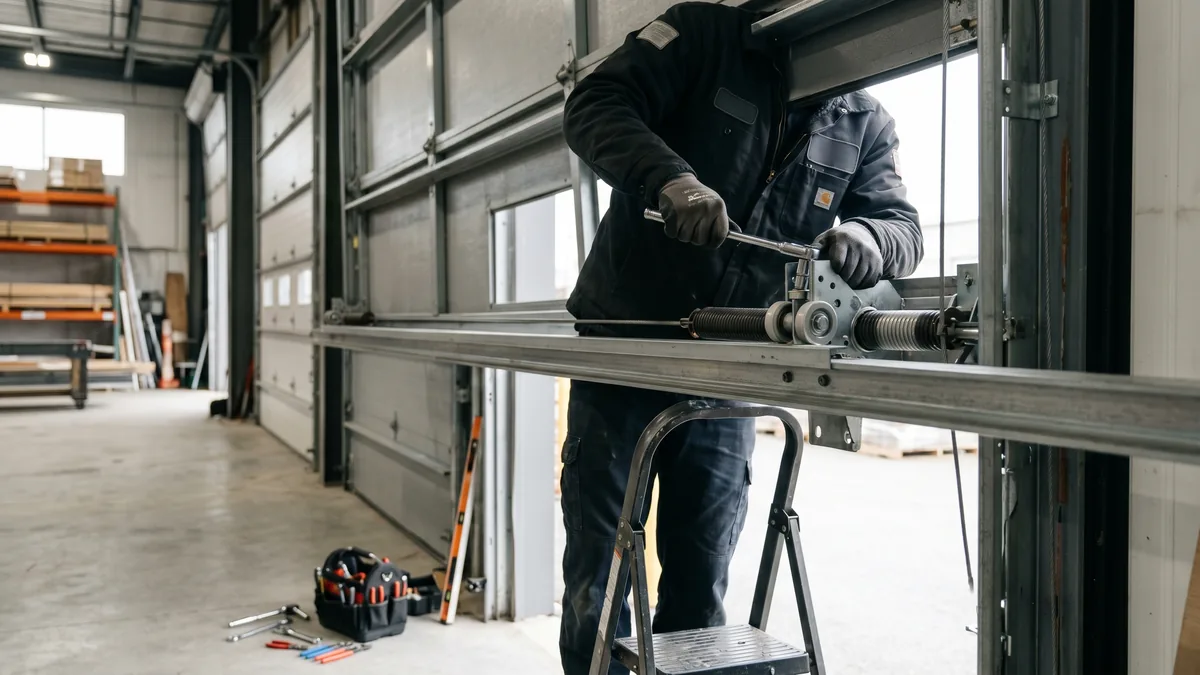
Commercial garage doors should be on a cycle-based preventive maintenance schedule: low-traffic doors twice a year, busy loading docks and fleet bays quarterly or monthly. Every visit should include a balance test, spring and cable inspection, lubrication, hardware tightening, and a safety-device check. A standard commercial tune-up runs $120 + tax per door in the GTA. High-cycle upgrades are discontinued; high-traffic doors need more frequent inspections and standard torsion replacement when worn. Never adjust springs or cables yourself — that work belongs to a certified technician.
What Is Commercial Garage Door Preventive Maintenance?
Preventive maintenance (PM) is a scheduled, documented inspection-and-service routine that keeps a commercial overhead door running before it breaks — rather than waiting for a failure. Unlike a one-off repair, PM is timed to how hard the door works: it tracks cycle counts, replaces wear parts on a planned basis, and catches small problems (a frayed cable, a dry bearing, a loose bracket) while they are still cheap to fix instead of a full-day shutdown.
A commercial overhead door is the busiest mechanical asset on most GTA loading docks — and the one owners think about least until it jams shut and stops the trucks. After 15 years servicing warehouses, shops, and fleet garages across Toronto and Mississauga, I can tell you the math is simple: a $100 tune-up is always cheaper than an afternoon of frozen shipping. This guide lays out exactly how to keep a commercial door running, on what schedule, and where the line is between in-house care and a call to a technician.
Why Commercial Door Maintenance Is Different
Commercial and industrial doors are not just bigger residential doors — they live in a completely different world of duty and risk. A typical home garage door opens and closes maybe 1,500 times a year. A loading dock door at a busy distribution centre can hit that number in a few weeks. That cycle volume changes everything about how the door is built and how it must be maintained.
- Cycle count drives wear. Springs, rollers, cables, and bearings all wear out on a cycle clock, not a calendar. A door cycling 50 times a day burns through parts roughly 10–15 times faster than a home door.
- Downtime has a dollar cost. When a residential door fails, one family is inconvenienced. When a commercial door fails, trucks back up, shipments stall, and staff stand idle — often costing far more per hour than the repair itself.
- Safety and liability stakes are higher. Heavy commercial doors operate around forklifts, staff, and the public. A failing spring or a defeated safety edge becomes a workplace hazard with regulatory and insurance consequences.
- Equipment is heavier-duty. Commercial doors use thicker-gauge steel, continuous-duty operators, heavy bearings, and high-cycle springs — components that need their own inspection standards.
This is the core difference: residential maintenance is a calendar habit, while commercial maintenance is a cycle-based discipline. If you operate doors across multiple bays, a structured program managed by a professional garage door company protects both uptime and your safety record. For repair-side support, our commercial garage door repair team handles springs, operators, and panels on the same heavy-duty doors.
The Commercial Garage Door Maintenance Checklist
Every thorough PM visit walks the same logical path: confirm the door is balanced, inspect the high-tension and high-wear parts, lubricate and tighten, then verify the safety systems and operator. Here is the checklist we run on commercial doors in the field, broken into the five inspection zones.
1. Balance & Spring System
The springs counterbalance the door’s full weight, so they are the heart of the system and the part that fails most expensively. With the operator disconnected, a balanced door should hold position when raised halfway. We inspect torsion springs for gaps between coils (a sign of a break), rust, and fatigue, and check that high-cycle springs are still within their rated life. We never adjust a loaded spring without proper winding bars and training. If a spring is at end of life, replacing it during PM is far cheaper than an emergency callout — see the warning signs in our broken spring guide.
2. Cables, Drums & Bearings
Lift cables carry the door’s weight in tension. We inspect them end to end for fraying, kinks, rust, and broken strands — a single broken wire means the cable is on its way out. Cable drums must be seated and grooved correctly, and the end bearings should spin smoothly without grinding. Worn cables and brackets are a common commercial repair; if yours need attention, our broken cable service covers replacement and re-tensioning.
3. Rollers, Hinges & Tracks
Heavy commercial doors use steel or heavy-duty nylon rollers with sealed bearings. We check each roller for flat spots, worn stems, and bearing roughness, inspect hinges for cracks and elongated holes, and sight the tracks for bends, dents, and loose lag bolts. Bent track is common on docks where forklifts clip the opening. Roller replacement keeps the door quiet and smooth — our roller replacement service upgrades worn builder-grade rollers to long-life units.
4. Panels & Hardware
We inspect every section for dents, bowing, rust-through, and delamination, and confirm the struts and reinforcement are intact on wide doors. Then we torque every bracket bolt, hinge fastener, strut bolt, and track lag — a single pass that prevents the rattles and misalignment that destroy rollers. If a section is damaged beyond repair, individual panel replacement is usually far cheaper than a whole new door.
5. Operator & Safety Devices
Commercial operators (jackshaft, trolley, or hoist) get a check of the limit and force settings, the manual disconnect, and the mid-stop and timer-to-close features many commercial units use. Then we test the safety systems: photo-eyes, the reversing edge on the bottom of the door, and the auto-reverse. A defeated or misaligned safety device is the single most common compliance failure we find. If your operator is acting up, our opener repair service covers commercial units, and we service the major brands directly — LiftMaster, Chamberlain, Genie, and Wayne Dalton.
How Often Should a Commercial Door Be Serviced?
There is no single answer — the correct interval is set by how many cycles the door runs, not the calendar. A door that opens 10 times a day and one that opens 80 times a day are two very different machines, even if they look identical. Use cycle volume to set the schedule:
| Usage Level | Typical Cycles/Day | Examples | Recommended PM Interval |
|---|---|---|---|
| Light | Under 10 | Small shop, single service bay, storage unit | Twice a year |
| Moderate | 10–25 | Auto shop, small warehouse, contractor garage | Every 3–4 months |
| Heavy | 25–50 | Busy distribution, fleet bay, car wash | Quarterly |
| Severe | 50+ | High-volume dock, courier hub, transit garage | Monthly |
If you do not track cycle counts, a simple field test is to listen and watch: a door that has started getting louder, jerkier, or slower since the last visit is telling you the interval is too long. Many commercial operators log cycle counts in their control board — ask your technician to read it during each PM so the schedule can be tuned to real usage.
High-Cycle Spring Upgrades: Discontinued
Royal Garage Doors no longer offers high-cycle spring upgrades. Busy commercial doors should use standard torsion springs with a documented inspection schedule. A standard torsion spring is rated for roughly 10,000 cycles. On a door cycling 50 times a day, that is about 200 working days — under a single year — before the spring is statistically due to break. The break almost never happens at a convenient time.
High-cycle springs are wound from heavier wire over a longer length, so they deliver the same lifting force with far more cycles before fatigue. They cost more upfront but transform the math on a high-traffic door:
| Spring Rating | Approx. Cycles | Best For | Years at 50 cycles/day* |
|---|---|---|---|
| Standard | ~10,000 | Light residential or low-traffic doors | ~0.5 years |
| High-cycle 25K | ~25,000 | Moderate commercial use | ~1.4 years |
| High-cycle 50K | ~50,000 | Busy docks and fleet bays | ~2.7 years |
| High-cycle 100K | ~100,000 | Severe, continuous-duty openings | ~5.5 years |
*Approximate estimates for planning only; actual life varies with door weight, balance, temperature swings, and maintenance.
For a deeper dive into spring selection for busy doors, see our companion article on high-cycle springs for commercial doors. If you want to verify which springs your door currently runs, the spring color code guide and our piece on how to measure torsion springs explain how to read the wire size and winding. Springs also come in oil-tempered vs galvanized finishes, which matters in damp dock environments.
Commercial Maintenance & Repair Costs in the GTA
A scheduled maintenance visit is the least expensive thing you will ever do for a commercial door, and it keeps the bigger numbers from showing up unexpectedly. Here is current GTA pricing (CAD, plus tax) for commercial-door work, all from our live pricing page:
| Service | Typical Cost (CAD) |
|---|---|
| Maintenance & tune-up (per door) | $120 + tax |
| Per spring (commercial / multi-spring) | $160 / spring + tax |
| Single torsion spring (lighter doors) | from $280 + tax |
| Double spring setup | $320–$460 + tax |
| Cables & brackets | $180–$260 + tax |
| Cables with bottom brackets | $260 + tax |
| Safety sensor repair / replacement | $120–$180 + tax |
| Weather seal (bottom / side, by size) | $120–$260 + tax |
| Panel replacement | $500–$1,000 + tax |
| New commercial opener / operator | from $630 + tax |
A few cost notes that matter for budgeting commercial work:
- The service call is FREE with any repair or installation. A diagnostic-only visit is $120 if you decide not to proceed after the assessment.
- Multi-door sites are quoted per door — a scheduled PM contract across several bays is usually priced below the single-door tune-up rate.
- Warranties: 1-year labour, 5-year hardware, and a lifetime panel warranty against rust-through perforation.
- No weekend or holiday surcharge and same-day service is available across the GTA.
If a door is past economical repair, replacement of the door or the operator may be the better call. See our pages on garage door replacement, overhead garage doors, and the opener installation cost breakdown.
What You Can Do In-House vs. When to Call a Pro
A facilities team can safely handle a meaningful share of routine care between professional visits — and doing so extends the life of every part. The dividing line is tension: anything under spring or cable load is a technician’s job, period.
| Task | Frequency | In-House? | Notes |
|---|---|---|---|
| Keep tracks clean & clear | Weekly | Yes | Never lubricate inside the tracks |
| Lubricate rollers, hinges, bearings | Monthly | Yes | Use commercial-grade lubricant, not WD-40 |
| Test photo-eyes & auto-reverse | Monthly | Yes | Block the beam; door must reverse |
| Tighten visible bracket bolts | Quarterly | Yes | Do not touch spring or bottom brackets |
| Balance test & spring inspection | Per PM | No | Requires winding bars & training |
| Cable / drum replacement | As needed | No | High tension — technician only |
| Operator force / limit adjustment | Per PM | No | Affects safety reversing |
| Bent track repair / replacement | As needed | No | Professional alignment needed |
Two authoritative references are worth keeping on hand for your facilities team. The Door & Access Systems Manufacturers Association (DASMA) publishes technical data sheets on commercial door maintenance and operator safety, and the U.S. Occupational Safety and Health Administration (OSHA) outlines safety expectations around powered doors in workplaces — useful background even though Ontario operates under its own OHSA rules. When in doubt, the heavy, high-tension parts are a professional’s job.
Warning Signs Your Commercial Door Needs Service Now
Between scheduled visits, train staff to flag these symptoms — each one signals a part heading toward failure that is cheaper to fix today than after a shutdown:
- The door has gotten louder, jerkier, or slower. Rising noise is the earliest sign of dry bearings, worn rollers, or loosening hardware.
- It hesitates, lurches, or feels heavy on the operator. A balance or spring problem that overworks the operator and shortens its life.
- You can see a gap in a torsion spring coil. A broken spring — stop using the door and call immediately.
- Cables look frayed, loose, or are off the drum. A failing cable can drop the door; this is urgent.
- The safety reverse does not trigger. A compliance and injury hazard that must be corrected before the door stays in service.
- Daylight or drafts around the perimeter. Worn weather seal raises heating costs through GTA winters — an easy, cheap fix.
A door that lurches or reverses unexpectedly may also have an operator or sensor fault; our blog on a door that reverses after hitting the floor walks through that specific failure. For a sense of how long commercial equipment should last with good care, see how long a garage door lasts.
Keep Your Commercial Doors Running — and Your Trucks Moving
Royal Garage Doors runs scheduled preventive maintenance and same-day repairs on commercial overhead and loading dock doors across Toronto & the GTA. FREE service call with any repair, no weekend surcharge, fully insured.
Call 437-265-9995