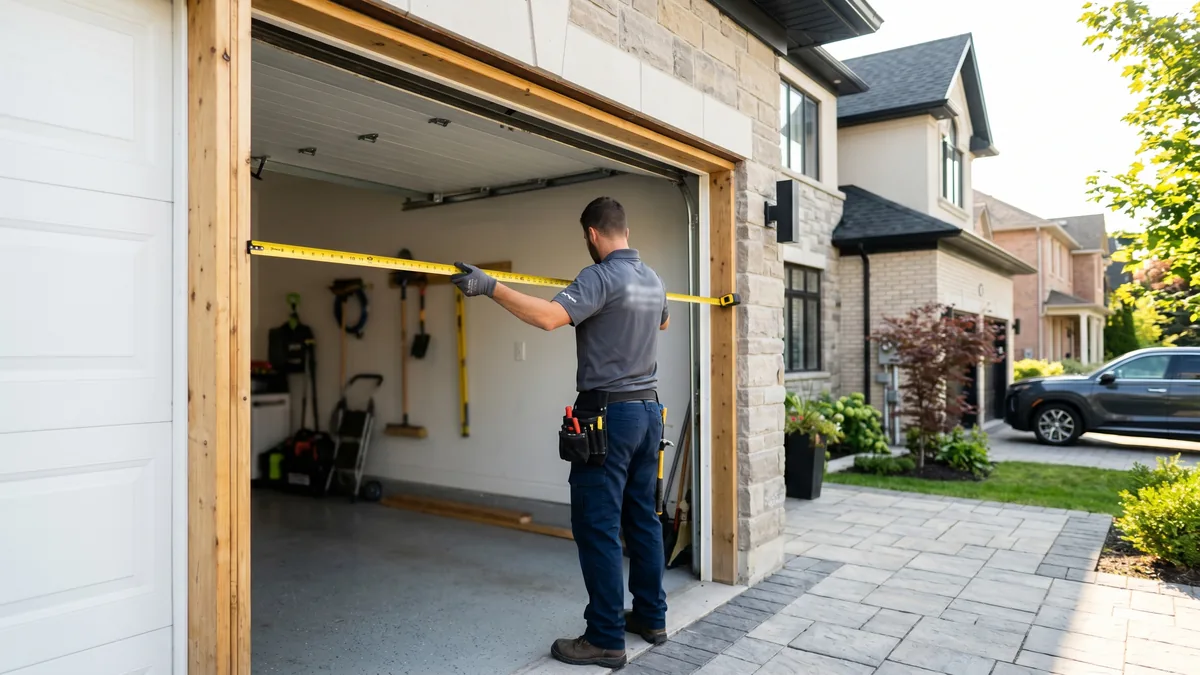
To measure for a new garage door, record six numbers: the opening width, the opening height, the side room on each side, the headroom above the opening, and the backroom (depth) into the garage. Measure the finished opening — the daylight hole the door covers — not the old door. The opening width and height (e.g. 16 ft × 7 ft) is the door size you order; do not add or subtract inches.
What Does "Measuring for a Garage Door" Mean?
Measuring for a garage door means recording the dimensions of the rough opening and the clearances around it so the manufacturer can build a door and the installer can fit the track, springs and opener. The door is sized to the opening, not to the old door panel. A correct measurement covers width, height, side room, headroom and backroom.
Getting the measurement right is the single most important step in buying a new garage door — an order placed off the wrong number means weeks of delay and a restocking headache. In 15+ years installing doors across Toronto and the GTA, I have seen more orders go wrong from a sloppy tape measure than from any other cause. This guide walks you through every measurement, in the order I take them on a real site visit.
Tools You Need and How to Prepare
You don't need anything exotic. Before you start, gather:
- A 25-foot tape measure — longer than a typical opening so you never have to "walk" the tape.
- A step ladder to reach the headroom and backroom along the ceiling.
- A level to confirm the floor and jambs are square.
- A pen and a printed worksheet (or the notes app on your phone) to write down all six numbers.
Park vehicles outside and clear anything stored against the side walls so you can measure the wall flat, not over a shelf or a hook. Measure with the door closed for width and height, then open it to check the backroom and the ceiling. Take every reading in inches first, then convert — garage doors are ordered in feet and inches (for example, 9′0″ × 7′0″).
One habit that prevents almost every ordering error: write each number twice and have a second person re-read it. A 9-foot opening that gets recorded as 8 feet is a brand-new double door sitting in a warehouse while you wait for the reorder. Because garage doors in Ontario are sold by the nominal opening size, the conversion is simple — 96 inches is 8 feet, 108 inches is 9 feet, 192 inches is 16 feet — but it only works if the raw inch measurement is accurate to within about half an inch.
Step 1 & 2: Width and Height of the Opening
These two numbers define the door size. Measure the finished opening — the clear hole the door covers when closed.
Measuring the width
Measure the horizontal distance between the inside faces of the left and right jambs at three points: bottom, middle and top. Use the smallest of the three measurements as your opening width. On a typical single-car opening you should land near 96 inches (8 ft) or 108 inches (9 ft); a double opening is usually 192 inches (16 ft).
Measuring the height
Measure vertically from the floor to the underside of the header (the structural beam across the top of the opening) on the left, centre and right. Again, use the smallest reading. Most GTA homes use a 7-foot (84-inch) opening, though many newer builds use 8-foot (96-inch) openings to clear trucks and SUVs.
Step 3: Side Room (Left and Right)
Side room is the flat, unobstructed wall space on each side of the opening, measured from the edge of the opening outward to the nearest wall, window or obstruction.
- Standard installation: you need a minimum of about 3.75 inches of clear flat wall on each side to mount the vertical track and brackets.
- Wall-mount (jackshaft) opener: you need at least 8 to 12 inches on one side to mount the motor and torsion shaft — useful when you have no ceiling room. Learn more in our guide to side-mount vs wall-mount openers.
If a side window, electrical panel or man door eats into the side room, measure exactly how much space remains. There are low-side-room track options, but your installer needs to know before ordering.
Measure side room on the inside of the garage, against the actual mounting surface. If your garage is finished with drywall, measure to the finished wall, not the bare stud behind it — the track mounts to the surface you see. A common GTA situation is a single garage with a service door (man door) crammed close to the opening on the left; if that door swing or its trim falls inside the 3.75-inch track zone, you may need a low-side-room bracket or a slightly repositioned track. Catching this on paper saves an installer from arriving with hardware that physically cannot be mounted.
Step 4: Headroom Above the Opening
Headroom is the vertical distance from the top of the opening (the header) to the ceiling or the lowest obstruction above, such as a duct, beam or light.
| Setup | Headroom Required | Notes |
|---|---|---|
| Standard torsion spring | ~12 inches | The most common configuration |
| Extension spring | ~10 inches | Older or budget systems |
| Low-headroom track kit | 4.5–6 inches | Double-track; needs extra side room |
| High-lift conversion | 15+ inches | Door rides higher before turning back |
| With opener (any of the above) | Add ~3 inches | For the opener bracket and rail |
If you have less than 12 inches, do not panic — a low-headroom kit solves most cases. But it changes the hardware and the price, so it has to be specified up front. Reaching for the lowest profile? Our jackshaft opener guide covers ceiling-free options.
Step 5: Backroom (Depth)
Backroom is the unobstructed depth from the opening straight back into the garage, measured along the ceiling. The horizontal tracks and the opener rail live in this space.
- Manual door (no opener): door height plus about 18 inches. For a 7-foot door that is roughly 102 inches of clear depth.
- Door with an opener: door height plus about 42 inches to leave room for the opener motor head and rail behind the tracks.
Watch for ceiling-mounted storage racks, water heaters, or HVAC units that hang into this zone. If backroom is tight, a wall-mount opener removes the ceiling rail entirely.
To measure backroom accurately, stand the tape at the top inside edge of the opening and run it straight back along the ceiling to the first obstruction or the rear wall. In many GTA bungalows and townhomes the rear of the garage is shared with a furnace room or a built-in shelving unit, so the usable depth is shorter than the slab itself. Note both the slab depth and the depth to the nearest obstruction — the smaller number is what governs the install.
How the door type affects backroom
A heavier insulated steel door is no deeper than a single-layer door, but the springs and tracks behind it must be sized correctly for the extra weight, and the opener you choose needs the horsepower to match. If you are weighing an insulated upgrade alongside your new door, our opener comparison and our replacement service page explain how door weight, track depth and motor choice work together. The measurement stays the same; the hardware spec changes.
Standard Garage Door Sizes in Ontario
Once you have your opening width and height, compare them to the common sizes. Manufacturers like Clopay build to these standards, and ordering a standard size keeps cost and lead time down:
| Door Type | Common Size (W × H) | Best For |
|---|---|---|
| Single car | 8 × 7 ft | Compact cars, older GTA homes |
| Single car | 9 × 7 ft | Most common single in Ontario |
| Single car (tall) | 9 × 8 ft | SUVs, pickups, newer builds |
| Double car | 16 × 7 ft | Most common double |
| Double car (tall) | 16 × 8 ft | Two large vehicles |
| Oversized double | 18 × 7 ft | Wide three-bay layouts |
If your opening is a non-standard size — say 100 inches wide — a custom door is possible but costs more and takes longer. Often the better answer is a standard door with the framing adjusted. That is a judgment call best confirmed with a professional measure-up before you commit.
Common Measuring Mistakes to Avoid
Here are the errors I correct most often when re-measuring after a homeowner's first attempt:
- Measuring the door instead of the opening. The number one mistake. Always measure the hole.
- Measuring width at only one point. Openings are rarely perfectly square; take three readings and use the smallest.
- Forgetting the floor slope. A sloped slab changes effective height and how the door seals.
- Ignoring obstructions in the headroom and backroom. Ducts and racks routinely block the rail path.
- Not accounting for the opener. If you plan to add an automatic opener, your backroom and headroom needs both increase.
- Assuming an old door's size was correct. Plenty of doors were installed wrong years ago.
Your Garage Door Measurement Checklist
Before you place an order or request a quote, confirm you have all six numbers recorded:
- Opening width — smallest of three horizontal readings
- Opening height — smallest of three vertical readings (lowest floor point)
- Left side room — flat wall to the nearest obstruction
- Right side room — flat wall to the nearest obstruction
- Headroom — header to ceiling or lowest obstruction
- Backroom — opening to the back wall along the ceiling
With these in hand you can confidently price a door. At Royal Garage Doors, a new supply-and-install starts at $1,350 + tax for an 8×7 single (door panels, all hardware, weatherstripping, professional installation, old door removal and safety check), with a 9×7 single from $1,500 and a 16×7 double from $2,300. Door-only delivery starts at $850 + tax. See the full breakdown on our pricing page, or design your door visually with the door designer.
Want a Guaranteed-Correct Measurement?
Skip the tape-measure stress. Royal Garage Doors offers a free, no-obligation measure-up and quote for a new door anywhere in Toronto & the GTA — we measure, you choose.
Call 437-265-9995