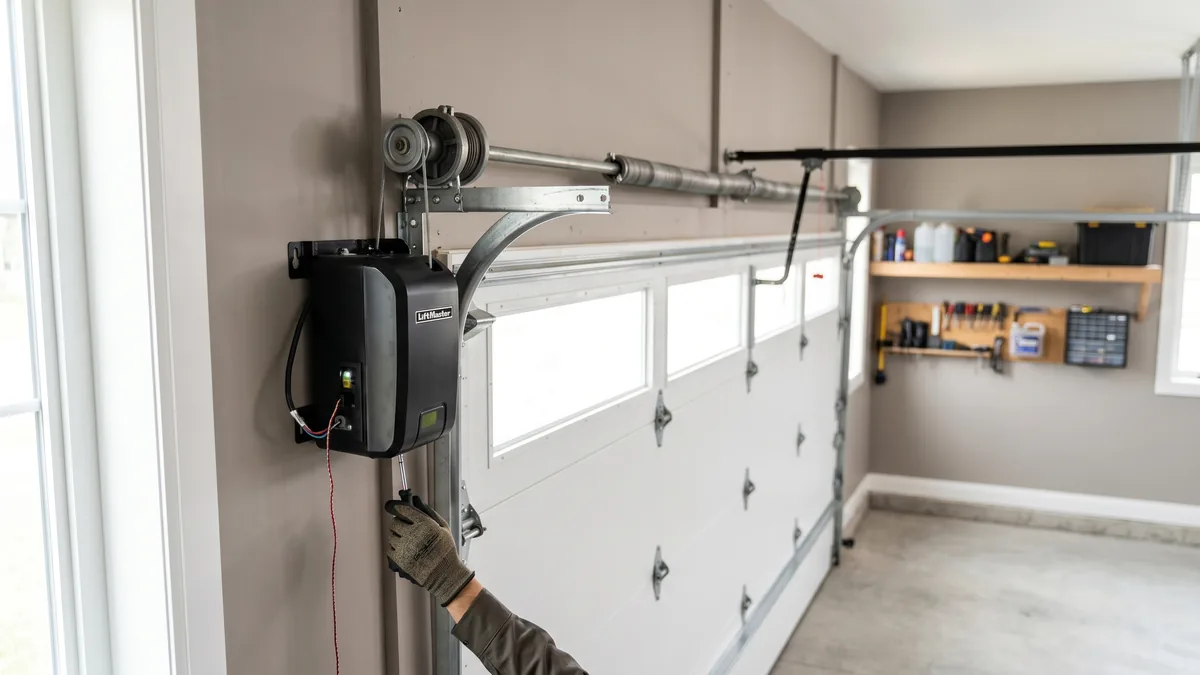
A side-mount garage door opener and a wall-mount (jackshaft) opener are the same thing: a unit that mounts on the wall beside the door and turns the torsion bar directly, instead of pulling the door with a ceiling-mounted rail. Choose a side-mount/jackshaft opener if you have low or finished ceilings, a high-lift door, or want the quietest operation and maximum ceiling storage. Stick with a traditional trolley (rail) opener if you have normal headroom and want the lowest cost — a quality belt-drive trolley is nearly as quiet for less money.
What Is a Side-Mount (Jackshaft) Garage Door Opener?
A side-mount opener is a motor unit that bolts to the wall to the left or right of the garage door and connects directly to the torsion bar (the horizontal steel shaft that holds the springs). When activated, the motor rotates the torsion bar through a coupling, which winds the cables on the drums and raises the door — the same physical action you do by hand when the opener is disconnected. Because the motor is not overhead, there is no rail, trolley, or chain crossing the ceiling. LiftMaster brands this design a “wall-mount opener,” while technicians often call it a “jackshaft” opener because it drives the jackshaft (torsion bar) itself.
If you have ever wished you could reclaim the ceiling above your garage door, or you are tired of a noisy chain rattling through the room above the garage, a side-mount opener is probably what you are looking for. After installing both styles in thousands of GTA garages, here is exactly how they differ, who each one suits, and what they cost in Ontario.
How Each Opener Type Works
The word “side-mount” can be confusing because three terms describe the identical product. Let’s clear that up first, then look at how it differs from the opener most homes already have.
Trolley (rail) openers — the traditional design
The opener most GTA homes have is a trolley opener. A motor head hangs from the ceiling at the back of the garage, connected to a steel rail that runs to a header bracket above the door. A trolley travels along that rail, pushing and pulling the door open and closed via the door’s top section. The rail is driven by a chain, a belt, or a screw. These are reliable and inexpensive, but they require roughly 7 to 14 feet of clear ceiling depth and a few inches of headroom above the door for the rail and trolley.
Side-mount / wall-mount / jackshaft openers
A jackshaft opener replaces the entire overhead assembly with a compact motor mounted on the wall beside the door. Instead of moving the door section by section along a rail, it spins the torsion bar, which does the lifting through the existing cable-and-drum system. There is no rail, no trolley, and no chain. The result is a completely clear ceiling and very quiet operation. Most jackshaft models also include an automatic deadbolt that drives into the track when the door is closed, plus a 24-volt battery backup so the door still works in a power outage — useful during the GTA’s ice-storm-season blackouts.
Side-by-Side Comparison
Here is how a wall-mount jackshaft opener stacks up against a standard belt-drive trolley opener on the factors GTA homeowners ask about most:
| Factor | Side-Mount / Jackshaft | Trolley (Rail) Opener |
|---|---|---|
| Mounting location | Wall, beside the door | Ceiling, rail to header |
| Ceiling clearance used | None — ceiling stays clear | Needs 7–14 ft rail run + headroom |
| Noise level | Lowest (no overhead vibration) | Low with belt; loud with chain |
| Best for low ceilings | Excellent | Poor (needs headroom) |
| Works with high-lift / vaulted tracks | Yes — ideal | Often not without long rail |
| Door type required | Torsion spring only | Torsion or extension spring |
| Built-in deadbolt lock | Usually yes | No (relies on opener hold) |
| Battery backup | Standard on most models | Optional add-on |
| Relative cost | Higher | Lower |
| Typical lifespan | 15+ years | 10–15 years |
Noise: the most common reason people switch
If the room above your garage is a bedroom, office, or living space, opener noise matters. A jackshaft opener is the quietest type because the motor is bolted to the wall low to the ground, and there is no rail transmitting vibration into the ceiling joists overhead. A premium belt-drive trolley opener is close behind and far quieter than a chain-drive. If quiet is your only goal and you have headroom, a belt-drive trolley is the value pick. If you want the absolute quietest and a clear ceiling, the jackshaft wins.
When to Choose a Side-Mount Opener
A jackshaft opener is the right call — and worth the premium — in these situations:
- Low headroom: Garages with under 7 inches of clearance above the door often can’t fit a standard rail and trolley. A side-mount opener needs no overhead space at all.
- High-lift or vaulted ceilings: If you have raised the tracks to gain ceiling height (for a car lift, overhead storage, or a tall vehicle), a jackshaft drives the torsion bar regardless of how high the door travels.
- Finished or storage ceilings: Want a drywalled ceiling, a ceiling-mounted rack, or a sport-court hoist? Keeping the ceiling clear is exactly what this opener is for.
- Bedroom or office above the garage: Many GTA two-storey and bungaloft homes have living space over the garage. The wall-mount design keeps vibration out of those rooms.
- Wide or heavy doors: Jackshaft units handle insulated double doors well because they turn the torsion bar directly rather than pushing a single point on the top section. If you are pairing a new opener with a new door, see our garage door replacement guide and the door designer to plan the whole system.
Installation Requirements in the GTA
Before booking a side-mount install, a technician confirms a few things specific to your garage:
- Side clearance: You need roughly 7 to 8 inches of clear wall space beside the door on the side where the opener will mount, so the unit clears the track and any framing.
- Solid mounting surface: The motor bolts to studs or solid blocking. On a poured-concrete or block wall, masonry anchors are used.
- Torsion bar and coupling: The opener clamps onto the torsion bar through a coupling. The bar must be the right diameter and in good condition. If the existing bearings or end plates are worn, they are replaced at the same time — see our end bearing plate guide.
- Power outlet: A grounded outlet must be within reach of the unit’s cord. Many older GTA garages need an electrician to add one.
- Properly balanced door: The door must be balanced and the springs healthy before any opener is installed. An unbalanced door will overwork and shorten the life of any opener.
If your current opener simply died and the door is fine, you may not need a side-mount upgrade at all — a like-for-like repair or replacement is often cheaper. Our garage door opener repair service covers that, and we serve homeowners through pages like garage door repair in Mississauga and across the GTA.
Cost of a Side-Mount Opener in Ontario
At Royal Garage Doors, a wall-mount/side-mount jackshaft opener starts at $800 plus tax, including the unit, professional installation, and remote programming. For comparison, chain-drive trolley openers start at $600 and belt-drive DC trolley openers at $630:
| Opener Type | What You Get | Starting Price (CAD) |
|---|---|---|
| Belt-drive trolley | Quiet rail opener, ceiling-mounted | from $630 + tax |
| Chain-drive trolley | Budget rail opener, louder | from $600 + tax |
| Side-mount / jackshaft (wall-mount) | Clear ceiling, deadbolt, battery backup | from $800 + tax |
| Spring conversion (if extension springs) | Convert to torsion before jackshaft | On-site quote |
The jackshaft sits at the upper end because the unit itself costs more than a basic trolley opener and the install may include adding or upgrading the torsion bar coupling. If your door currently has extension springs, it needs an on-site torsion-conversion assessment; replacement extension-spring sets are discontinued. For a full breakdown of opener and door pricing, see our transparent pricing page. Remember, the service call is FREE with any installation.
The Verdict
Buy a side-mount (jackshaft) opener if you have low or finished ceilings, a high-lift door, living space above the garage, or you simply want the quietest, cleanest setup — the deadbolt and battery backup are real bonuses for Ontario winters. Choose a quality belt-drive trolley opener if you have normal headroom and want excellent quiet operation for less money. Either way, make sure your springs are healthy and the door is balanced first — that single step protects whatever opener you install.
Thinking About a Side-Mount Opener?
Not sure if your garage can take a jackshaft opener? Our IDEA Certified technicians check your side clearance, torsion bar, and spring balance on site. Royal Garage Doors offers FREE service calls with any installation across Toronto & the GTA.
Call 437-265-9995Frequently Asked Questions
Sources and further reading: LiftMaster wall-mount (8500W) opener specifications and the DASMA (Door & Access Systems Manufacturers Association) technical resources on torsion systems and opener clearances.