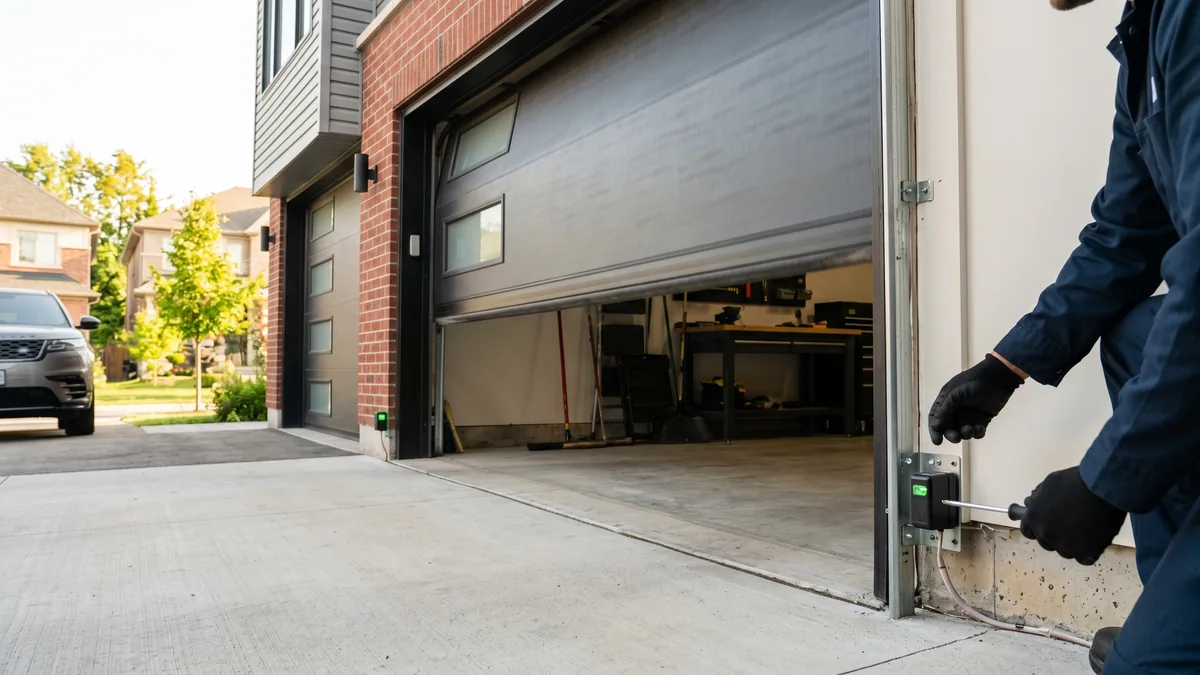
A garage door reverses right after it hits the floor because the opener believes it has struck an obstacle. The most common causes are a down-travel limit set too far (the door keeps pushing after the seal touches down) and a close-force setting that is too sensitive. Worn rollers, a sticky track, a slightly unbalanced door, or a reflected safety-sensor beam can also create enough drag to trigger the auto-reverse. Adjusting the down limit and close force on the opener fixes the majority of cases in a few minutes.
What Is Happening When a Door Reverses at the Floor?
Every modern opener constantly compares how far the door has travelled and how much force it is using against two programmed limits. When the door reaches the floor with the down-limit set correctly, the opener stops. If the door is told to keep travelling past the floor, or if it meets unexpected resistance before the limit, the opener interprets that as a person, pet, or object in the way and automatically reverses — exactly as the safety standard requires.
A garage door that closes all the way, touches the floor, and then immediately rolls back up is one of the most confusing faults a homeowner can face — and one of the most common service calls we take across Toronto and the GTA. The good news is that the opener is doing its job: it is reversing to protect you. The bad news is that something is tricking it. In this guide I will walk you through the six real causes, how to tell them apart, and the exact opener adjustments that fix it.
The 6 Most Common Causes of a Door Reversing at the Floor
A door that reverses at the bottom of its travel is almost never a dead opener — the motor clearly has plenty of power, since it just drove the door all the way down and back up. The real culprit is one of these six things, ranked roughly from most to least common.
1. Down-Travel (Close) Limit Set Too Far
The down limit tells the opener exactly where the floor is. If it is programmed to drive the door slightly past the floor, the door bottoms out, the opener feels the sudden resistance, and it reverses thinking it hit something. This is the number-one cause we see, and it often appears after a power outage, a new opener install, or a seasonal floor-height change. The fix is to back the down-limit off in small increments until the door stops with the bottom seal just kissing the floor.
2. Close-Force Setting Too Sensitive
The close-force (or down-force) control sets how much resistance the opener tolerates before it decides there is an obstacle. Set too low, the opener reverses at the slightest drag — a cold roller, a stiff hinge, or the normal compression of the bottom weather seal. A small bump in close force is often all it takes, but never crank it to maximum, because that defeats the safety reverse that protects children and pets.
3. Worn Rollers or a Sticky, Dirty Track
Near the floor, the door transfers from the curved part of the track to the vertical section, where binding shows up most. Worn rollers with seized bearings or flat spots, a dented track, or built-up grit make the door drag right at the bottom. The opener reads that drag as an obstruction and reverses. Replacing worn rollers and cleaning the tracks removes the false resistance — see our garage door roller replacement service for details.
4. A Slightly Unbalanced Door or Weak Spring
If the counterbalance springs are losing tension, the door gets heavier as it descends and can slam or drag near the floor. The opener has to fight that extra weight, trips the force limit, and reverses. A door that will not stay put when raised halfway by hand has a spring or balance problem — the most serious cause on this list. Read our guide to a broken garage door spring and do not attempt the repair yourself.
5. Safety Sensors Blocked, Misaligned, or Reflecting Sun
The two photo-eye sensors mounted about six inches off the floor will reverse the door instantly if the invisible beam between them is broken. A leaf, a garbage bin, a cobweb, or a knocked bracket all count. A uniquely GTA cause is low winter or evening sun reflecting off a shiny or wet floor straight into a sensor, fooling it right as the door nears the ground. Learn more about how light enters the garage and how to shade or realign the eyes. Sensor service runs $120–$180 + tax.
6. A Faulty or Old Logic Board
Less commonly, a worn opener circuit board misreads travel or force data and reverses for no real reason. This is more likely on openers over 15 years old. If limits, force, sensors, and balance all check out and the door still reverses randomly, the logic board or the opener itself may be at the end of its life. Our garage door opener repair team can confirm whether a board swap or a new opener (from $600) is the smarter spend.
How to Diagnose Why Your Door Reverses
Before you touch a single adjustment screw, spend ten minutes isolating the cause. Working in this order separates a quick opener tweak from a mechanical fault that needs a professional.
- Watch closely where it reverses. Does it reverse the instant it touches the floor, or an inch or two before? Touching first points to the down-limit or close force; reversing early points to the sensors or a mid-travel obstruction.
- Check the sensor lights. Both photo-eyes should show a steady (not flickering) indicator. Wipe the lenses, clear the path, and watch for sun glare on a shiny floor at the time of day it misbehaves.
- Disconnect the opener and lower the door by hand. Pull the red release cord and ease the door down. If it binds, drags, or feels heavy near the floor, you have a mechanical problem — fix that before touching opener settings.
- Run the balance test. Raise the door halfway by hand and let go. A balanced door stays put. One that drops or shoots up has a spring problem.
- Inspect the bottom of the tracks and rollers. Look for grit, dents, or seized rollers in the lowest two feet of travel, where reversing-at-the-floor faults concentrate.
How to Fix It: Limit and Force Adjustment
If the door touches the floor before reversing and lowers smoothly by hand, the fix is usually a simple opener adjustment you can do yourself. Most LiftMaster, Chamberlain, and Genie openers have a down-travel limit screw and a close-force dial on the motor head. Always read your owner’s manual for your exact model first — the official LiftMaster support site has model-specific guides.
- Rule out the sensors. Confirm both photo-eye lights are steady, wipe the lenses, and clear and shade the beam path.
- Set the down (close) limit. Locate the down-travel limit screw. Turn it in small steps so the door stops with the bottom seal just touching the floor — not crushing into it and not leaving a gap.
- Adjust the close force. Nudge the close-force dial up slightly so the opener can seat the door without false-tripping, then stop. If you need a big increase, the real issue is mechanical drag — do not keep adding force.
- Test the safety reverse. Lay a flat 2x4 board on the floor where the door lands. Close the door; it must reverse the moment it strikes the wood. If it does not, the safety system is unsafe — stop and call a technician.
- Re-test a normal close. With the board removed, the door should now close fully and stay closed, and still reverse on a genuine obstacle.
DIY Fixes vs. When to Call a Pro
Some causes of a door reversing at the floor are genuinely homeowner-friendly. Others involve high-tension springs and cables that send people to the hospital every year. Use this table to decide which side of the line you are on.
| Cause | Difficulty | Safe to DIY? | Action |
|---|---|---|---|
| Down-limit set too far | Easy | Yes | Back off the down-travel screw |
| Close force too sensitive | Easy | Yes | Increase force slightly, re-test |
| Blocked or dirty sensors | Easy | Yes | Clean, realign, shade the beam |
| Dry rollers / sticky track | Easy | Yes | Lubricate, wipe tracks clean |
| Worn rollers | Moderate | Caution | Replace (bottom roller needs care) |
| Bent or dented track | Hard | No | Call a technician |
| Unbalanced door / weak spring | Hard | No | Call a technician immediately |
| Faulty opener logic board | Hard | No | Professional opener repair |
The Difference Between This and a Door That Reverses Mid-Travel
It is worth separating two faults that get confused. A door that reverses at the floor usually has a down-limit, force, or bottom-drag problem. A door that reverses before it ever reaches the floor, somewhere in the middle of travel, is almost always a broken sensor beam or an obstruction higher in the track. The diagnostic in this guide tells the two apart, and the cause and fix are different for each.
What It Costs to Fix in the GTA
If the fix is a limit and force adjustment, many homeowners handle it themselves for free. When a technician is involved, the adjustment is usually folded into a maintenance tune-up — lubrication, balance, sensor alignment, and limit setting — which runs $120 + tax. If diagnosis turns up a deeper fault, here is what the underlying repairs typically cost across Toronto and the GTA:
| Repair | Typical Cost (CAD) |
|---|---|
| Maintenance & tune-up (incl. limit/force set) | $120 + tax |
| Safety sensor repair / replacement | $120–$180 + tax |
| Cables & brackets | $180–$260 + tax |
| Single torsion spring | from $280 + tax |
| New opener / motor | from $600 + tax |
For full, current pricing on every service, see our garage door pricing page. Note that our service call is FREE with any repair — a $120 diagnostic fee applies only if you choose not to proceed after the assessment. When you are ready, book a same-day appointment online or check our customer reviews first. Homeowners across Mississauga, Toronto, and Brampton rely on us for fast opener and sensor diagnosis.
Brand Notes: LiftMaster, Chamberlain, Genie & Wayne Dalton
Limit and force controls differ slightly by brand, but the principle is identical. We service every major opener brand without favouring one — whether you need LiftMaster, Chamberlain, Genie, or Wayne Dalton opener repair, the diagnostic path is the same: sensors, balance, then limits and force. The DASMA technical bulletins on entrapment-protection systems, available at DASMA.com, explain why every residential opener is built to reverse on contact.
Door Still Reversing After You Adjusted It?
If the door keeps reversing after a limit and force adjustment, the cause is usually a worn roller, a weak spring, or a failing sensor — jobs best left to a pro. Royal Garage Doors provides FREE service calls with any repair across Toronto & the GTA, with same-day appointments available.
Call 437-265-9995