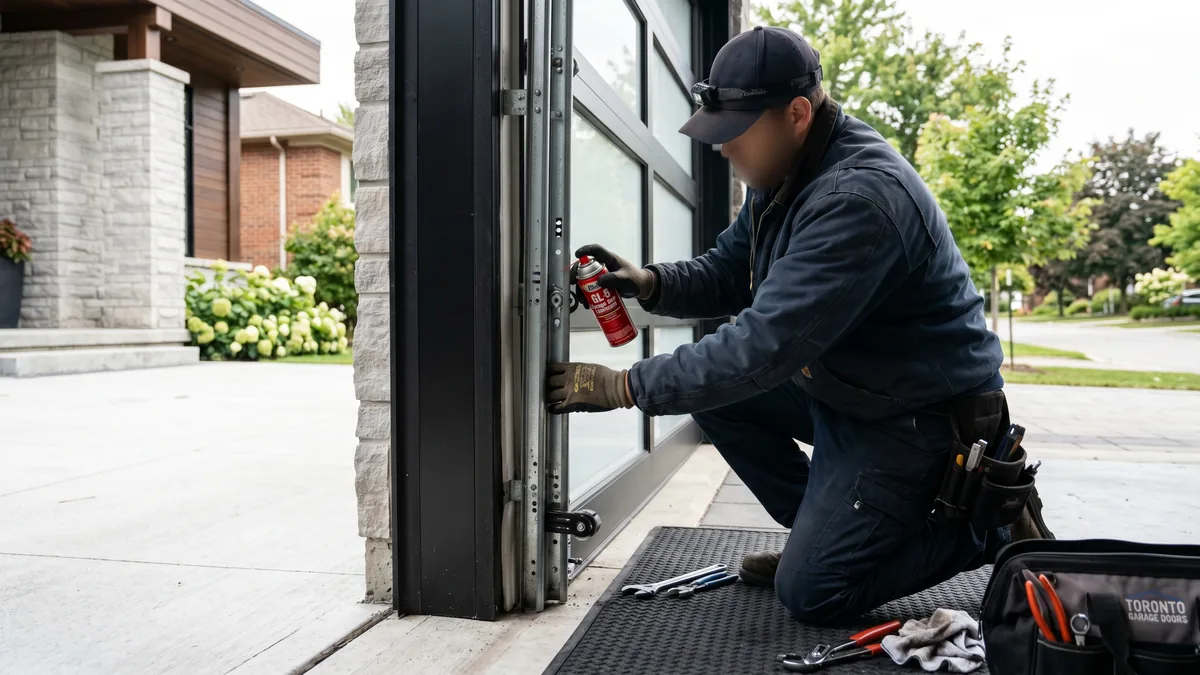
A professional garage door tune-up costs $120 + tax across Toronto and the GTA in 2026. That flat rate covers a full maintenance service: lubrication of rollers, hinges, and springs, a balance test, safety-sensor alignment, and tightening of every nut, bolt, and bracket. There are no extra charges for weekends or holidays, and any parts that need replacing are quoted up front. Booked once a year, a tune-up prevents far costlier spring (from $280) and opener (from $630) failures.
What Is a Garage Door Tune-Up?
A garage door tune-up is a preventive maintenance service in which a technician lubricates, adjusts, tightens, and inspects every moving part of the door system. The goal is to keep the door balanced and quiet, catch worn components before they fail, and extend the life of the springs, rollers, cables, and opener. Think of it as an oil change for the largest moving object in your home — small, scheduled, and far cheaper than the breakdown it prevents.
Every week I get asked some version of “is a garage door tune-up actually worth the money?” across Toronto, Mississauga, and the wider GTA. The honest answer is yes — and the math is simple. A $120 tune-up regularly heads off a snapped spring, a burned-out opener, or a 7 a.m. emergency call that costs several times more. Here is exactly what a tune-up costs in 2026, what is included, and how to tell when it is time to book one.
How Much Does a Garage Door Tune-Up Cost?
In the GTA, a standard residential garage door tune-up is a flat $120 + tax. Pricing sits at the lower end for a single door in good condition and the upper end for a double door or a system that needs more adjustment. Unlike some trades, a reputable garage door company charges the same rate on weekends and holidays — there is no surcharge for a Saturday appointment. The only variable is parts: if the inspection turns up a worn roller, a fraying cable, or a spring losing tension, those repairs are quoted separately and approved by you before any work happens.
Here is how tune-up pricing breaks down against the repairs it is designed to prevent. Our full, current rates live on the pricing page, but this gives you the at-a-glance picture:
| Service | Typical Cost (CAD) | What It Covers |
|---|---|---|
| Maintenance & tune-up | $120 + tax | Lubrication, balance, sensor alignment, hardware tightening |
| Safety-sensor repair | $120–$180 + tax | If a sensor is faulty rather than just misaligned |
| Cables & brackets | $180–$260 + tax | Replace frayed cables, realign brackets ($260 with bottom brackets) |
| Single torsion spring | from $280 + tax | If a spring is past its cycle life |
| New opener / motor | from $600 + tax | If an overworked opener has failed |
The pattern is clear: the tune-up is the cheapest line on the list, and it exists to keep you off the rest of it. A door that gets serviced once a year rarely surprises its owner with a sudden, expensive failure.
Does a Tune-Up Include a Free Service Call?
This is where Royal Garage Doors differs from many shops. Our service call is FREE whenever you proceed with a repair or installation. A standalone tune-up is the flat $120, and if it uncovers a repair you choose to go ahead with, the diagnostic is folded in at no extra charge. A separate $120 diagnostic fee only applies if, after the assessment, you decide not to proceed with the recommended work. In practice, most homeowners booking a tune-up either get a clean bill of health or approve a small fix on the spot.
What's Included in a Garage Door Tune-Up
A real tune-up is more than a quick spray of lubricant. When one of our IDEA Certified technicians services a door, the visit follows a consistent checklist that touches every safety-critical and wear-prone component. Here is the full scope.
1. Lubrication of All Moving Parts
The technician applies a garage-door-specific or silicone-based lubricant to the rollers, hinges, springs, bearing plates, and the opener rail. This is the single most impactful maintenance task — it cuts noise, reduces friction, and protects metal parts through the GTA’s freeze-thaw winters. WD-40 is never used; it is a degreaser, not a lubricant, and it strips the protection a door actually needs.
2. Hardware Tightening
A door cycles thousands of times a year, and that constant vibration loosens nuts, bolts, hinge screws, and track brackets. The technician snugs every fastener with a socket wrench so the panels and tracks stop shifting and rattling. Loose hardware is a leading cause of a noisy or shaking door — if that is your symptom, see our guide on why a garage door shakes or vibrates.
3. Balance Test and Spring-Tension Check
The opener is disconnected and the door is lifted by hand. A correctly balanced door rises smoothly and stays put when raised halfway. If it drifts or feels heavy, the spring tension is off — which overworks the opener and risks a sudden failure. The technician adjusts tension within safe limits or flags the spring for replacement.
4. Safety-Sensor Alignment and Auto-Reverse Test
The photo-eye sensors near the floor are checked for alignment and clean lenses, and the auto-reverse feature is tested with an obstruction to confirm the door reverses on contact. This is a Canadian safety requirement on every opener built since the early 1990s and the part of the system that protects children and pets. Misaligned sensors are corrected on the spot; a genuinely faulty sensor falls into the door-reverses-after-touching-the-floor family of fixes.
5. Cable, Roller, and Track Inspection
The technician sights down every track for bends and gaps, checks the rollers for flat spots and worn bearings, and inspects the lift cables for fraying or rust. Catching a fraying cable at a tune-up — before it snaps — is exactly the kind of early save that makes the service pay for itself. If a roller is on its way out, we cover the swap in our roller replacement service.
6. Full Operational Test and Report
Finally, the door is run through several full cycles to confirm smooth, quiet operation, and the technician walks you through anything approaching the end of its life so there are no surprises later.
DIY Tune-Up vs. Professional Service
You can safely handle part of a tune-up yourself and save the call-out for the high-tension work. The trick is knowing where the safe line is. This table shows which tasks are homeowner-friendly and which belong to a technician.
| Tune-Up Task | Safe to DIY? | Why |
|---|---|---|
| Lubricate rollers, hinges, springs | Yes | Low-risk; use silicone, not WD-40 |
| Wipe tracks clean | Yes | Never lubricate inside the tracks |
| Tighten hinge & bracket bolts | Yes | Socket wrench; do not overtighten |
| Test auto-reverse on an obstruction | Yes | Place a 2x4 flat under the door |
| Adjust spring tension | No | Extreme stored energy — injury risk |
| Replace cables or bottom brackets | No | Held under load by the springs |
| Correct door balance | No | Requires spring adjustment |
| Calibrate / replace safety sensors | Caution | Alignment yes; wiring faults need a pro |
The 20-Minute DIY Maintenance Routine
If you want to stretch the interval between professional tune-ups, run this short routine every few months:
- Tighten everything. From a stable ladder, snug each hinge screw, roller-bracket bolt, and track bracket with a socket wrench.
- Lubricate the moving parts. Apply silicone or garage-door lubricant to rollers, hinges, springs, and bearing plates. DASMA, the door and access systems trade body, publishes manufacturer-aligned maintenance guidance — see the DASMA homeowner resources.
- Wipe the tracks. Clean out dirt and old grease with a rag; never lubricate inside the tracks themselves.
- Test the safety reverse. Lay a flat 2x4 where the door meets the floor and close it — it must reverse on contact.
- Run a balance check. Pull the red release, lift the door halfway, and let go. If it drops or feels heavy, book a pro — do not touch the springs.
How Often Should You Tune Up Your Garage Door?
The standard recommendation — from manufacturers and from my 15 years in the field — is once a year for a typical residential door. In the GTA, the best windows are spring and fall. Our winters are genuinely hard on a garage door: lubricant thickens in the cold, metal contracts, spring tension shifts, and road salt accelerates rust on cables and rollers. A fall tune-up gets the door ready for January; a spring tune-up clears out the winter’s wear.
Some doors need attention more often:
- High-use doors — if your garage is the main entrance and the door cycles four or more times a day, consider a tune-up every six months.
- Older systems — doors and openers past 10 years benefit from twice-yearly checks as parts approach end of life.
- Detached and unheated garages — greater temperature swings mean faster lubricant breakdown.
- Commercial and multi-cycle doors — these run on a different schedule entirely; see our commercial maintenance guide and the commercial repair service.
Tune-Up Schedule at a Glance
| Door Type / Use | Recommended Frequency |
|---|---|
| Standard residential, average use | Once a year (spring or fall) |
| Garage as main entrance, 4+ cycles/day | Every 6 months |
| Door or opener over 10 years old | Every 6 months |
| New door (first 12 months) | One check after the first winter |
| Commercial / high-cycle | Quarterly or per manufacturer spec |
Is a Garage Door Tune-Up Worth the Money?
Let me put the value in plain numbers. A tune-up is $120. The failures it commonly prevents look like this:
- A snapped torsion spring — from $280, and it leaves the door stranded until a tech arrives.
- A burned-out opener from running an unbalanced door — from $630 for a replacement.
- A frayed cable that lets a panel drop — $180–$260, and potentially a damaged panel ($500–$1,000) on top.
- An after-hours emergency call when the door fails at the worst possible moment.
Spending $120 a year to keep the door balanced and the wear parts in check is one of the cheapest forms of home maintenance insurance there is. Beyond avoiding repairs, a well-tuned door is quieter, runs faster, and its opener lasts years longer because it is not fighting friction and imbalance on every cycle. If you are weighing a tune-up against a full door replacement, regular maintenance is also what postpones that bigger expense.
The Bottom Line
At $120 + tax, an annual garage door tune-up is the single best-value service we offer. It costs a fraction of the spring, cable, and opener failures it prevents, keeps your door quiet and safe, and extends the life of every component. For most GTA homes, one tune-up a year — plus a few minutes of DIY lubrication in between — is all it takes to keep the largest moving object in the house running like new.
What a Tune-Up Won't Cover
A tune-up is maintenance, not a substitute for repairs that are already needed. If a spring is already broken, a cable has snapped, or the opener has failed, you are past the tune-up stage and into repair territory — priced separately on our pricing page. The tune-up’s whole job is to spot those problems while they are small, or ideally before they start. It also will not magically fix a door that was poorly installed; in that case, a fresh overhead door or professional reinstall is the real answer.
Ready to Book Your Garage Door Tune-Up?
Keep your door quiet, safe, and reliable for a flat $120 + tax — no weekend surcharge, same-day appointments across Toronto & the GTA. Catch the small problems before they become expensive ones.
Call 437-265-9995