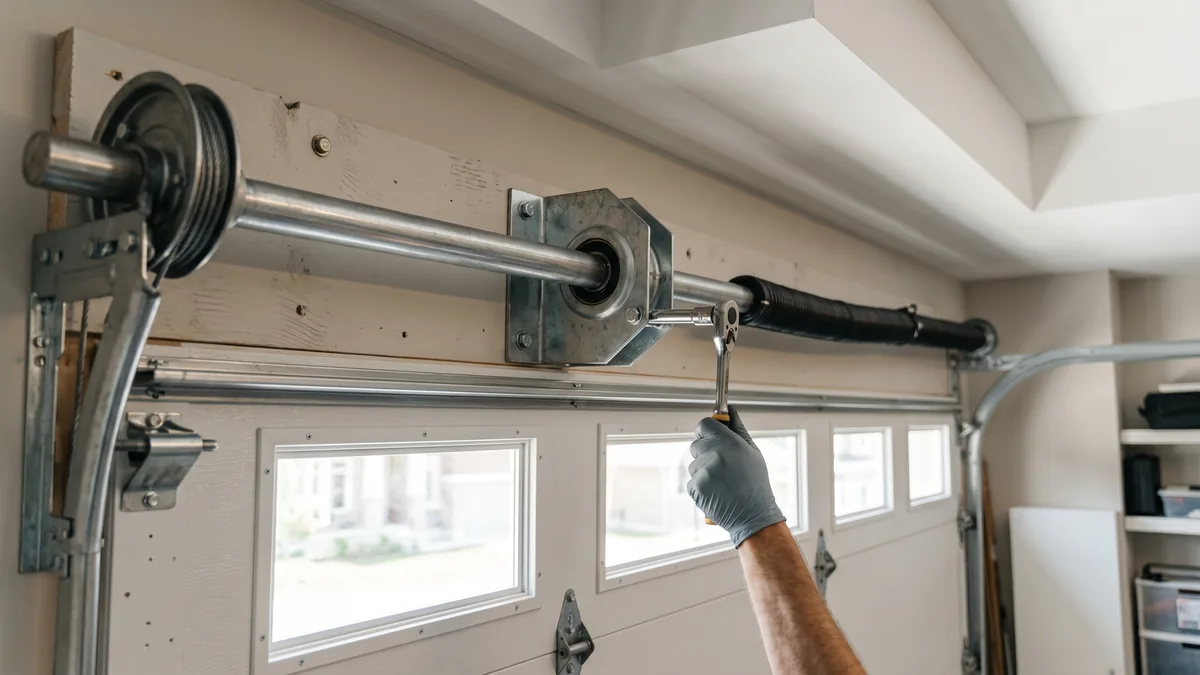
The garage door center bearing is the bearing seated in the center bracket above your door, supporting the torsion bar where it spins. When it wears out you’ll hear a loud squeal or grind from the middle of the door. To replace it: fully unwind the torsion springs with winding bars, loosen the center bracket, slide the bar out, swap the worn bearing for a new one, reassemble, and re-tension the springs. Because the springs hold dangerous stored energy, most GTA homeowners should leave this to a pro.
What Is a Garage Door Center Bearing?
The center bearing is a small steel-and-nylon (or all-steel) bearing pressed into the center bracket plate that mounts to the wall directly above the middle of your garage door. The torsion bar passes through it, and the bearing lets that bar rotate freely while supporting the load transferred from the torsion springs. On a standard residential setup there is one center bearing; doors with two torsion springs usually have the center bracket positioned between them.
A garage door that suddenly squeals from the center every time it moves rarely needs a whole new system — it usually just needs a $5 bearing and the know-how to safely unwind the springs to install it. Across Toronto and the GTA, a worn center bearing is one of the most common (and most ignored) causes of that nerve-grating metallic shriek. Here is how the part works, how to recognize when it’s failing, and exactly how the replacement is done.
How the Center Bearing Fits Into the Torsion System
To understand why the center bearing matters, picture the hardware running across the top of your door. The torsion bar (also called the torsion shaft or tube) spans the full width of the opening. The torsion springs are mounted on it, anchored at the center. As the door moves, the springs wind and unwind, and the bar rotates — transferring lifting force to the cable drums at each end.
That bar has to spin on something. It rests in three bearing points:
- Two end bearing plates — one above each vertical track, where the cable drums sit. If these wear, the noise comes from the corners.
- One center bearing — in the center bracket above the middle of the door, where the springs are anchored. This bearing takes a heavy share of the load because the spring tension pulls hardest at the center anchor.
Because the center bearing carries that concentrated load and spins thousands of cycles a year, it is often the first bearing to fail. In our humid GTA summers and salty winters, moisture and road grit work their way into the bearing race, the factory grease dries out, and metal grinds on metal. The result is the classic squeal. If you want a refresher on how the whole counterbalance works before you dig in, our overview of a broken garage door spring explains the spring side of the system in plain language.
Signs Your Center Bearing Is Worn Out
The center bearing announces its decline well before it fully fails. Watch and listen for these signals:
1. A loud squeal or grind from the center of the door
This is the number-one symptom. A healthy bearing is nearly silent. A worn one produces a high-pitched squeal or a low grinding rumble that seems to come from above the middle of the opening rather than the corners or the tracks. The sound usually appears partway through the travel cycle and grows worse week over week.
2. Lubricant only quiets it temporarily
If you spray the bearing and the squeal disappears for a few days then returns, the bearing surfaces are already worn or pitted. Lubricant is masking the problem, not solving it. A bearing that needs re-lubing every week is a bearing on its way out.
3. Visible rust, discoloration, or play in the bar
Inspect the center bracket with the door closed (springs are at lowest tension when the door is down, but never put hands near a wound spring). Look for orange rust streaking out of the bearing, a bearing that looks scorched or blued from heat, or a torsion bar that visibly wobbles or shifts up and down at the center as the door runs.
4. Rough, jerky, or hesitant movement
A seizing bearing adds friction. The door may move unevenly, hesitate, or seem to fight itself. Your opener will draw more power and may begin straining — which can mimic a failing motor when the real culprit is a frozen bearing.
Why Center Bearing Replacement Is a High-Risk DIY Job
Unlike lubricating a hinge or aligning a sensor, replacing the center bearing means you have to take the torsion springs completely out of play. Here is why that matters.
A torsion spring on a typical 7-foot door is wound to roughly 7–8 turns of tension and stores enough energy to break bones or worse if it releases suddenly. The center bearing sits behind the spring anchor, so you cannot remove it without first unwinding both springs using proper steel winding bars — never screwdrivers or rebar. One slip with the wrong tool is how technicians end up in the ER.
Because the springs are already unwound during a center bearing swap, it is the ideal time to replace springs that are near end-of-life and to inspect the end bearings and cables. That is why our technicians almost always bundle bearing work with a full system check rather than treating it as an isolated fix.
How to Replace a Garage Door Center Bearing (Step by Step)
This is the professional sequence, written so you understand exactly what the repair involves whether you tackle it yourself or hire it out. You will need: two winding bars sized to your spring, a socket/wrench set, an adjustable wrench, vise grips, a stepladder, safety glasses, and the correct replacement center bearing.
- Disconnect power and the opener. Unplug the opener and pull the red emergency release cord so the door is fully manual. Close the door so the springs are at their lowest tension.
- Clamp the door. Lock vise grips onto the track just above a roller, or clamp the bottom roller, so the door cannot rise once spring tension is released.
- Unwind both torsion springs. Insert a winding bar into the winding cone, take the load, loosen the two set screws, and let the spring down a quarter-turn at a time, swapping bars hand-over-hand. Repeat for the second spring. Keep your body out of the bar’s arc at all times.
- Loosen the cable drums and center bracket. Mark cable position, loosen the drum set screws to free the cables, then unbolt the center bracket from the wall (or loosen it enough to free the bearing) and loosen the spring anchor.
- Slide the bar and remove the old bearing. Shift the torsion bar sideways enough to expose the center bracket, then pop or press the worn bearing out of the bracket. Note its orientation and size.
- Install the new bearing. Seat the new bearing into the center bracket in the same orientation. Make sure it sits flush and the bar will pass through cleanly.
- Reassemble. Re-center the bar, re-bolt the center bracket, reset the cable drums to your marks, and confirm the cables are seated in the drum grooves with no slack.
- Re-tension the springs. Wind each spring back to the manufacturer’s turn count (typically the original 7–8 turns), tighten the set screws onto the bar — not the threads — and remove the winding bars carefully.
- Test and balance. Remove the vise grips, reconnect the opener, and run the door. Then do a manual balance test (below) to confirm everything is correct.
If at any point the bar binds, the drums slip, or the door is unbalanced, do not force it. A binding bar after a bearing swap usually means the bearing isn’t seated square or the bracket is slightly off. This is also a job that pairs naturally with adjusting garage door spring tension since the springs are already off.
Center Bearing Types and What to Buy
Center bearings are inexpensive, but choosing the right one matters for noise and longevity. Here is how the common options compare for GTA homes.
| Bearing Type | Best For | Noise Level | Lifespan |
|---|---|---|---|
| Nylon-race (standard) | Most residential doors; quiet operation | Very quiet | Good (matches spring life) |
| Steel-race (sealed) | Heavy doors, high-cycle use, double-spring setups | Quiet when greased | Excellent |
| Bearing-in-bracket (combo) | Replacing a damaged center bracket too | Quiet | Good |
| Cheap open bushing | Avoid — no sealed race | Squeals fast | Poor in GTA humidity |
For Mississauga, Toronto, and the wider GTA, where humidity and winter salt are hard on hardware, we recommend a sealed bearing with a matching bracket. Match the bearing’s bore to your torsion bar diameter — most residential bars are 1 inch, but heavier and commercial doors use larger bars. If your bracket is rusted or bent, replace the bracket and bearing as a unit. Worn bearings often travel with worn rollers, so it’s worth reviewing our guide to garage door roller replacement while the system is apart.
Cost, Balance Testing, and When to Call a Pro
What it costs in the GTA
The bearing part itself runs only a few dollars. The cost is the labour and risk of safely unwinding and re-tensioning the springs. At Royal Garage Doors, center bearing work is normally handled within our cables and brackets service in the $180–$260 range (with bottom brackets included, $260), and we frequently combine it with spring replacement because the springs are already unwound — a single torsion spring is $280 and a double spring setup runs $320–$460. A maintenance tune-up that includes lubrication and a balance check is $120. See current rates on our pricing page. There are never weekend or holiday surcharges, and the service call is free with any repair.
The balance test that confirms the fix
After any torsion work, always run a manual balance test:
- Disconnect the opener (pull the red release cord).
- Lift the door manually to about waist height and let go.
- A correctly balanced door stays put. If it drops or rises on its own, the spring tension is off and needs adjustment.
A door that won’t hold position puts strain right back onto your new bearing and your opener — defeating the repair. The Ontario electrical and safety standards administered through Canadian safety bodies expect garage door openers to reverse on contact, so pair your balance test with an auto-reverse safety check as well.
When to call Royal Garage Doors
Call a professional if: you don’t own proper winding bars, the springs look damaged or rusted, the bar is bent, the bracket is pulling away from the wall, or you simply aren’t comfortable working under spring tension. If your opener has been straining or your door movement is rough, our team can diagnose whether it’s the bearing, the springs, or the opener — and our garage door opener repair service covers the motor side if that turns out to be the cause. We serve homeowners across the region, including garage door repair in Mississauga and garage door repair in Toronto.
Hearing a Squeal From the Center of Your Door?
Don’t risk unwinding torsion springs yourself. Royal Garage Doors replaces center bearings safely, with a FREE service call on any repair across Toronto & the GTA — same-day appointments available.
Call 437-265-9995