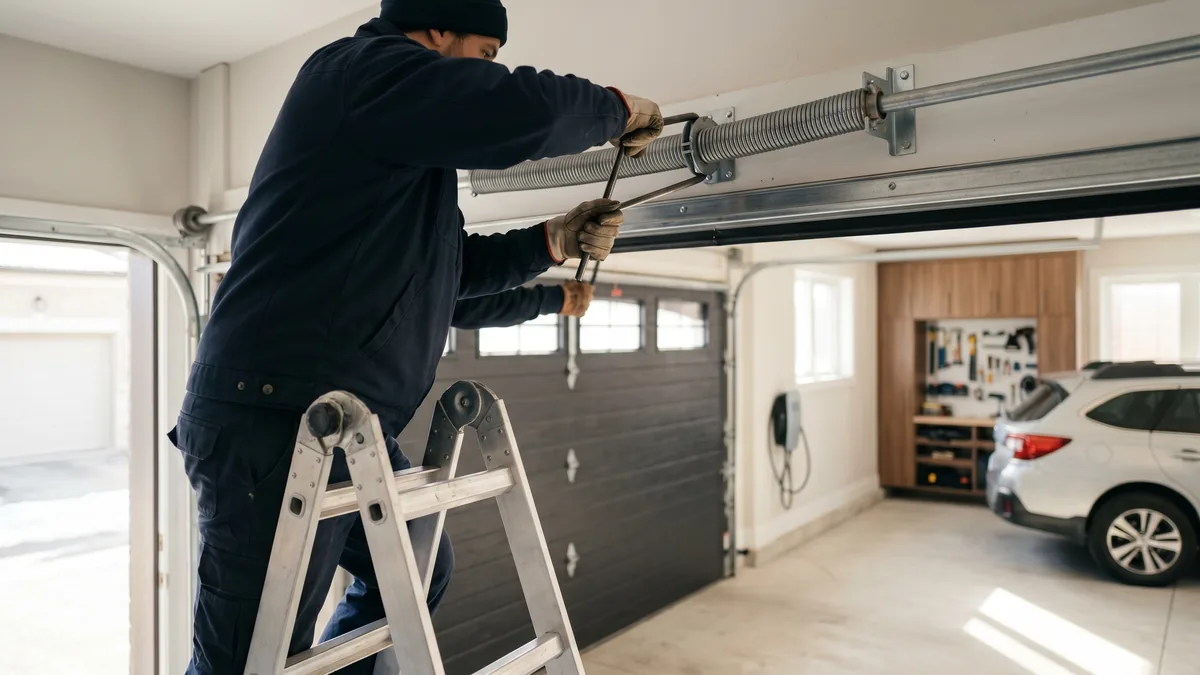
To adjust garage door spring tension, you add or relieve a quarter turn at a time using two solid-steel winding bars on the torsion spring (or move the lift-cable hook on extension springs), then run the balance test: a correctly tensioned door stays put when lifted halfway by hand. Torsion-spring adjustment is genuinely dangerous — the spring stores enough energy to break bones. If you do not own proper winding bars and training, hire a technician.
What Is Garage Door Spring Tension?
Spring tension is the stored energy in your door’s torsion or extension springs that counterbalances the door’s weight. When correctly set, the springs do almost all the lifting, so the door feels nearly weightless and stays put at any point in its travel. Too little tension and the door slams down or strains the opener; too much and it creeps open on its own. Adjusting tension means precisely winding or unwinding the spring until the door is balanced.
Spring tension is the heart of how a garage door works — and the part most likely to send a DIYer to a GTA emergency room. After 15 years servicing doors across Toronto, Mississauga, and the wider GTA, I have seen what happens when a winding bar slips. This guide explains exactly how spring tension is adjusted, how to tell whether yours is off, and where the line sits between a safe homeowner task and a job for a trained technician.
Signs Your Spring Tension Is Off
Before touching anything, confirm the problem really is tension and not a broken part. These are the symptoms I diagnose most often when a door is out of balance:
- The door opens by itself or won’t stay closed. Too much tension overpowers the door’s weight and pushes it up.
- The door slams shut or feels very heavy. Too little tension means the door wins and the opener strains to lift it.
- The door stops partway and drifts. A door that won’t hold position when raised halfway is out of balance.
- The opener works hard, then reverses. An under-tensioned door makes the opener overheat and trip its safety reversal.
- One side lifts before the other. Often a cable or single-spring issue rather than pure tension — see our guide to a cable that came off the drum.
If instead you hear a loud bang and the door simply won’t open, you likely have a broken garage door spring, which needs replacement, not adjustment.
Torsion vs. Extension Springs: Know What You Have
The two spring systems are adjusted completely differently, and the safe approach depends entirely on which you own. Look above the door and along the upper tracks before you do anything else.
| Feature | Torsion Springs | Extension Springs |
|---|---|---|
| Location | Mounted on a shaft above the door opening | Stretched along each horizontal track |
| How they store energy | By twisting (torque) | By stretching |
| Adjustment method | Winding cone + two winding bars | Move cable hook / S-hook to a different hole |
| DIY risk level | High — extreme stored torque | Moderate — still hazardous |
| Typical lifespan | 10,000–20,000 cycles | 8,000–15,000 cycles |
Most newer GTA homes use a single or double torsion spring above the door. Older and lighter doors often use extension springs. If you have torsion springs and no winding bars, stop here and book a professional adjustment.
How to Adjust Extension Spring Tension
Extension-spring adjustment is the more homeowner-friendly of the two, because the energy is released in stages as you reposition the lift cable. Even so, the door must be fully open and locked before you touch a hook.
- Open the door fully and clamp it. With the door all the way up, the extension springs are at their slackest. Clamp a locking plier onto the track below the bottom roller so the door cannot drop.
- Locate the cable hook. Each extension spring connects to a lift cable through an S-hook or eye bolt anchored to the track hanger.
- Move the hook one hole. To increase tension, shorten the cable by moving the hook to the next hole or knotting the cable shorter. To decrease it, lengthen the cable. Adjust both springs equally so the door stays even.
- Test and repeat. Release the clamp, run the balance test, and adjust one hole at a time until the door stays put halfway.
How to Adjust Torsion Spring Tension (The Winding-Bar Method)
This is the procedure trained technicians use. I am describing it so you understand what is involved — not as encouragement to do it without proper tools and experience. A slipped bar at this tension has cost people fingers and worse.
What You Need
- Two solid-steel winding bars sized to your winding cone (never substitutes)
- An adjustable wrench or socket for the set screws
- A sturdy ladder, safety glasses, and gloves
- A locking plier or C-clamp for the track
Step-by-Step
- Secure the door. Close it fully, disconnect the opener with the red release cord, and clamp the track just above a roller so the door cannot rise.
- Mark the spring. Draw a chalk line down the length of the spring so you can count turns and see slippage.
- Seat a winding bar and loosen the set screws. Insert one bar fully into the winding cone, hold it firmly, then loosen the two set screws on the cone. The spring’s full tension is now on your bar — keep your body to the side.
- Wind in quarter turns. Using two bars in alternation, add tension (wind up) or relieve it (wind down) one quarter turn at a time. To raise a too-low door, add a quarter turn; to tame a self-opening door, relieve a quarter turn.
- Re-tighten the set screws. With a bar holding tension, snug both set screws a quarter to half turn past first contact onto the shaft — tight enough to grip, not so tight you strip the screw.
- Run the balance test. Remove the clamp and lift the door by hand to waist height. Repeat quarter-turn adjustments until it stays put, then reconnect the opener.
How Many Turns Does a Torsion Spring Need?
A common rule of thumb is one quarter turn of tension per foot of door height, plus four. A standard 7-foot door usually lands around 7.5 to 8 full turns (about 30 to 32 quarter-turns) past slack. But spring wire size, inside diameter, and door weight all change the number, so the turn count is only a starting point — the balance test is the real authority.
The Balance Test: How to Know the Tension Is Right
Every adjustment, on either spring type, is verified the same simple way. The balance test is the single most reliable check of spring tension and costs nothing.
- Disconnect the opener. Pull the red release cord with the door closed.
- Lift the door to waist height by hand and let go gently.
- Read the result: A balanced door stays put. A door that drops needs more tension. A door that rises needs less.
- Check full travel. The door should move smoothly and feel light from floor to fully open, with no heavy spots.
Common Mistakes to Avoid
- Using the wrong tools. Screwdrivers and rebar are the leading cause of spring injuries. Only solid-steel winding bars belong in a winding cone.
- Adjusting one spring on a double-spring door. On a two-spring setup, both must be matched or the door pulls unevenly and wears the cables — covered in our tune-up guide.
- Over-winding. Too much tension makes the door fly up, wears the opener’s up-limit, and accelerates cable fatigue.
- Ignoring worn cables. A frayed cable will fail soon after a tension change. Inspect cables and bottom brackets at the same time.
- Adjusting a broken or rusted spring. If the coil is gapped, cracked, or rusty, it needs replacement, not winding.
When to Call a Pro & GTA Pricing
For extension springs in good shape, a careful homeowner can rebalance the door. For torsion springs, my honest advice from garage door service work is to let a trained technician handle it — the risk-to-reward ratio simply isn’t in your favour. Call a pro right away if you have a double-spring torsion door, a broken or rusted spring, frayed cables, or any uncertainty about the procedure.
Here is what spring work typically costs across Toronto and the GTA:
| Service | Typical Cost (CAD) |
|---|---|
| Maintenance & tune-up (incl. balance & adjustment) | $120 + tax |
| Cables & brackets | $180–$260 + tax |
| Cables with bottom brackets | $260 + tax |
| Single torsion spring replacement | from $280 + tax |
| Double spring setup (both springs) | $320–$460 + tax |
| Per spring (commercial / multi-spring) | $160 / spring |
| Torquemaster conversion to standard torsion | $530 + tax |
A simple tension adjustment is usually folded into a $120 tune-up. Because Royal Garage Doors includes a FREE service call with any repair (only a $120 diagnostic applies if you choose not to proceed), having a pro do it correctly costs little more than buying winding bars yourself. All spring work carries our 1-year labour and 5-year hardware warranty. For full, current pricing see our pricing page, and read what GTA homeowners say on our reviews page.
Serving every corner of the region, our team handles spring tension and replacement in Mississauga, Toronto, Brampton, and Hamilton. If your door turns out to need more than a tune-up, we also handle full door replacement and panel replacement.
Don’t Risk a Spring Injury
Torsion spring tension is one job where a pro is worth it. Royal Garage Doors provides FREE service calls with any repair across Toronto & the GTA, with same-day appointments and a full warranty on every spring.
Call 437-265-9995