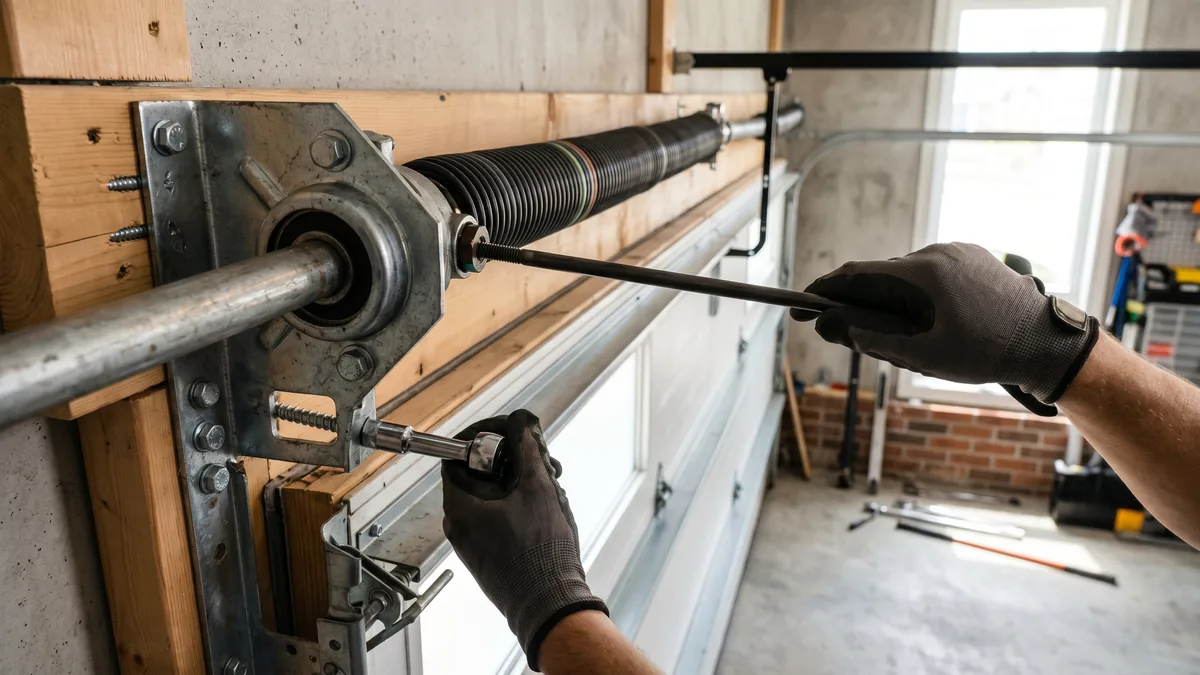
A worn garage door bearing shows up as a loud grinding, squealing, or rumbling noise from a fixed point along the torsion shaft, plus visible play or wobble in the shaft. The bearing sits inside the end bearing plate at each top corner (and a center bearing in the middle). Because the shaft is under spring tension, a worn bearing should be replaced by a technician, who must first unwind the springs with winding bars. In the GTA, this is usually done during a tune-up ($120 + tax) or alongside spring or cable work.
What Is a Garage Door End Bearing Plate?
An end bearing plate is a flat steel bracket bolted to each side of the wall above the door (the header). It holds a bearing that supports one end of the torsion tube, the long horizontal shaft your springs are mounted on. The bearing lets the shaft spin freely while the cable drums wind the lifting cables. Each torsion system has two end bearing plates, and most have one center bearing bracket near the springs.
Most homeowners never think about bearings until the door starts screaming every morning. The bearing is a small, cheap part, but it carries the entire weight of your door through the torsion shaft. When it wears out, it can fray cables, throw the door out of balance, and damage other parts — so it pays to catch it early. Here is how to recognize a failing bearing and what fixing it actually involves.
What the Bearing and End Plate Actually Do
To understand why a worn bearing matters, you need to picture the torsion system above your door. A steel shaft (the torsion tube) runs horizontally across the top of the opening. Your torsion springs ride on this shaft. At each end, a cable drum winds the lifting cable that pulls the door up. The whole assembly has to rotate smoothly, and that is the bearing's job.
There are three bearing locations on a typical residential door:
- Two end bearings — one inside each end bearing plate at the top corners, supporting the outer ends of the shaft.
- One center bearing — mounted on the center bracket between the springs (on a two-spring setup), keeping the middle of the shaft from sagging.
Each bearing is essentially a hardened steel race with rollers or balls inside. When it is healthy, the shaft spins almost silently. When the race pits, dries out, or cracks, metal grinds on metal and the shaft starts to wobble. That wobble is what eventually damages the drums and cables. If you want the full picture of how the torsion system carries the load, our guide to a broken garage door spring walks through the same components from the spring's point of view.
6 Signs of a Worn Garage Door Bearing
Bearings rarely fail overnight. They give you weeks or months of warning if you know what to listen and look for. Here are the most reliable signs my crews see across Toronto and the GTA.
1. Grinding or squealing from one fixed spot
This is the classic symptom. Unlike a dry roller (which makes noise as it travels up the track), a bad bearing makes noise from a stationary point near a top corner or the center of the door. The pitch is usually a metallic grind or a high squeal that gets louder as the door speeds up mid-travel.
2. A rumbling or vibration you can feel
Place a hand lightly on the wall near the end bearing plate while a helper cycles the door (stay clear of moving parts). A failing bearing transmits a rough rumble or vibration into the bracket and wall that a good bearing does not.
3. Visible wobble in the torsion shaft
With the door fully closed and the springs still under tension, watch the shaft as the door operates. A worn end or center bearing lets the shaft visibly oscillate up and down or side to side instead of spinning true.
4. Rust streaks or grease “blow-by” on the bracket
A dry, overheating bearing often leaves reddish-brown dust or rust streaks below the bearing plate, and sometimes flung-off grease. In our climate, road salt and winter humidity accelerate this corrosion.
5. The door feels heavier or balance has shifted
When a bearing binds, it adds drag the springs were never sized for. The door can feel sluggish, or the opener may strain. A binding bearing can mimic a spring problem, which is why an accurate diagnosis matters before you replace anything.
6. A bearing that has spun out of its plate
In severe cases the bearing seizes and starts spinning inside the bracket hole, or the plate cracks. At that point you may see the shaft visibly dropping at one end — an urgent safety problem, because everything above the door is under spring load.
End Bearing vs. Center Bearing: Which Is Failing?
Both bearings do the same job in different positions, but the symptoms and access differ slightly. Use this comparison to narrow down which one is making noise before you book a repair.
| Feature | End Bearing Plate | Center Bearing |
|---|---|---|
| Location | Top left & right corners, on the header | Middle of the header, on the center bracket |
| Quantity | Two (one per side) | Usually one |
| Common failure | Worn race from drum load + corrosion | Worn race from spring side-load |
| Noise location | Near a top corner | Center of the door |
| Replaced with | Whole plate or just the bearing | Bearing or full center bracket |
If the grinding clearly comes from a corner, suspect an end bearing plate. If it comes from the middle near the springs, suspect the center bearing. When in doubt, a technician will check all three during a center bearing inspection as part of routine service. For deeper drum or cable wobble issues, the cable drum replacement guide covers what happens when bearing wear has already damaged the drums.
How a Worn Bearing Is Replaced (and Why Pros Do It)
Replacing a bearing is mechanically simple but dangerous because of where it sits. Here is the actual sequence a trained technician follows so you understand what you are paying for and why it is not a screwdriver-and-YouTube job.
- Secure the door. The door is clamped to the track and the opener is disconnected so the door cannot move during the work.
- Unwind the springs. Using winding bars, the technician fully releases all spring tension. This is the step that injures DIYers who improvise.
- Loosen the drums and slide the shaft. The set screws on the cable drums are loosened and the cables are taken off so the shaft can be shifted to clear the bearing.
- Swap the bearing or plate. The old end bearing plate (or center bearing) is unbolted and the new one installed, often with a fresh coat of rust-inhibiting grease.
- Reset cables, re-wind springs, and balance. Cables are reseated on the drums, springs re-tensioned to the correct turns, and the door balance-tested by hand.
- Lubricate and test. The technician lubricates the new bearing and runs several full cycles to confirm the noise is gone and the door is balanced.
Because the shaft has to come apart anyway, smart technicians inspect the springs, cables, and drums at the same time. If any of those are near end-of-life, replacing them together saves a second service call — a big deal if your only door is your daily access in a busy GTA household.
GTA Cost, Lifespan, and Prevention
Bearings themselves are low-cost parts, so they are almost never sold as a standalone visit. At Royal Garage Doors, bearing replacement is bundled into related work. Here is roughly how it lands on the invoice.
| Scenario | Typical GTA Price (+ tax) | What's Included |
|---|---|---|
| Bearing checked & replaced during tune-up | $120 | Lubrication, balance check, sensor alignment, hardware tightening |
| Bearing done with single torsion spring | from $280 | Spring, labor, bearing service, 3-tier warranty |
| Bearing done with cable/drum work | $180–$260 | Cable replacement, bracket realignment, full inspection |
Quality sealed bearings typically last 10–15 years — about the same as a set of springs. Several things shorten that life, and most are within your control:
- Lack of lubrication. A drop of light machine oil on each end and center bearing twice a year keeps races from drying out.
- Winter freeze-thaw. Toronto and GTA garages swing through humidity and salt exposure that corrode unsealed bearings faster. Our winter prep checklist includes bearing lubrication for exactly this reason.
- Cheap parts. Builder-grade unsealed bearings wear out far sooner than sealed replacements. Always confirm a sealed bearing is being installed.
For accurate, current pricing on springs, cables, and tune-ups, see our transparent pricing page, or if your opener is also straining against the binding bearing, our opener repair service can confirm whether the motor is the cause or just the symptom. Maintenance specialists at the International Door Association recommend the same annual inspection cadence we use on every GTA service call.
Hearing a Grinding Bearing? Don't Wait.
A worn bearing frays cables and throws the door off balance the longer you run it. Royal Garage Doors diagnoses and replaces bearings, springs, and drums across Toronto & the GTA — with a FREE service call on any repair.
Call 437-265-9995