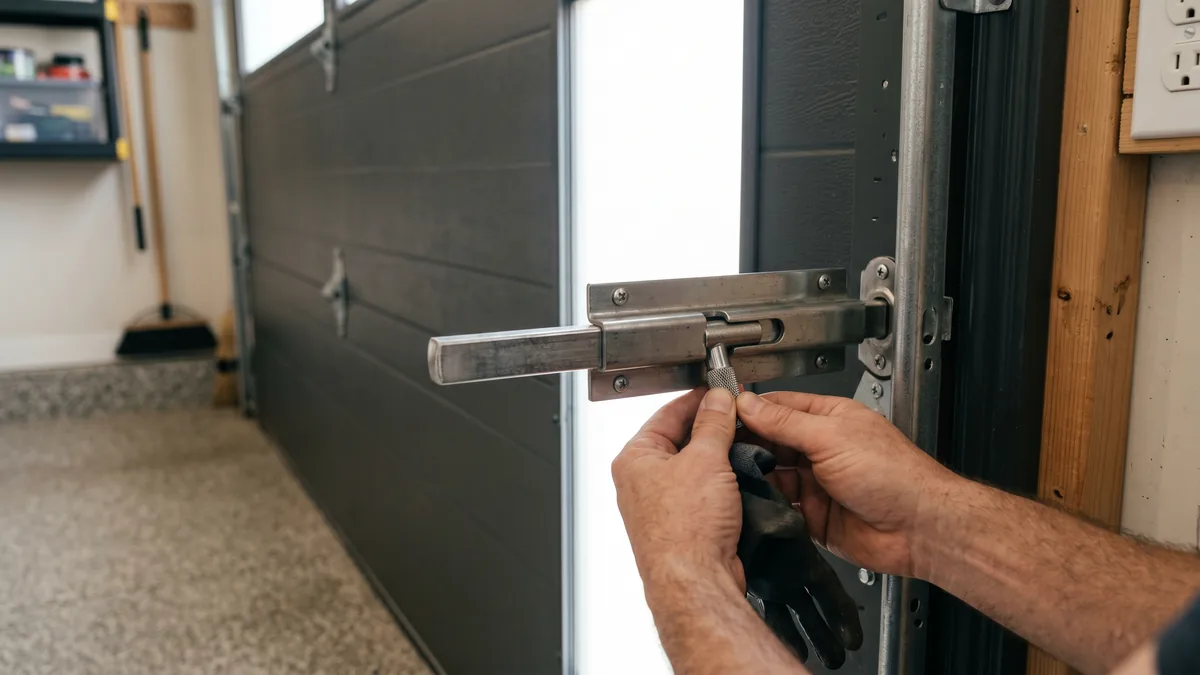
A garage door lock bar is a horizontal steel bar that slides into a slot in the vertical track to mechanically lock a manual door shut, usually operated by an inside handle or an outside keyed T-handle. If you have an electric opener, the opener already holds the door closed, so a separate lock bar is mostly used for vacations, power outages, or older non-encrypted openers. The critical rule: never leave a lock bar engaged while the opener is connected — forcing a locked door can bend panels, snap cables, or burn out the motor.
What Is a Garage Door Lock Bar?
A lock bar (also called a slide lock or spring lock) is a flat steel bar mounted to the back of a garage door that extends sideways into a punched slot or hole in the vertical track. When engaged, it physically blocks the rollers from moving, so the door cannot be lifted even if someone defeats the opener. Many older doors pair two interior slide locks with an exterior keyed T-handle, all linked so one turn of the key throws both bars.
Whether you are staring at a mysterious handle on the back of an old door, or wondering why your opener suddenly strains and refuses to lift, garage door locks are one of the most overlooked parts of home security across Toronto and the GTA. In this guide I will explain how lock bars, slide locks, T-handle locks, and modern automatic deadbolts work, when you actually need them, and the one mistake that can wreck your door.
Types of Garage Door Locks Explained
Not every "lock" on a garage door is the same. Over the years I have serviced everything from 1970s manual doors with key-throw spreader bars to brand-new smart openers with built-in motorized deadbolts. Here are the main types you will run into in a GTA garage.
1. Slide Lock (Interior Spring Lock)
The classic lock bar. A spring-loaded handle on the inside of the door pushes a steel bar sideways into a hole in the vertical track. Some doors have one; many have two — one on each side — linked by a horizontal spreader bar so a single handle throws both. There is no key and no outside access; it is operated only from inside the garage. This is the most common type of true lock bar.
2. T-Handle Lock (Exterior Keyed)
The T-shaped handle you see in the centre of older manual doors. Turning the key rotates the handle, which pulls cables or a spreader bar that retracts the slide locks on each side. It lets you lock and unlock the door from outside without an opener — essential on a fully manual door, and a handy backup on opener-equipped doors during a power failure.
3. Side-Mount Deadbolt (Track Lock)
A simple, modern add-on. A small deadbolt or L-bracket bolts through the vertical track into the wall framing or jamb, physically pinning the track so the door cannot rise. It is inexpensive, effective, and easy to add to a door that lost its original lock bar. We install these regularly as a security upgrade.
4. Automatic Opener Deadbolt (Smart Lock)
Newer LiftMaster and Chamberlain openers offer a motorized deadbolt — LiftMaster's Secure View and similar systems — that drives a steel pin into the track automatically every time the door closes, then retracts it before opening. It is the modern replacement for the manual lock bar and removes the risk of forgetting to disengage it. If you are upgrading, see our garage door opener repair and LiftMaster service pages.
5. Opener Lock / Vacation Mode
Most wall-control panels have a "Lock" button or vacation mode that disables all remotes and keypads, so only the wired wall button works. It is not a mechanical lock, but it stops code-grabbing and remote attacks while you are away. Combine it with a manual lock for the strongest travel security.
Lock Bar vs. Modern Garage Door Locks: Comparison
Each lock type trades convenience against security. This table shows how they stack up so you can pick the right protection for your situation.
| Lock Type | Operated From | Security Level | Best For |
|---|---|---|---|
| Slide lock / lock bar | Inside only | High (mechanical) | Manual doors, travel, outages |
| T-handle keyed lock | Outside (key) | High (mechanical) | Fully manual doors |
| Side-mount deadbolt | Inside | High (mechanical) | Adding a lock to an opener door |
| Automatic opener deadbolt | Auto / app | Very high | New smart-opener installs |
| Opener lock / vacation mode | Wall panel | Medium (electronic) | Blocking remotes while away |
Lock Bar Stuck? Why Your Opener Won't Lift the Door
One of the most common service calls I get is a homeowner convinced their opener has died — when the real culprit is an engaged lock. If a child, tenant, or previous owner pushed a slide lock into the track, the opener will strain, click, or reverse the moment it tries to lift. Here is how to check before you spend money on the wrong repair.
- Listen to the opener. If the motor runs but the door barely moves, or it reverses immediately, an obstruction — often a lock — is the likely cause.
- Inspect both sides of the door. Look at the bottom corners where the door meets the vertical track. A slide-lock handle pushed toward the track, or a bar sitting in the track slot, means the door is locked.
- Disengage the lock. Pull the handle back to centre so the bar clears the track. Some need a slight lift of the door by hand to release tension on the bar.
- Re-test the opener. Cycle the door. If it now opens smoothly, the lock was the problem.
- If it still won't open, the issue is mechanical — usually a broken spring, a cable off the drum, or a worn opener. Read our guides on a broken garage door spring and broken garage door cable, or have a technician diagnose it.
Do You Still Need a Lock Bar With a Modern Opener?
For day-to-day security, a modern opener is the lock. The trolley and motor hold the door closed, and a quality opener with rolling-code encryption is very hard to defeat. So for most GTA households, you do not need to manually throw a lock bar every night. There are, however, four situations where a manual or automatic lock still earns its keep:
- Extended travel. Away for a week or more? A side deadbolt or slide lock (with the opener disconnected) plus vacation mode gives genuine peace of mind.
- Power outages. During a Toronto ice-storm blackout, a manual lock keeps a disconnected door secured.
- Older non-encrypted openers. Openers made before the mid-1990s use fixed codes that can be grabbed. Until you upgrade, a manual lock adds real protection.
- Detached or laneway garages. A garage not attached to the alarmed house benefits from a physical lock as a visible deterrent.
The Emergency Release Vulnerability
One security weakness worth knowing: on many doors, a thief can fish a hook or wire through the top weather seal and pull the red emergency release cord, disconnecting the opener and lifting the door by hand. You can defend against this by shortening the release cord, fitting a release-cord shield, or installing a side deadbolt that bolts the track to the wall — so even a disconnected door cannot rise. The U.S. Consumer Product Safety Commission also recommends keeping the release within reach for safe escape, so balance the two by using a shield rather than removing the cord. See the CPSC garage door safety guide for details, and DASMA's homeowner resources at DASMA.com.
How to Secure Your Garage Door the Right Way
If your door has lost its original lock bar, or you want to retire a manual lock that someone keeps forgetting to disengage, here are the upgrades we recommend most often across Mississauga, Toronto, and the wider GTA.
- Add a side-mount deadbolt. A simple track-to-wall bolt is the cheapest mechanical upgrade and defeats the release-cord trick.
- Upgrade to a smart opener with an automatic deadbolt. A new Chamberlain or LiftMaster opener with a motorized lock secures the door every cycle with no effort — and adds smartphone monitoring.
- Shield the emergency release. A small plastic shield or a shortened cord stops fishing attacks.
- Use vacation / lock mode. Disable remotes from the wall panel whenever you travel.
- Keep hardware tight and aligned. A lock only works if the track and door are square; a tune-up keeps everything aligned.
What Garage Door Locks Cost in the GTA
Adding or fixing a garage door lock is one of the more affordable security upgrades you can make. Here is what the work typically runs in Toronto and the GTA, with current Royal Garage Doors pricing:
| Service | Typical Cost (CAD) |
|---|---|
| Side-mount deadbolt / slide lock fit & align | $120–$180 + tax |
| Maintenance & tune-up (lock check included) | $120 + tax |
| Cables & brackets repair (if lock damaged them) | $180–$260 + tax |
| New smart opener with automatic deadbolt | from $630 + tax |
| Panel replacement (if forced lock bent a panel) | $500–$1,000 + tax |
The service call is FREE with any repair or installation — a $120 diagnostic fee applies only if you choose not to proceed after assessment. Every job is backed by our 1-year labour, 5-year hardware, and lifetime panel warranties. For full, current pricing on every service, see our pricing page, read genuine customer reviews, or book online. Local teams are available in Mississauga, Toronto, Brampton, and Hamilton.
Lock Bar Jamming Your Door? We Can Help
Whether your opener won't lift because of a stuck lock, or you want to add a secure deadbolt or smart opener, Royal Garage Doors provides FREE service calls with any repair across Toronto & the GTA, with same-day appointments available.
Call 437-265-9995