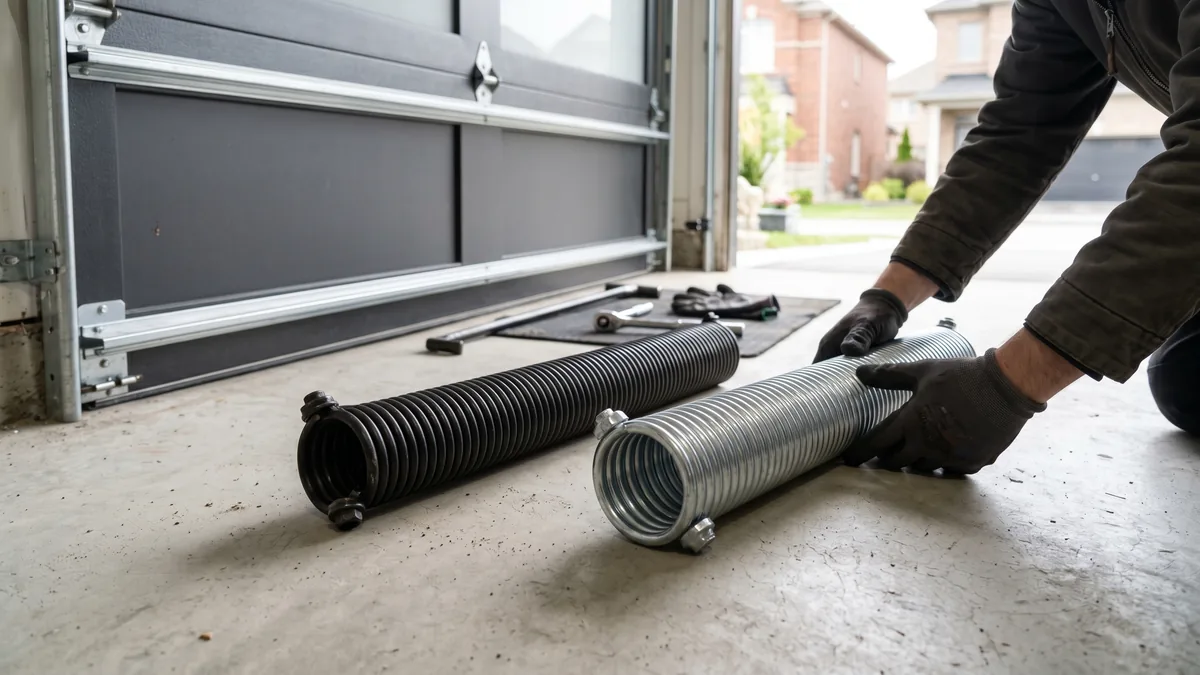
Oil-tempered springs are stronger, hold tension better, and run quieter, which is why most technicians fit them on residential doors. Galvanized springs have a zinc coating that resists rust and keeps a clean silver look, making them ideal in damp garages or where appearance matters. For most Toronto and GTA homes, a quality oil-tempered spring is the best balance of durability and value — but the bigger decision is choosing a higher cycle rating, which affects lifespan far more than the coating does.
What Is the Difference Between Oil-Tempered and Galvanized Springs?
Both are torsion (or extension) springs made from high-carbon steel wire, but they differ in finish. An oil-tempered spring is heated and quenched in oil to relieve internal stress, giving it a dark grey-black, slightly oily surface and excellent, uniform strength. A galvanized spring is coated in a layer of zinc that sacrifices itself to stop rust, giving it a bright silver finish but slightly lower fatigue strength at the same wire size.
When a spring snaps, most GTA homeowners just want the door working again — but if you have a few minutes, the choice between oil-tempered and galvanized springs is worth understanding. It affects how quiet your door runs, how it copes with a damp Toronto garage in February, and how many years before you are reading this guide again. After 15 years replacing springs across the GTA, here is the honest, balanced comparison I give my own customers.
Oil-Tempered vs Galvanized: The Quick Comparison
Both spring types do the same job — counterbalancing the weight of the door so the opener only fights friction, not gravity. The difference is in the steel finish, and that finish changes durability, noise, rust resistance, and looks. Here is how they stack up head to head.
| Factor | Oil-Tempered | Galvanized |
|---|---|---|
| Appearance | Dark grey/black, oily | Bright silver/zinc |
| Strength & tension hold | Higher, very uniform | Slightly lower at same size |
| Rust resistance | Fair (oil film only) | Excellent (zinc coating) |
| Noise | Quieter, smoother | Can be slightly noisier |
| Typical cycle life* | Excellent | Good |
| Maintenance | Lubricate to prevent rust | Low, but still lubricate |
| Best for | Most residential doors | Damp/humid garages, looks |
*Cycle life depends far more on the rating you buy (10,000 vs 20,000+ cycles) than on the coating. We cover that below in the section on what actually makes a spring last.
Oil-Tempered Springs: Strength and Quiet Operation
Oil-tempered torsion springs are the workhorse of the garage door industry. The wire is drawn, formed into a coil, then heated and quenched in oil — a process that relieves the internal stresses created during winding and produces a remarkably uniform, fatigue-resistant steel. That uniformity is the key: a spring that is consistent along its entire length flexes evenly, so no single coil takes more than its share of the load.
Why Technicians Prefer Oil-Tempered
- Better tension retention. Oil-tempered springs hold their set tension reliably over years of cycling, so the door stays balanced and the opener is not overworked.
- Quieter operation. The residual oil film between coils reduces metal-on-metal friction, so the door runs smoother and quieter — a real benefit on attached garages with a bedroom above.
- Consistent strength. Uniform heat treatment means fewer weak points and more predictable cycle life.
- Wide availability. Oil-tempered is the default stock for most distributors, so the right wire size and length is almost always on the truck.
The Trade-Off: Rust
The one weakness of an oil-tempered spring is corrosion. The oil film offers only mild protection, so in a humid garage — or one where road salt and meltwater drip off cars all winter — bare oil-tempered springs can develop orange surface rust over time. Rust between the coils increases friction (causing that familiar squeak) and, over many years, can become a stress point. The fix is simple: a light spray of garage-door lubricant on the springs two or three times a year. A spring that squeaks may just need lubrication — learn the warning signs in our guide to a broken garage door spring.
Galvanized Springs: Rust Resistance and Clean Looks
Galvanized springs start as the same high-carbon steel wire but receive a zinc coating, usually applied by an electro-galvanizing process for springs. Zinc is more reactive than steel, so it corrodes first and protects the steel underneath — the same principle that keeps galvanized nails and chain-link fences from rusting. The result is a bright silver spring that shrugs off the surface rust that plagues bare steel.
Where Galvanized Makes Sense
- Damp or humid garages. If your garage floods, has poor drainage, or sits below grade and stays clammy, galvanized springs resist corrosion far better.
- Appearance-conscious installs. On a showroom-clean garage or a glass-and-aluminum modern door, the bright zinc finish looks tidier than a black oily spring.
- Coastal-style or high-salt environments. While the GTA is inland, properties near water or with heavy winter salt exposure benefit from the extra corrosion barrier.
The Trade-Offs
Galvanizing is not free of downsides. The zinc-coating process — and the fact that a galvanized spring sometimes uses slightly thinner wire to hit the same outside dimensions — can reduce fatigue strength a little compared to an oil-tempered spring of identical size. In practice this means a galvanized spring may be rated for slightly fewer cycles, and some run a touch noisier because they lack the oil film that quiets oil-tempered coils. None of this makes galvanized a bad choice — it is simply a different balance of priorities. For a humid garage, the rust resistance often outweighs the small strength difference.
What Actually Makes a Spring Last: Cycle Ratings
Here is the part most articles skip: the coating matters less than the cycle rating you buy. A garage door spring is rated in cycles — one cycle is one full open and one close. Standard builder-grade springs are typically rated around 10,000 cycles. If your household opens the door four times a day, that works out to roughly 7 years; open it eight times a day and you are looking at 3 to 4 years.
Higher-cycle spring designs use thicker wire or a larger coil, but Royal Garage Doors no longer offers those upgrades. We install standard oil-tempered or galvanized torsion springs and service existing high-cycle systems.
| Cycle Rating | Approx. Years (4 cycles/day) | Best For |
|---|---|---|
| 10,000 cycles | ~7 years | Low-use second doors |
| 15,000 cycles | ~10 years | Average family home |
| 20,000–25,000 cycles | ~14–17 years | Busy daily-use doors |
| High-cycle (30,000+) | 20+ years | Commercial & high-traffic |
For commercial overhead doors that cycle dozens of times a day, the cycle rating is everything — see our breakdown of high-cycle springs for commercial doors. Getting the wire size and color code right is equally important; our guides to garage door spring color codes and how to measure torsion springs explain how technicians spec the correct replacement.
How to Choose: Oil-Tempered or Galvanized for Your GTA Home
There is no single right answer — the best spring depends on your garage, your usage, and your priorities. Here is the decision framework I use on every estimate across Toronto, Mississauga, Brampton, and the GTA.
Choose Oil-Tempered If...
- Your garage stays reasonably dry (most attached and heated garages).
- Quiet operation matters — especially with living space above or beside the garage.
- You want the best strength and tension retention for the money.
- You are matching a standard residential door and want a proven, widely available spring.
Choose Galvanized If...
- Your garage is damp, poorly drained, below grade, or sees heavy winter salt and meltwater.
- You have already replaced rusted oil-tempered springs and want to break the cycle.
- Appearance matters — a clean, bright finish on a modern or showroom door.
- You want lower spring maintenance, though a light lube is still recommended.
Our Verdict
For the typical GTA home, a quality oil-tempered spring in a 15,000–20,000 cycle rating delivers the best mix of strength, quiet, longevity, and value. Choose galvanized when corrosion is the real enemy — a damp garage, salt exposure, or a history of rusted springs. Either way, spend the extra few dollars on a higher cycle rating; that single choice does more for lifespan than the coating ever will.
A Note on Torquemaster and Extension Springs
Not every door uses a standard torsion spring. Older Wayne Dalton doors often use a Torquemaster system, where the spring sits enclosed inside a tube. These are convenient but harder to service and slower to replace; many homeowners convert them to a standard torsion setup for easier future repairs and a wider choice of oil-tempered or galvanized springs. We cover that conversion (about $530 + tax) for any door type, and you can read more in our Wayne Dalton garage door repair guide.
Lighter, older single-car doors may use extension springs that stretch along the horizontal tracks rather than wind on a shaft. Extension springs also come in oil-tempered and galvanized finishes, and the same logic applies: oil-tempered for strength and quiet, galvanized for rust resistance. Whatever the system, always confirm the right safety cables are in place — an extension spring without a containment cable is a hazard.
Garage Door Spring Replacement Cost in the GTA
The good news for homeowners weighing oil-tempered against galvanized is that both fall in the same price range for a standard residential replacement — the choice rarely changes your bill. Here is what spring replacement costs at Royal Garage Doors across Toronto and the GTA:
| Service | Typical Cost (CAD) |
|---|---|
| Single torsion spring | from $280 + tax |
| Double-spring setup (both springs) | $320–$460 + tax |
| Per spring (commercial / multi-spring) | $160 / spring |
| Cables & brackets | $180–$260 + tax |
| Torquemaster conversion to standard torsion | $530 + tax |
| Maintenance & tune-up | $120 + tax |
Every spring replacement includes parts, labour, balancing, a full system inspection, and a multi-tier warranty (1-year labour, 5-year hardware). The service call is FREE with any repair, and there is never an extra charge for weekends or holidays — a $120 diagnostic applies only if you choose not to proceed after the assessment. For complete, current numbers see our pricing page and our detailed garage door spring replacement cost breakdown. Ready to book? Use our online booking or call directly.
Springs are one part of a healthy door. If yours is also noisy or rough, you may need new rollers or a opener repair, and if the door itself is aging, our garage door replacement and overhead door teams can help. See why GTA homeowners trust us on our reviews page and learn more about our company. We serve Toronto, Mississauga, Brampton, and Hamilton.
For the engineering standards behind torsion spring counterbalance systems, the Door & Access Systems Manufacturers Association (DASMA) publishes the industry technical guidance manufacturers follow.
Need a Spring Replaced Today?
Whether you need a quiet oil-tempered spring or a rust-resistant galvanized one, Royal Garage Doors fits the right spring and rebalances your door — with FREE service calls and same-day appointments across Toronto & the GTA.
Call 437-265-9995