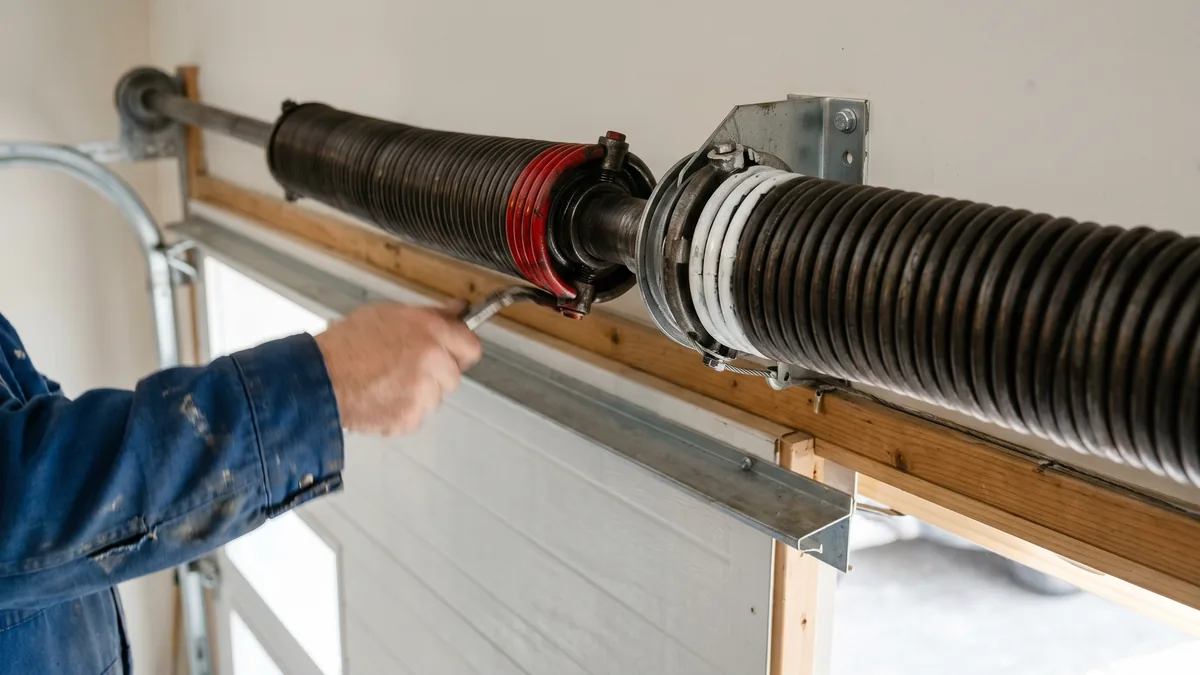
On most garage doors, the painted color on the end of a torsion spring marks the wind direction, not the strength. A black-painted end usually means a right-wound spring and a red-painted end a left-wound spring, so a technician knows which side of the door each one belongs on. The actual strength is set by the wire size, inside diameter, and length — never by the color. Wayne Dalton Torquemaster springs are the exception: their color dots indicate the torque rating instead.
What Is a Garage Door Spring Color Code?
A spring color code is the paint mark a manufacturer applies to the end of a torsion spring to communicate one specific detail at a glance — most often the winding direction. On standard exposed torsion springs this is almost always black for right-wound and red for left-wound. A few brands use color to signal the spring’s torque rating instead, so the meaning depends on the spring system, not on a universal rainbow chart.
Few parts of a garage door cause as much confusion as the little dab of paint on the end of a spring. Homeowners across Toronto and the GTA call us convinced that “the red spring is the heavy-duty one” or that they can match a replacement just by the color — and both ideas can lead to a dangerous mismatch. This guide explains exactly what the color codes mean, why they are not a size, and how to identify your spring the right way.
What the Spring Colors Actually Mean
The single most important thing to understand is that on a standard torsion spring, color equals direction, not power. Every torsion spring is wound either clockwise or counter-clockwise, and a balanced two-spring door needs one of each. To stop installers from grabbing two identical springs by mistake, manufacturers paint the stationary (cone) end of each spring a standard color.
Here is the convention used by the large North American spring makers and recognized across the industry:
- Black-painted end — Right-wound spring. The coils slope down to the right when you look at the spring from the side. On a typical door this spring mounts on the left half of the center bearing plate.
- Red-painted end — Left-wound spring. The coils slope down to the left. This spring mounts on the right half of the center bearing plate.
That is the whole story for the vast majority of residential doors in the GTA. The black/red pair tells the technician which spring goes where so the door winds and unwinds in balance. It says nothing about how strong the spring is or how heavy a door it can lift.
Why People Think Color Means Strength
The myth comes from one real exception — Wayne Dalton’s Torquemaster system — where color genuinely does indicate the spring rating. Because Torquemaster doors are common in the GTA, homeowners who have owned one often assume every brand works the same way. They do not. On a standard torsion spring you cannot read strength from the paint, and assuming you can is how the wrong spring ends up on a door — leaving it heavy on one side, hard on the opener, and unsafe to operate.
Garage Door Spring Color Code Chart
Use this chart as a quick reference. The first two rows are the universal standard-torsion convention; the rest cover the brand-specific systems you may run into in Mississauga, Brampton, and across the GTA.
| Painted Color | What It Indicates | System |
|---|---|---|
| Black | Right-wound spring (mounts left of center) | Standard torsion |
| Red | Left-wound spring (mounts right of center) | Standard torsion |
| Color dot (blue, red, white, brown, etc.) | Torque rating matched to door weight & height | Wayne Dalton Torquemaster |
| No paint / raw oil-tempered | Direction read from coil slope only | Older or unbranded springs |
| Galvanized silver finish | Corrosion-resistant coating, not a code | Galvanized torsion springs |
Notice that the bottom rows are not really “codes” at all — a raw oil-tempered spring simply has no paint, and a galvanized silver spring is coated for rust resistance, not labelled. If you want to understand the coating difference, our guide on oil-tempered vs galvanized springs breaks it down.
The Wayne Dalton Torquemaster Exception
Wayne Dalton’s Torquemaster system hides the spring inside a steel tube, so you never see exposed coils. Instead of black/red direction marks, Torquemaster springs carry a color dot or colored tip — shades like blue, red, white, and brown — that identifies the spring’s torque rating, matched to a specific door weight and height. Here, color really does map to strength.
That makes Torquemaster the opposite of a standard torsion spring: the color is a rating, not a direction. These springs are not interchangeable with exposed torsion springs, and the tube assembly has its own winding mechanism. Many GTA homeowners eventually convert a worn Torquemaster system to a standard torsion setup for easier, cheaper future repairs.
Torquemaster vs Standard Torsion at a Glance
A standard torsion spring sits exposed on a shaft above the door, uses black/red direction codes, and is serviced with winding bars. A Torquemaster spring lives inside a tube, uses a color dot for its rating, and is wound through a bolt at the end of the tube. Converting Torquemaster to standard torsion runs about $530 + tax in the GTA and should always be done by a pro. If you own a Wayne Dalton door, see our Wayne Dalton repair page or compare brands in Clopay vs Wayne Dalton.
Why Color Is Not the Same as Spring Size
If color only tells you direction (or, for Torquemaster, a rating you can’t cross-shop), how do you actually match a spring? Three physical measurements determine a standard torsion spring’s strength, and you must read all three:
- Wire size (wire diameter). The thickness of the steel wire itself, typically between about 0.207 in and 0.295 in on residential doors. This is the biggest single factor in a spring’s lifting power.
- Inside diameter (ID). The width of the hole through the center of the coils. Common residential IDs are 1 3/4 in and 2 in, and the ID is often stamped or printed on the stationary cone.
- Overall length. The relaxed length of the coiled section, measured end to end without the cones. Length combined with wire size and ID sets the total turns and lift.
Two springs painted the exact same red can have completely different wire sizes and therefore completely different strengths. That is why a supplier or technician will always ask for these three numbers plus the wind direction — never just “the red one.” If you want the deeper measuring walkthrough, see our guide on how to measure torsion springs.
How to Read the Three Numbers Safely
You can gather all three measurements without ever touching the spring’s tension:
- Wire size: push 10 or 20 coils tightly together, measure that span with a tape, and divide by the number of coils to get one coil’s thickness.
- Inside diameter: measure straight across the opening at the end of the spring, or read the stamp on the cone.
- Length: measure the coiled body only, not the cones, while the spring is relaxed.
Pair those numbers with the wind direction you read from the color or coil slope, and you have a complete spring spec. Hand that to a technician and the replacement will match exactly.
Single-Spring vs Two-Spring Doors
The color codes only come into play on doors with two springs. Understanding your setup helps you know what to expect on a service call.
| Setup | Color Pattern | Typical Door |
|---|---|---|
| Single spring | One spring, color reflects its wind direction | Lighter single-car doors (8×7, 9×7) |
| Two springs (standard) | One black (right-wound) + one red (left-wound) | Double doors & heavier single doors |
| Multi-spring (commercial) | Pairs of black/red, often high-cycle | Commercial & oversized doors |
A balanced two-spring door must have one right-wound and one left-wound spring — that is exactly what the black/red codes guarantee. If a past repair installed two springs of the same direction, the door will fight itself. On commercial units you will often see two or more matched pairs; see high-cycle springs for commercial doors for how those are specified, or our commercial garage door repair service.
How to Identify Your Garage Door Spring
Put it all together with this safe, no-tension-released procedure. You are only reading and measuring — not removing anything.
- Read the color / direction. Note the painted end of each spring and confirm the slope of the coils. Record which colored spring sits on which side of the center bracket.
- Measure the wire size. Use the 10- or 20-coil method above to find the wire diameter.
- Measure the inside diameter. Read the stamp on the cone or measure across the coil opening.
- Measure the length. Record the relaxed coil length, cones excluded.
- Confirm before ordering. Give the wind direction plus all three numbers to a technician or supplier. Never release spring tension to measure.
If reading a wound spring feels uncertain, that is normal — and a free assessment is the safest route. A technician can confirm the spec in minutes and check the cables, bearings, and balance while they are there.
What Spring Replacement Costs in the GTA
Once you know what spring you have, here is what replacement typically costs across Toronto, Mississauga, Brampton, and Hamilton. Prices include parts and labour, with no weekend or holiday surcharge.
| Service | Typical Cost (CAD) |
|---|---|
| Single torsion spring | from $280 + tax |
| Double spring (both replaced) | $320–$460 + tax |
| Per spring (commercial / multi-spring) | $160 / spring |
| Cables & brackets | $180–$260 + tax |
| Torquemaster conversion to torsion | $530 + tax |
| Maintenance & tune-up | $120 + tax |
Every repair comes with our 3-tier warranty — 1-year labour, 5-year hardware, and a lifetime panel warranty — and a FREE service call when you proceed with the work; the $120 diagnostic applies only if you choose not to go ahead. For the full breakdown see our pricing page and the dedicated spring replacement cost guide. If your cables are also worn, our broken garage door cable page explains that repair.
According to the trade association DASMA, torsion springs are typically rated for about 10,000 open-and-close cycles — roughly 7 to 12 years for an average household — so a spring that fails on a 10-year-old GTA door is right on schedule. High-cycle spring upgrades are discontinued; Royal Garage Doors installs standard torsion springs only.
When to Just Replace the Whole Setup
If your door is original to a 1990s build, has a discontinued Torquemaster system, or has already eaten through several springs, it can be worth modernizing. We handle everything from a single spring up to a full garage door replacement and new overhead garage doors. A new opener also pairs well with fresh springs — see garage door opener repair if yours is straining. You can read what GTA neighbours say on our reviews page.
Not Sure Which Spring You Have?
Reading a wound spring can be tricky — and getting it wrong is unsafe. Royal Garage Doors will identify and replace your spring fast, with a FREE service call on any repair across Toronto & the GTA and same-day appointments available.
Call 437-265-9995